A European Capital of Culture is an official title awarded by the EU to one or more cities for a calendar year, with the aim of highlighting European cultural diversity and strengthening community across borders. The initiative started in 1985, and since then The title awarded to over 70 citiesThe title is not a prize for already existing culture, but a tool to create new development in the city that receives it.
Definition and purpose: what the title means in practice
A European Capital of Culture commits to building its cultural program around what the EU calls the European dimension. It means that the city should demonstrate cooperation with artists and institutions from other European countries, not just celebrate its own local culture. The program should also increase participation in cultural life and strengthen the connection between culture and other areas of society such as education, health, and urban planning.
A cultural year typically includes a mix of large and small activities.
- Opening ceremonies and international art exhibitions
- Music festivals with both local and international artists
- Construction projects that transform old industrial areas into cultural centers
- Local citizen projects where neighborhoods design their own events
- School programs that connect young people to art and cultural heritage
The goal is rarely just a festive year. It's about using culture as a lever to support something that lasts longer than the twelve months the title is valid.
History and Development: from Melina Mercouri to today
The initiative is not a modern invention of Brussels' bureaucrats. It stemmed from a concrete political proposal by a Greek culture minister with a keen eye for the diplomatic value of culture.
- 1985: Athens becomes the first cultural city. The idea came from the then Greek Minister of Culture, Melina Mercouri, who wanted to give culture the same importance in European cooperation as the economy and trade.
- 1999: The EU institutionalizes the arrangement. The title shifts from being an intergovernmental agreement to a formal EU program with clear rules for selection and funding.
- 2014: New rules tighten the criteria. The EU is introducing stricter requirements for applications, including a greater focus on long-term impact rather than a single festive year.
- 2025: 40th anniversary. The initiative celebrates four decades, during which over 70 cities have borne the title, and the program has evolved from a celebration of fine culture to a tool for social inclusion and sustainable urban development.
The historical line is clear: from a single political vision in Athens to a system that today governs cultural policy in dozens of European cities every year.
Selection process and criteria: how a city is designated
The process takes years, not months. Buyers are usually appointed four years before the actual cultivation year, and the application process often begins long before that.
The selection takes place in two phases:
- Prequalification: Buyers send an initial application, and an independent jury selects those who advance.
- Final application: The selected cities elaborate on their cultural programs and funding plans, after which the jury selects a winner.
The jury evaluates the applications based on six main criteria (644196_EN.pdf), including a strategy for lasting impact, the European dimension of the program, the ability to actually implement the plans, and a clear outreach plan to citizens. The quantity of events matters less than quality and partnerships.
Professional tip: If you follow a city's candidacy as an interested traveler, look for whether the city mentions specific remnants such as museums, renovated harbor areas, or new cultural institutions. Cities with such plans often keep their cultural programs alive long after the actual title year.
Effects for the city: urban development, tourism, and social inclusion
The title functions as a prominent marketing tool. Buyers use the cultural year to reinvent their international image and attract investments that would otherwise go to larger, more well-known destinations.
The benefits extend beyond the cultural program itself:
- Worn-out industrial areas are becoming cultural centers and exhibition spaces
- The city receives international media coverage that it would rarely achieve otherwise.
- New collaborations between local artists and international institutions are emerging
- The number of tourists often increases significantly in the very title year.
Statistics: Since 1985, the title has been awarded to over 70 European cities, making the program one of the most widespread cultural policy tools in Europe.
There are also risks. The cultural year costs money, and not all investments pay off. Evaluations indicate that successful candidacies demonstrate a plan for lasting socio-cultural impact, not just a year of events. Buyers who do not think beyond the year of the title risk empty cultural centers and disappointed citizens when the festivities die down.
How does a city prepare: practical steps and involved actors
The work begins early, often several years before the official application is sent off.
- Build political support. The council, the region, and local cultural institutions must support the application for several years, not just the year in which the title is celebrated.
- Involve the citizens. The towns that fare best in the selection typically involve the local community in the design of the cultural program.
- Create regional and international partnerships. Collaboration with neighboring towns and foreign cultural institutions strengthens both the application and the implementation itself.
- Plan infrastructure and evaluation. New venues, transportation solutions, and a plan for how the impact will be measured afterward are included in a solid application.
In practice, many cities start the informal preparatory work six to seven years before the title year to build the necessary political and public support.
Examples of cities and notable years
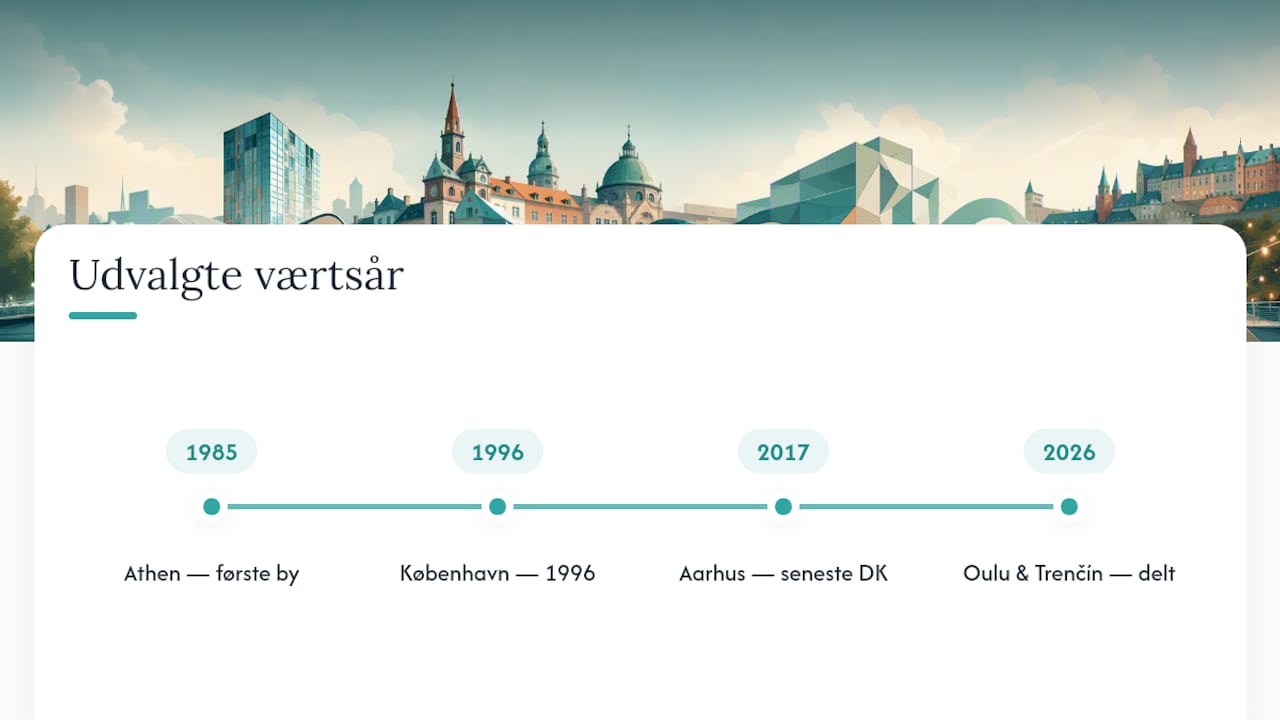
Athens was the first city to bear the title in 1985, and the choice was not accidental. Greece wanted to place culture on par with the economy as a European concern, and Athens became the symbol of that ambition.
Copenhagen received the title in 1996, at a time when the city was in the midst of a major transition from an industrial port to a modern capital. The cultural year helped to kickstart projects that have since shaped the city's self-identity as a cultural city.
Aarhus was the Danish host most recently, holding the title in 2017. The Culture Year focused on Jutland as a cultural region and not just on Aarhus itself, and the program involved a number of smaller towns in Central Denmark Region as co-organizers.
In 2026, Oulu in Finland and Trenčín in Slovakia share the title, which shows another point: several cities can hold the title in the same year. It is the rule rather than the exception in modern editions of the program, where the order of host countries is fixed several years in advance, according to EU's official regulations.
Rejsidanmark-perspektiv: hvad det betyder for besøgende
A year of culture changes what you can experience in a city. Pop-up exhibitions appear in buildings that are otherwise empty, the streets are filled with installations, and museums often significantly extend their opening hours and exhibitions.
For you as a traveler, it means more options, but also more to keep track of. Rejsidanmark collects Inspiring examples of cultural activities around the country so you can see what actually happens before you plan the trip. If you want to go deeper into how to find cultural experiences in general, there is a practical overview of it. how to find cultural experiences In Denmark, regardless of whether it is a cultural year or not.
— Tommy
Plan your cultural visit with Rejsidanmark
There are platforms that gather an overview of attractions, prices, and age groups on a single interactive map, which can help plan a visit to a Danish cultural city, both during a cultural year and for ordinary cultural experiences.
Mad experiences are often an overlooked part of a cultural program, and Local gastronomy plays an increasing role in modern tourism, which also applies when cities use the cultural year to showcase their food culture.
If you're going to travel in Denmark soon, then start with The practical travel tips, covering everything from transportation to local customs, so you can spend your time on experiences instead of research.
Sources
If you want to delve deeper into the rules, the European Commission's pages on culture in cities and regions are the best starting point. EUR-Lex’s summary of the rules describes the legal framework and the sequence of host countries, while the European Parliament’s briefing provides a thorough overview of the selection criteria.
Frequently Asked Questions
What is a European Capital of Culture?
It is a title awarded by the EU to one or more cities for a calendar year, with the aim of highlighting European cultural diversity and creating sustainable urban development. The title has been awarded to over 70 cities since 1985.
When did the European Capital of Culture program start?
The order began in 1985 with Athens as the first city. The idea came from the Greek Minister of Culture, Melina Mercouri, who wanted to give culture a prominent place in European cooperation.
How is a city designated as a cultural capital?
The process takes place in two phases, pre-qualification and final application, and cities are usually designated four years before the actual title year. A jury evaluates the application based on criteria such as long-term strategy and European cooperation.
Which Danish cities have been European Capital of Culture?
Copenhagen held the title in 1996, and Aarhus followed in 2017. Both cities used the cultural year to strengthen their positions as cultural destinations, both nationally and internationally.
Can multiple cities be a European Capital of Culture at the same time?
Yes, it happens regularly. In 2026, Oulu in Finland and Trenčín in Slovakia share the title as an example that multiple cities can hold the title in the same calendar year.
What can I, as a tourist, experience during a cultural year?
You can typically experience special exhibitions, pop-up installations, festivals, and extended opening hours at museums and cultural institutions. Rejsidanmark gathers several concrete examples of cultural activities around Denmark that you can use to plan your visit.