
TL;DR:
- It is important to choose an outdoor playground that suits the children's age, needs, and temperament. Professional checklists and criteria such as support, shade, and accessibility help prevent dangerous situations. By filtering, you specifically search for natural playgrounds, and by using local guides, you can find the best outdoor offers.
Finding the right outdoor playground for your children sounds simple, but it is rarely so in practice. Many family guides mix indoor and outdoor options in the same list, and when you finally find a playground that looks promising, it's hard to know if it suits your children's age, needs, and temperament. Actually offers Aalborg Municipality's parks and green areas A good example of how to actively seek outdoor opportunities through municipal websites. This article provides you with concrete criteria, strong recommendations, and practical tips so that your next outdoor playground visit will be a success from start to finish.
Main Points
| Point | Details |
|---|---|
| Filter by outdoor elements | Bridge guides and municipal pages but always filter for genuine outdoor spaces. |
| Choose according to family needs | Check the shadow, facilities, and whether the play equipment is suitable for your children's age. |
| Look for safety standards | The best playgrounds follow DS/EN 1176 and DS/EN 1177 for optimal safety. |
| Bridge inspiration list smart | Find new nature and city spots via guides, but always use your own checklist before you go. |
Criteria for choosing the best outdoor playground
Now that you know the challenges, let's look at what you should really consider to choose the right playground. It's not just about finding a place with a slide and swings. It's about finding the place that matches your family's specific needs on that very day.
Many families end up on inspiration lists that mix outdoor and indoor activities. A guide might list an indoor adventure land alongside a natural playground in a forest, and then the confusion is created. The solution is to filter actively. Search specifically for words like "nature playground," "forest playground," or "park playground" instead of the broader term "playground," because it will lead you more quickly to the truly outdoor options.
When you have found the candidates, you should go through them using a fixed checklist. A practical family guide to playgrounds I recommend filtering specifically for outdoor elements such as nature, the sea, and parks, and then creating a concise checklist before the visit. It saves time and disappointment.
Here are the most important criteria you should go through:
- Corresponding tools: Are there play equipment for your young and elderly age groups? Many places are best for either 0 to 5 years or 6 to 12 years.
- Basis Rubber underlay, sand or gravel protects against falls. Check if the surface is maintained and free of holes or hard edges.
- Shadow: The sun is lovely, but on a hot summer day, shade from trees or a cover is essential for children to play for hours.
- Toilets: Are there public toilets nearby? For families with small children, this is a deal-breaker.
- Lunchbox area: Borders, benches, and barbecue options turn a day trip into a full experience rather than just a quick stop.
- Nature and surroundings Natural playgrounds with water, stones, hills, and trees stimulate children's imagination and motor skills much more than plastic play equipment alone.
- Access conditions Is there parking? Is the space accessible with a stroller or wheelchair?
- Maintenance A dilapidated playground is not only ugly to look at, but it can also be dangerous.
Professional tip: Search for "nature playground" instead of just "playground" on Google Maps or municipal websites. You will find many more outdoor, nature-based alternatives, which are often free and in beautiful surroundings. Always check opening hours and any parking rules before you set off.
It is also a good idea to get informed about outdoor activities for familiesWhen planning your outing, the playground can be combined with other activities in the area.
Top outdoor playgrounds – recommendations and experiences across the country
Once you have your criteria in order, you can choose from some of the best and most recommended playgrounds in Denmark. The country is actually full of fantastic outdoor playgrounds that go far beyond the classic park playground with swings and slides.
Below is an overview of some of the most praised outdoor playgrounds across the country.
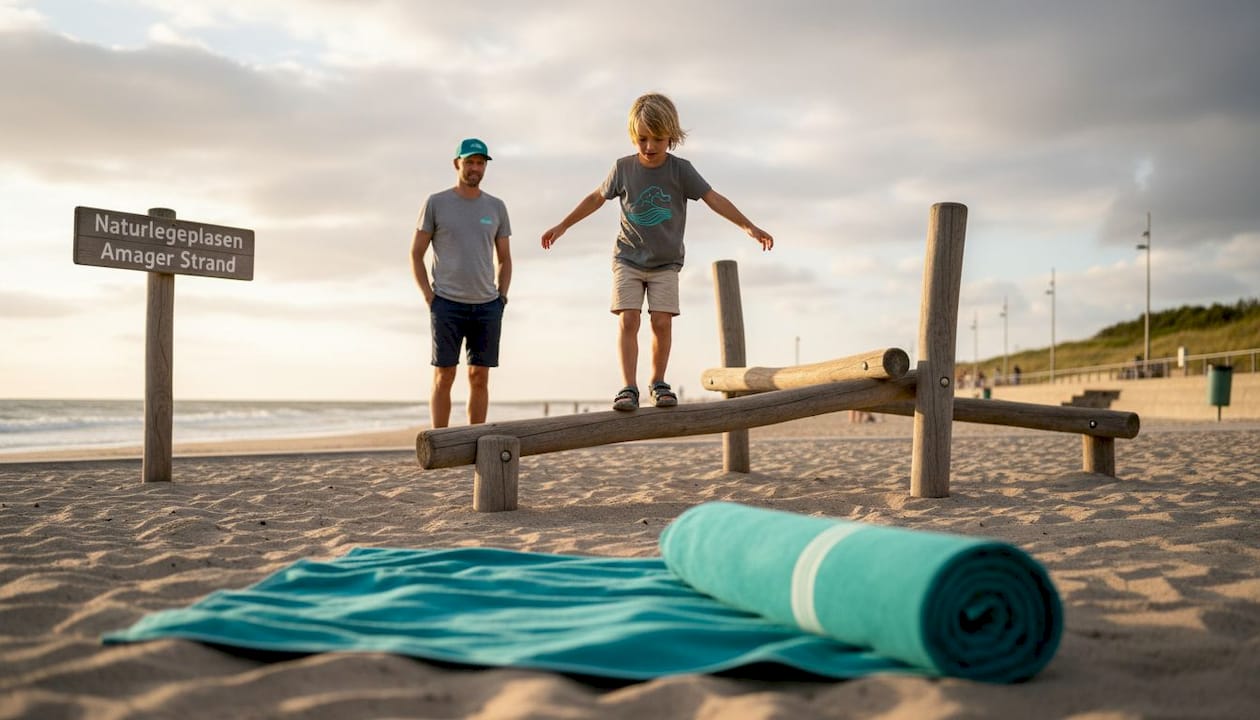
Natural playground at Amager Beach, Copenhagen
One of the most popular playgrounds in the capital region. It combines proximity to the beach with modern play equipment and plenty of space to run, dig, and build in the sand. Momland's guide to playgrounds in Copenhagen highlights this playground as one of the strong outdoor alternatives in Copenhagen because it offers a combination of nature and play that is rare in the city center.
Tisvilde Nature Playground, Zealand
One of Denmark's most talked-about natural playgrounds. Tisvilde Nature Playground offers balance beams, swings, slides, and a zip line, all integrated into a forest environment. It's the kind of playground that keeps children active for hours, because each corner offers new challenges. Especially children aged 4 to 12 thrive here.
Heavenly High Nature Playground, Central Jutland
Heaven-high is a strong example of what a well-designed natural playground can do for a whole family day. The square is created in natural surroundings with hills, water, and trees as active elements, not just as background decoration. There are facilities for packed lunches and good parking conditions.
The Hill and the Deer Park, North Zealand
The Deer Park not only contains world-famous nature and animals but also world-class playgrounds with plenty of greenery and open spaces around the amusement park. Here, big and small children can find something that suits them.
Ribe Viking Center, Southwest Jutland
In addition to the historical experience, Ribe Viking Center has an outdoor playground and activity zone with elements inspired by the Viking Age. Perfect for families who want to combine learning and play.
Here is a quick overview in table format:
| Playground | Location | Type | Special facilities |
|---|---|---|---|
| Natural Playground, Amager Beach | Copenhagen | Nature and beach | Sand, water proximity, modern tools |
| Tisvilde Nature Playground | Zealand | Forest Nature Playground | Cable car, balance beams, roller coaster |
| Heaven-high Nature Playground | Midtjylland | Natural playground | Bakker, water, lunchbox area |
| Dyrehaven playgrounds | North Zealand | Park and forest playground | Natural environments, open areas |
| Ribe Viking Center | Southwest Jutland | Temalegeplads | Viking-inspired military equipment |
Professional tip: Always check the seasonal influence on your chosen playground. Tisvilde is fantastic in summer, but can be muddy in spring. Amager Beach is best in dry weather, and many natural playgrounds have limited maintenance outside the high season.
You can find even more ideas for child-friendly attractions for families or let yourself be inspired by family-friendly destinations around the country, when you plan your next outing.
Comparison of outdoor playgrounds – what sets them apart?
So how do the different types and areas of playgrounds actually differ from each other in practice? It is important to understand because a traditional playground and a natural playground can look similar in a picture, but offer very different experiences.
There are basically three categories of outdoor playgrounds in Denmark:
- Traditional parking lots You can find these in most city parks. They typically have fixed medical tools made of metal or plastic, rubber mats, and are easily accessible. Suitable for the tiniest children and quick visits.
- Natural playgrounds Nature is used as the primary remedy. Tree trunks, stones, hills, and water are part of the play experience. These spaces stimulate creativity and motor skills in a different way than traditional tools.
- Specially designed playgrounds Themed areas with a story or a special function, e.g., Viking-inspired areas, water play areas, or climbing forest concepts. Often requires more planning and is rarely free.
Here is a comparison of the three types:
| Criterion | Traditional parking lot | Natural playground | Specially designed playground |
|---|---|---|---|
| Price | Free | Free or low price | Often entered |
| Age spectrum | 1 to 8 years | 2 to 12 years | Varies by theme |
| Stimulation | Physical motor skills | Creativity and motor skills | Experience and learning |
| Availability | High | Middle | Varies |
| Maintenance | Municipal responsibility | Varies | Private or municipal |
| Facilities | Get | Often limited | Most often good |
| Natural content | Low | High | Varies |
Many municipalities are good at publishing overviews of their playgrounds and natural areas online, as seen with Aalborg Municipality's parks and green areas, which list parks, playgrounds, and nature trails in a single overview. It is a method that makes it much easier for families to find the relevant outdoor activities in the local area.
The best playground is not necessarily the most advanced. It is the one that suits your child's age and curiosity, and that allows children to explore at their own pace without too many restrictions. This point is especially valid when choosing between nature and traditional places, because nature often wins in the long run.
It is largely about matching the space's offerings with the children's age and interests. Familiar with children under three years old rarely benefits from a large natural playground with challenging climbing installations. Conversely, a seven-year-old child can quickly get bored at a park playground designed for toddlers.
Feel free to use our overview of family-friendly activities to combine the playground with other nearby experiences so that the day becomes complete.
Safety on the playground – rules and practical advice for families
When you have chosen your playground, it is also important to know about safety and rules. Unfortunately, this step is overlooked by many families who take safety for granted because the playground looks new and nice.
In Denmark, safety on playgrounds is regulated by European standards. DS/EN 1176 and DS/EN 1177 They are the two central standards: the first covers the requirements for the play equipment itself, and the second concerns the shock-absorbing surface under and around the equipment. These standards specify, among other things. requirements for fall heights, risk of entrapment, and material durability
That does not mean, however, that all playgrounds automatically meet the standards. Older playgrounds may have equipment that has not been updated, and municipalities with tight budgets may find it difficult to maintain all the playgrounds equally. As a parent, you can easily help identify problems before they become dangerous.
Here is a numbered checklist you can review before the children start playing:
- Check the basis: Is it intact and does it cover correctly under all tools? Sand, rubber, or chips should have a specific thickness depending on the fall height.
- Inspect the tools visually: Are there sharp edges, loose bolts, cracked planks, or rust? Avoid tools with visible wear.
- Assess fall risk: Is there enough distance between the tools, and is there enough space for a child to fall without hitting anything else?
- Look for pinching zones: Openings in railings and structures must be either less than 89 mm or more than 230 mm so that a child's head cannot get stuck.
- Assess the supervision options: Can you as a parent see your child from the lunch table or bench? Good playgrounds are designed with parents' insights in mind.
- Check for foreign objects Broken glass, cigarette butts, and other debris should be reported to the municipality and avoided by children.
Statistics to remember: According to European statistics, a significant proportion of childhood accidents occur outdoors in play-related contexts. Properly maintained equipment and well-kept tools are the two factors that make the biggest difference in reducing the risk of serious injuries.
If you discover a playground with obvious safety issues, you can usually report it directly through the municipality's website or citizen service. It is a quick action that can prevent accidents for other families.
What many overlook: How to find the perfect playground for your family
No matter how well-prepared you are and how good the list is, there is something the family should remember: Even the best-rated playgrounds in Denmark can disappoint if they do not match your own needs and expectations.
We see it again and again in family guides. A playground is named one of the best in the country, yet families return home with disappointed children because the space was designed for a different age group, there was no shade on a sunny day, or because it was a 45-minute drive from the nearest toilet facility.
It emphasizes an important point: Lists and reviews are inspiration, not a guarantee. It is based on averages and others' experiences, which do not necessarily resemble yours.
What do you do instead? You use the lists as a starting point and then run them through your own family filter. Think about:
What is the age and physical capacity of the youngest child? A two-year-old child needs lower tools, softer surfaces, and shorter distances to facilities than an eight-year-old child. None of the most highly rated natural playgrounds are necessarily suitable for both, and there is nothing wrong with that.
What is the weather forecast, and what is your pain threshold regarding? Sun, rain, and wind? Many natural playgrounds are much more fun in dry weather, while a partially covered traditional playground can function in light rain.
Do any of your children have special needs? Accessibility is still not standard on all playgrounds in Denmark. Wheelchair users and children with motor challenges need flat surfaces, ramps, and accessible equipment.
We always recommend combining a good review with a quick look at nature parks and family life In the area you plan to visit. The nature around a playground is often just as important as the playground itself.
Our overall recommendation is simple: spend a maximum of five minutes creating your own mini checklist with the three to five most important things for your family before making a choice. It takes a short time, but it can make the difference between a good and an excellent family day.
Plan your next family outing with ease
Now you have a solid foundation for finding and choosing the right outdoor playground, and it's time to turn it into concrete actions. On Rejs in Denmark, you will find plenty of resources that make planning easy and manageable. Use our Checklist for a day trip to ensure that you have everything covered, from snacks and sunscreen to parking arrangements and an alternative plan in case of bad weather. If you want to combine the playground with other experiences, our overview of child-friendly attractions Find inspiration for what is nearby. And if you need an overall overview of Denmark as a family holiday destination, you will find it All about Denmark for visitors Gathered in one place.
Frequently Asked Questions about Outdoor Playgrounds in Denmark
What three things should I check before choosing an outdoor playground?
You should check if the playground is age-appropriate, has safety surfacing, and access to shade or a picnic area. A short checklist with these points ensures that you avoid the most common surprises upon arrival.
Where can I find a complete list of outdoor playgrounds in my municipality?
Most municipalities have overviews of playgrounds on their park and nature area pages. A good example is Aalborg Municipality's nature guide, which lists parks, playgrounds, and green areas together.
Are parking spaces in Denmark secured with special standards?
Yes, most new playground equipment and surfaces comply with the DS/EN 1176 and DS/EN 1177 standards, which set requirements for, among other things. fall height, substrate, and risk of entrapment
How do I tell if a playground is suitable for young children?
Look for designated areas for young children, lower play equipment, and barriers against the road. Many municipal playgrounds are zone divided, so you can quickly find out which part is suitable for your youngest.
Are there free outdoor playgrounds near popular family attractions?
Yes, many popular attractions and parks have free outdoor playgrounds nearby. Momland's guide to Copenhagen shows examples of playgrounds that are located at natural distances from the city's major attractions and can be visited without an entrance fee.