In short:
- Local tourism strengthens the economy, culture, and environment in Denmark and creates jobs in rural areas. By choosing local experiences, you support authentic cultures and reduce environmental impact. It is an important way to develop resilient, sustainable communities all year round.
Local tourism is defined as travel activity that takes place within one's own country and supports local businesses, cultures, and natural areas rather than distant destinations. 75% of Danes assess, and tourism has more positive than negative effects for Denmark. This number is not random. The benefits of local tourism range from direct job creation in rural areas to the preservation of cultural heritage and reduced environmental impact. VisitDenmark and the Rural Districts' Joint Council both document that domestic travel is one of the most effective ways to strengthen local communities. This guide shows you exactly what you gain and what the community gains when you choose Denmark as your next destination.
What are the economic benefits of local tourism?
Local tourism is a direct cash flow for small and medium-sized businesses. When you eat at the local restaurant, stay at the family-run bed and breakfast, or buy handmade ceramics at a local market, the money stays within the local business cycle instead of disappearing to larger corporations. This principle is often called the "local multiplier effect," and it makes a measurable difference.

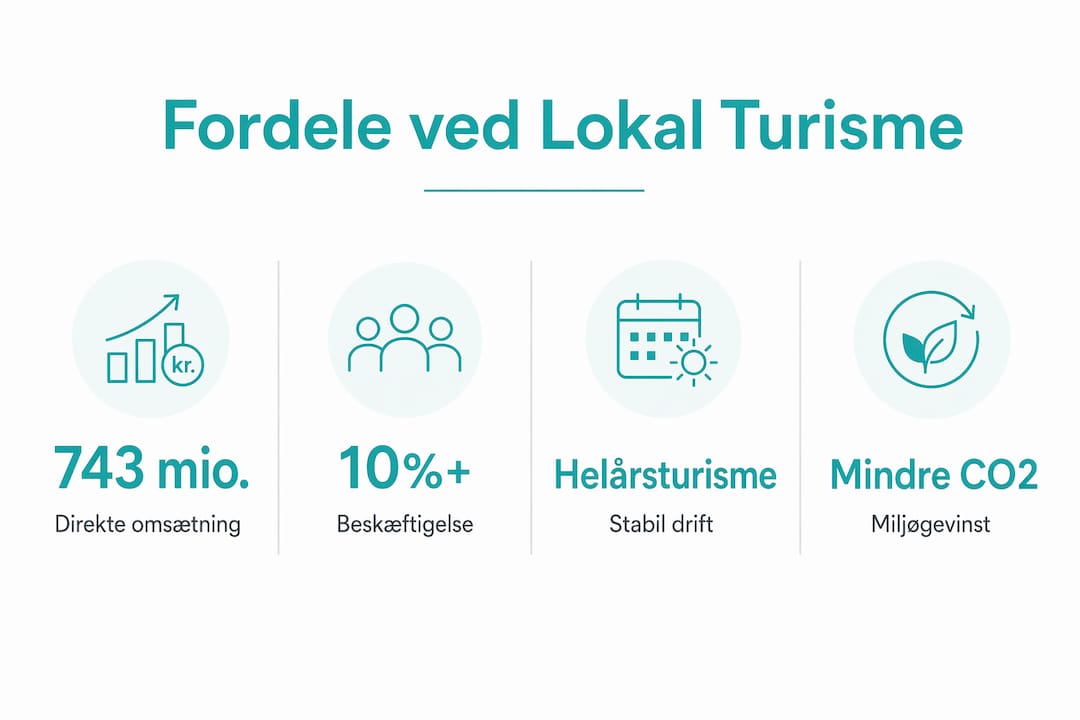
The numbers speak for themselves. The tourists spent 743 million kroner In the local business community in a single Funen municipality in 2025. It corresponds to an amount that many municipalities cannot generate through other business sectors alone. Tourism is therefore not just a seasonal phenomenon, but a structural part of the local economy.
The employment effect is particularly evident in the outer areas. Over 10% of all employees In inner, rural, and outer municipalities, work is being done within tourism. It means that tourism in many cases is the most important employer outside of agriculture in these areas. Without tourists, many of these jobs simply wouldn't exist.
Season extension as a key to stable operation
Year-round tourism is essential for local businesses to survive outside the summer months. Even one extra overnight stay It has a noticeable positive effect on local service functions and shops. It sounds modest, but in a small coastal town, a single extra guest in winter can mean that the baker stays open one more day a week.
| The effect of tourism | Example from practice |
|---|---|
| Direct turnover | 743 million kroner in a Funen municipality (2025) |
| Employment in remote areas | Over 10% of all employees in outer municipalities |
| Season extension | An extra overnight stay strengthens local service |
| Local multiplier effect | Money remains in the local business cycle |
Professional tip: Plan your visit outside the peak season, typically in April, May, September, or October. You get fewer tourists, lower prices, and support local businesses that otherwise struggle to stay open all year.
What cultural and social benefits does local tourism provide?
Local tourism strengthens cultural identity and creates lively encounters between guests and residents. When tourists actively participate in local events, markets, and traditions, a mutual exchange occurs that no travel guide can replace. Those are the kinds of experiences that are remembered.
Collaboration between the local community, businesses, and cultural institutions Creates growth with meaning. The West Coast Tourism Region is a concrete example of how tourism can preserve cultural heritage and develop local cultural spaces when all parties work together. The result is not only more visitors but stronger communities.
Cultural benefits of traveling locally include:
- Authentic experiences You experience the local everyday life rather than a tourist version of it. A visit to a local fish auction in Thyborøn or an artisan market in Ribe offers insights that no resort can provide.
- Strengthening local traditions Tourists participating in local festivals and events help keep traditions alive. Many public festivals and cultural events are partially funded by tourism revenue.
- Community and dialogue: Conversations with local residents provide perspectives that change your understanding of a place. It is a social benefit for both parties.
- Visible cultural spaces Tourism money funds the maintenance of museums, churches, and historic buildings that would otherwise decay.
- Respect for local everyday life Tourism should work together with Danes' daily lives, so that one can both live off and with tourism. It requires that tourists behave as guests, not as consumers.
Local gastronomy is a particularly strong bridge between cultures. Local food and drinks Connects tourists with the place's identity and directly supports local producers. Choosing the local brewery over a chain restaurant is not just a matter of taste, it is a cultural choice.
What are the environmental benefits of local tourism?
Local tourism significantly reduces environmental impact compared to long-distance travel. Shorter transportation distances mean fewer CO2 emissions per traveler. It is the most direct environmental benefit of domestic travel, and it is significant.
The concept of regenerative tourism goes a step further than just minimizing harm. Regenerative tourism focuses on rebuilding social structures, biodiversity, and local economic well-being through partnerships. It means that tourism actively improves the place it visits, rather than just leaving it unchanged. It is a fundamentally different approach than mass tourism.
How to travel sustainably locally in Denmark:
- Choose public transport. Taking the bus to your destination significantly reduces the carbon footprint. Rejsidanmark has a Guide to local transportation In Denmark, making it easy to plan without a car.
- Choose accommodation with environmental certification. Swedish Eco-labeled hotels and campsites document their environmental efforts. It's a concrete choice you can make in a few minutes.
- Eat locally and seasonally. Mad produced close to your destination has a lower carbon footprint and supports local farmers.
- Respect nature. Stick to marked trails in natural areas, take your trash with you, and avoid disturbing wildlife. Denmark's nature tourism He is strong, but vulnerable.
- Support nature conservation projects. Many local organizations work on nature restoration. Donating or volunteering is a direct investment in the place you visit.
Professional tip: Calculate your CO2 footprint for the trip before you travel. Free online tools from, among others, the Danish Society for Nature Conservation provide a quick overview. It takes five minutes and gives you a concrete starting point to compensate or reduce.
Collaboration with local nature and culture organizations is essential for regenerative tourism to work in practice. A tourist visiting a nature restoration project on the West Coast not only contributes money but also attention and engagement that attract additional support.
How can you actively support local tourism?
You support local tourism most effectively by making conscious choices about where you spend your money and your time. It doesn't require great sacrifices, but it does require attention. Engaged travelers participating in local events and dialogueContributes to resilient and robust destinations. It is documented that local involvement strengthens the positive effects of tourism in the long term.
Concrete ways to engage yourself:
- Choose local accommodation options. A locally operated summer house, inn, or farm keeps the money in the community. Rejsidanmark collects accommodation options in Denmark, that supports local ownership.
- Buy local products. Craftsmanship, food, and souvenirs produced locally directly strengthen the local business cycle.
- Participate in local events. Markets, festivals, and guided tours operated by local residents provide authentic experiences and direct support.
- Stay a little longer. A stay of three days instead of one triples your local turnover and gives you time to experience the place in depth.
- Talk to the locals. Ask for recommendations, stories, and local customs. That kind of dialogue is the most direct form of cultural exchange.
Long-term strengthening of local tourism requires engagement in local development plans and cooperation between tourists, businesses, and public institutions. You don't need to sit in a municipal council meeting to contribute. Your consumption decisions are your voice.
The benefits of domestic travel are not just about saving on flight tickets. It's about what you gain in terms of depth, authenticity, and meaning. A weekend at Møns Klint, Læsø, or Silkeborg offers experiences that rival any foreign destination and leave a positive impression rather than a negative one.
My perspective on local tourism after many years on the roads in Denmark
I have traveled in Denmark for many years, and I have come to one clear conclusion: the best experiences happen when you stop acting like a tourist and start acting like a guest.
It sounds like a cliché, but there is a practical difference. A tourist photographs the lighthouse and continues on. A guest asks the lighthouse keeper about the story behind it, buys lunch at the local inn, and returns home with a story rather than just a picture. That behavior is exactly what makes local tourism a force for change rather than just a consumption habit.
I see one pitfall again and again: travelers who choose the familiar over the local. The chain hotel instead of the guesthouse. The supermarket's ready-made food instead of the baker's freshly baked bread. Each such choice is a small leak in the local business cycle. Overall, there is a big difference.
My recommendation is simple. Use Rejsidanmark to find local experiences in Denmark, driven by people with a passion for their place. Plan a stay outside the high season. Ask the locals. Let your curiosity guide you forward rather than your comfort zone. Denmark is a country that rewards those who look closer.
— Tommy
Rejsidanmark makes local tourism accessible to everyone
Rejsidanmark is built for travelers who want more than just sightseeing. The platform gathers practical information about experiences, accommodation, and transportation throughout Denmark, so you can plan a trip that genuinely supports the places you visit. Whether you're planning a family weekend on Bornholm or a solo trip along the Hærvejen, you will find concrete and up-to-date resources.
A good start is Rejsidanmarks Complete guide to Denmark's journey, who guides you step by step from idea to departure. If you want to ensure you get around in a sustainable way, the guide to local transportation is the right starting point. Both resources are free and designed to make local tourism easier and more meaningful.
Frequently Asked Questions
What are the main advantages of local tourism?
Local tourism strengthens local economies, preserves cultural heritage, and reduces environmental impact. The money remains in the local business cycle, and travelers experience authentic encounters rather than mass tourism.
How does local tourism support employment?
Over 10% of all employees in coastal, rural, and outer municipalities work in tourism. Tourism is therefore one of the most important employers in many rural areas of Denmark.
What is regenerative tourism?
Regenerative tourism actively rebuilds social structures, biodiversity, and the local economy through partnerships. It is a step beyond sustainable tourism because it improves the destination rather than just preserving it.
How do I travel sustainably locally in Denmark?
Choose public transport, Swan-labeled accommodations, and locally produced foods. Participate in nature conservation projects and stick to marked trails in natural areas.
Why is year-round tourism important for local communities?
Even an extra overnight stay outside the high season has a noticeable positive effect on local shops and service functions. Year-round tourism ensures stable operations and maintains jobs in the rural areas throughout the year.