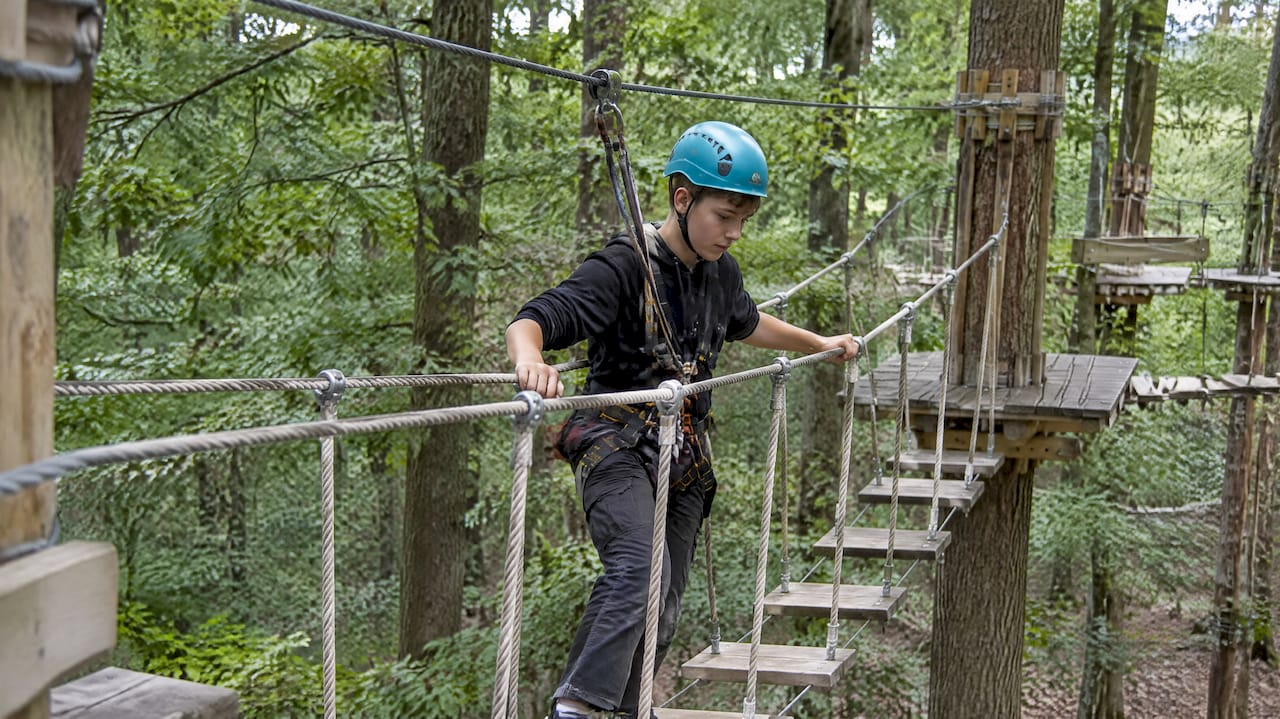
An adventure park is an outdoor event park where you move through climbing courses, ziplines, and obstacle courses built in trees or on constructed scaffolding. Most Danish parks are built around stations of varying difficulty levels, so both children and experienced climbers can find a suitable course. Professionally operated parks follow safety standards such as EN 15567-2, which imposes requirements on equipment and operation.
What does the term adventure park actually cover?
An adventure park combines physical challenges with play and learning in nature or on an established area. The towers are typically organized into stations, where each station has an element, such as a line, a bridge, or a platform, that you move over or through. Between the elements, you move from platform to platform, often secured with steel wire and carabiners, while the staff or an automatic safety system accompanies you along the way.
The concept spread across Europe from around the 1990s, when the first zip line courses and rope parks began to appear as a combination of nature experience and physical challenge. Since then, the parks have evolved from simple rope courses to complex facilities with dozens of stations spread across multiple difficulty levels.
Today, the industry often uses words like "track" for a complete route and "element" for the individual obstacle on the route. Some parks also have a separate "low-ride area" for the smallest guests, where they walk close to the ground without a safety harness. The division makes it easier for you to choose a route that suits your own experience, whether you are a beginner or have tried climbing before.
What activities can you typically try?
Activities in an adventure park are broadly divided into two categories: those that take place high up, and those that take place on or close to the ground.
- Climbing nets and high ropes courses, where you move between platforms in the trees with a safety harness.
- Ziplines and flying foxes, where you glide down a wire from a high point to a lower one.
- Obstacle courses on the ground with balance exercises, net and rope to crawl over or under.
- Team-building exercises and archery, which are often included in corporate events.
- Special elements such as net parks, bungee trampolines, or mega ziplines in the larger facilities.
Some parks are pure family places focused on fun and low risk, while others cater to guests seeking a more physically demanding experience with long ziplines and high climbing courses. It is worth checking the park's own description of difficulty levels before booking, so that the activities match the level you and your group want.
What types of adventure parks are there?
Adventure Parker comes in several versions, and the type determines the experience you will have.
- Climbing parks in treetops, where the courses are built around living trees with natural shade and terrain.
- Constructed climbing parks where the entire facility is built on poles or scaffolding independent of the natural terrain.
- Zipline rider, primarily focusing on long zip lines rather than climbing stations.
- Net parks, including indoor variants, where nets and trampolines replace traditional rope courses.
- Low ropes courses close to the ground opposite high ropes at several meters height, as well as family parks that combine both with other activities like mini-golf or playgrounds.
Low ropes courses are often better suited for the youngest or for groups looking to do team building without height challenges, while high ropes are aimed at guests who specifically seek height and adrenaline. Our Overview of amusement parks in Denmark reviews several concrete examples of how the types differ in practice.
How do the parks ensure you as a guest?
The safety in an adventure park relies on a set of technical standards that the facility must meet. EN 15567-2 sets operational requirements for ropes courses, including safety instructions before use, approved equipment, and ongoing inspections, while Part 1 of the standard covers the actual construction of the courses. Industry organizations like IAPA supplement with their own quality marks, which can serve as an additional checkpoint when choosing a park.
Statistics: EN 15567-2 states that the operation of a ropes course requires documented inspection routines and an appointed safety officer. In practice, this means that a serious park does not just open the doors without regular checks of equipment and courts.
Specifically, you as a guest typically meet:
- An oral or written safety instruction before you gain access to the tracks.
- Provision of a harness, helmet, and carabiners approved for the purpose.
- A continuous protection system where you cannot disconnect from the line during operation.
- Staff with special training in rescue procedures if a guest is trapped.
Branch guides such as ERCA's guide to ropes courses It also describes how the design and supervision should be arranged to maintain safety year after year.
What should you bring and prepare before the visit?
A successful visit starts with the right preparation. Most parks require both dress code and booking, which you should ideally know in advance.
- Put on closed footwear, preferably sports shoes, and avoid loose clothing that can get caught in equipment.
- Bring your own gloves if possible, although many parks lend out harnesses, helmets, and clips.
- Check the age and height requirements for the ride you have chosen before you leave.
- Book in good time if you are a group or if the visit falls during the peak season.
Professional tip: Call or write to the park the day before if the weather looks uncertain, as several courses temporarily close during heavy rain or wind.
A typical visit lasts one to several hours depending on the length of the track, and the price level varies with the number of stations and the age of the participant. If you are a corporate group, a booking system such as Riddlio Make it easier to coordinate registration and payment for many participants at once.
Who visits adventure parks, and how do they choose the right ones?
Adventure Parker attracts a wide range of guests: families with children on outings, school and leisure groups, companies holding team-building events, and young people seeking a dose of adrenaline. The right park depends on who will participate.
A family with young children will typically enjoy a park with low courses and short, manageable stations the most, while a group of adults or teenagers often prefers high ropes courses with greater heights and longer ziplines. Companies planning a team-building day can advantageously look for parks that offer comprehensive packages with instructors and group activities like those. Archers Battlefield demonstrates with their event packages for groups.
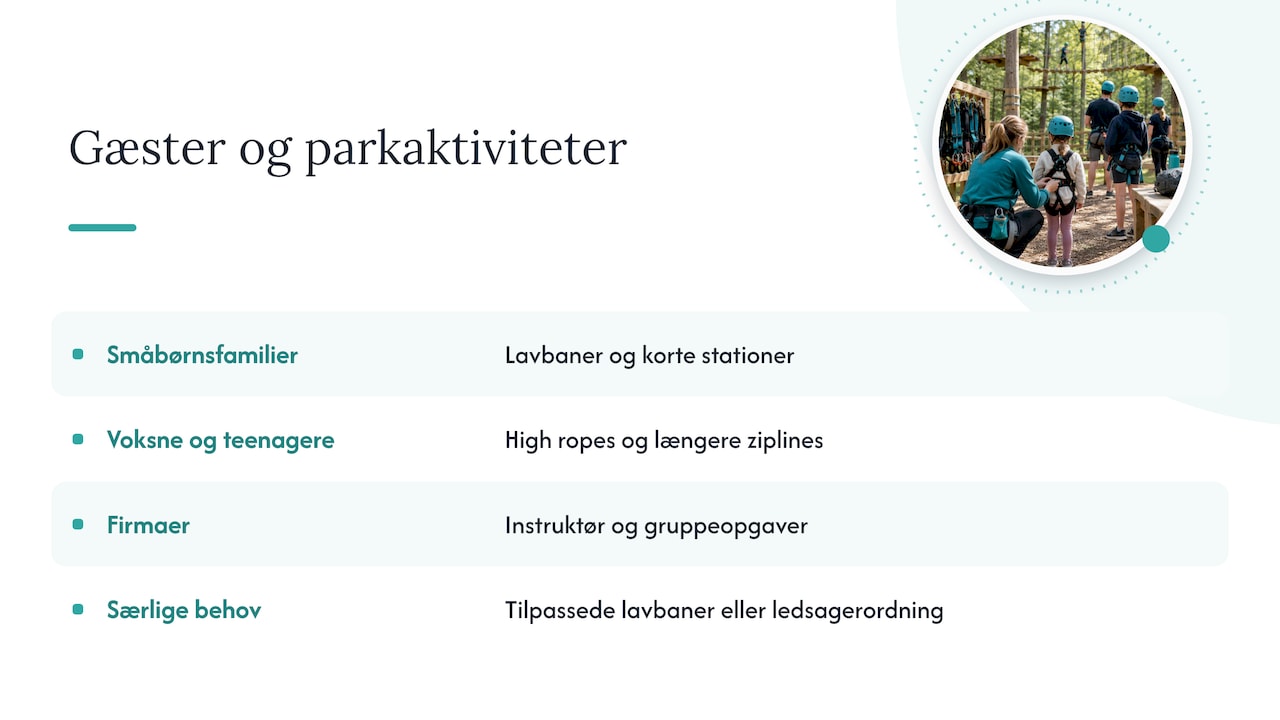
Most parks also adjust access according to special needs, for example with escort arrangements or adapted low-level areas, so that more people can participate regardless of physical ability.
How have adventure parks emerged and developed in Denmark?
The first adventure parks in Denmark came in the wake of the European wave of treetop courses and rope parks that spread from Southern European and Central European countries during the 1990s and early 2000s. The concept of building climbing courses between living trees suited Danish forest nature well, and the early installations emphasized the natural experience as much as the challenge itself.
As the demand grew, more parks began to supplement the pull rope courses with constructed elements such as ziplines, net parks, and ground obstacle courses. It made it possible to offer activities all year round, regardless of the season, and to adapt the facilities for guests who did not necessarily want to climb high up in the treetops.
The development has continued in recent years, with several Danish parks expanding with combined offerings: a mix of classic climbing, archery, and team-building courses on the same site. This reflects a broader trend in the industry, where adventure parks are moving from being a standalone attraction to becoming a comprehensive experience destination that can be enjoyed for an entire day.
Where do you find the most popular adventure parks in Denmark?
Adventure parks are spread throughout the country, from North Jutland to Zealand, and the location often determines the type of nature and facilities you encounter. Many of the most visited parks are located in forested areas near larger cities, making them easy to reach for a day trip, while others are situated in more remote scenic surroundings as part of a longer excursion.
Jutland has several established facilities built around forested hills and old deciduous forests, which provide good conditions for classic treetop courses. On Zealand, you will find both forest-based parks and newer, constructed facilities closer to the capital area, where space is more limited, but accessibility is better for city residents. Fyn and the islands have a smaller but varied selection, often focusing on family experiences rather than extreme heights.
When choosing between the parks, you can use an interactive map to see which facilities are closest to your route and which ones offer exactly the combination of activities you're looking for. Our Archive of experiences in Denmark gathers several specific locations that you can filter by area and activity type, including examples such as Velling Koller’s Fairy Tale Garden.
How do adventure parks think about the environment and sustainability?
Many adventure parks are naturally closely connected to the forest or natural area in which they are located, which places special demands on how the facilities are built and maintained. Tree-top climbing frames should typically be constructed in a way that does not harm the living trees over time, including by using protective materials around the trunks and regular checks to see if the trees' growth affects the setup.
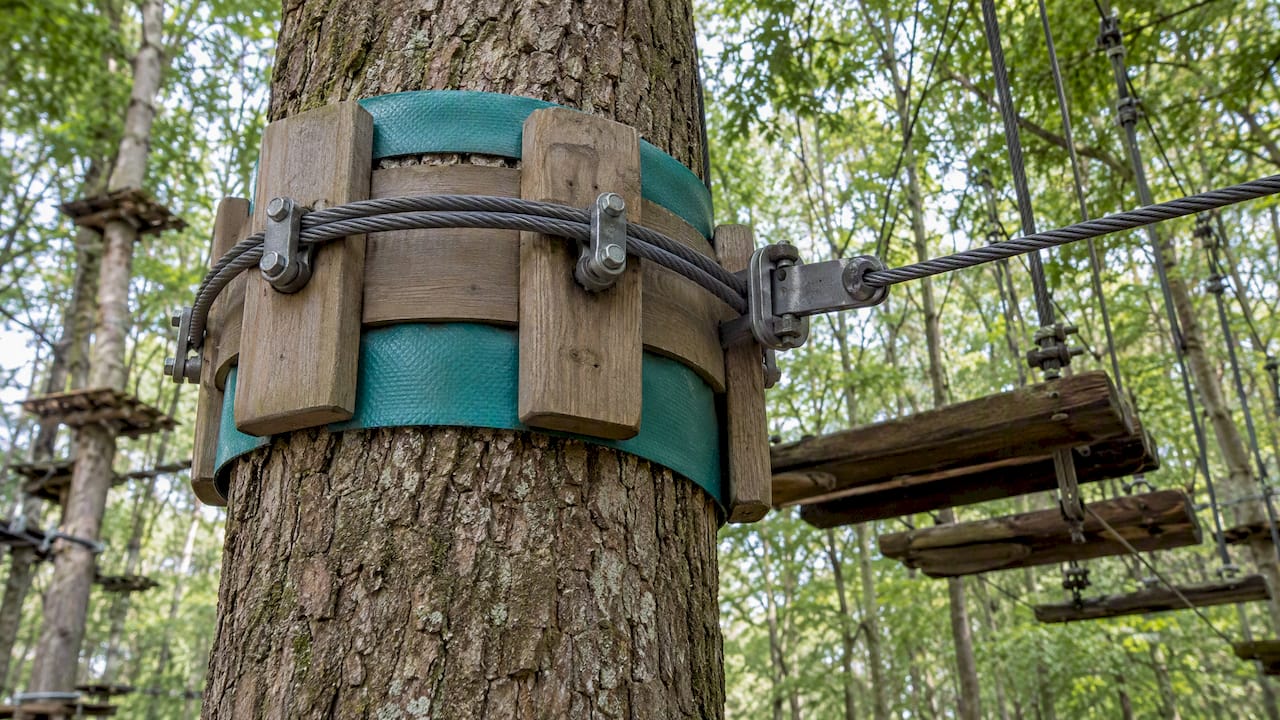
Several parks also work to limit their physical footprint by reusing existing forest trails instead of creating new ones, and by placing constructed elements in a way that minimally disturbs wildlife and vegetation. Suppliers who build and operate this type of facility are increasingly offering comprehensive solutions including design, construction, and subsequent maintenance, which can help keep the tracks in good condition for longer and thus require fewer material replacements over time, as seen with Suppliers of complete park solutions.
As a guest, you can contribute by following the park's designated paths, avoiding leaving marked areas, and respecting signage about wildlife or vulnerable vegetation. Such general consideration helps ensure that the natural areas around the parks remain intact for the enjoyment of both wildlife and future visitors.
What other facilities do you typically encounter in and around the park?
Most adventure parks are built around more than just the courses themselves, and part of the experience lies in the facilities that come with them. Many facilities have a café or kiosk where you can take a break with food and drinks during your visit, making it easier to extend the day over several hours without leaving the area.
Some of the larger parks are also located near accommodation options such as cabins, campgrounds, or shelter sites, so a visit can be extended to a whole weekend rather than just a few hours' trip. It makes the adventure park a natural focal point for a longer trip, especially if you combine the visit with other activities nearby, such as a swimming lake, a playground, or a small animal enclosure.
Several parks also offer combination tickets, where access to the climbing courses is combined with other experiences on the same site, such as mini-golf, archery, or a playground for the little ones. Such package deals can be a good idea if your group has mixed ages and interests, so not everyone needs to spend the whole day on the climbing courses.
Why adventure parks are one of the best day trips
Adventure Parker hits a rare balance: physical challenge, fresh air, and an experience that the whole family can share, even though the age difference is significant. It is the combination that makes them one of the most reliable day trips you can choose, whether you are four or fourteen people. We use maps and filters to help you find the park that suits your age and level. Always check the park's own height and age requirements before booking.
— Tommy
How to find the right adventure park with Rejs i Danmark
There are collections of experiences from all over the country on interactive maps, where you can filter by age, price, and season, so you can quickly see which adventure parks are within reach of your trip. It saves you from having to browse individual park websites when you just want an overview of the options in an area.
Our Overview of adventure activities for families Gather concrete suggestions you can use as a starting point before you choose the final park and book tickets.
Frequently Asked Questions
What is the difference between an adventure park and a climbing park?
A climbing park is typically a specific type of adventure park that focuses on treetop climbing courses or on constructed scaffolding. "Adventurepark" is the broader term and can also cover zipline facilities, net parks, and obstacle courses on the ground.
How tall are the courses in a typical adventure park?
The height varies greatly from park to park, as low ropes courses are close to the ground, while high ropes courses can be several meters up in the treetops. The park's own description of the courses usually provides the specific height for each difficulty level.
What age do you need to be to visit an adventure park?
Most parks have low courses for the youngest children and separate high ropes courses with a minimum age or height requirement to ensure that the harness and equipment fit properly. The specific requirements vary from park to park, so it is best to check the park's own website before the visit.
Are adventure parks safe to visit?
Parker, who follows standards such as EN 15567-2, requires safety instructions, approved equipment, and ongoing inspections of the tracks. As a guest, you typically experience an overview of the equipment and an instruction before gaining access to the courses.
What should you bring for a visit to an adventure park?
Closed footwear and tight-fitting clothing are the most important, as loose sleeves or sandals can cause problems on the courts. Many parks lend out harnesses, helmets, and carabiners, so you rarely need to bring your own safety equipment.