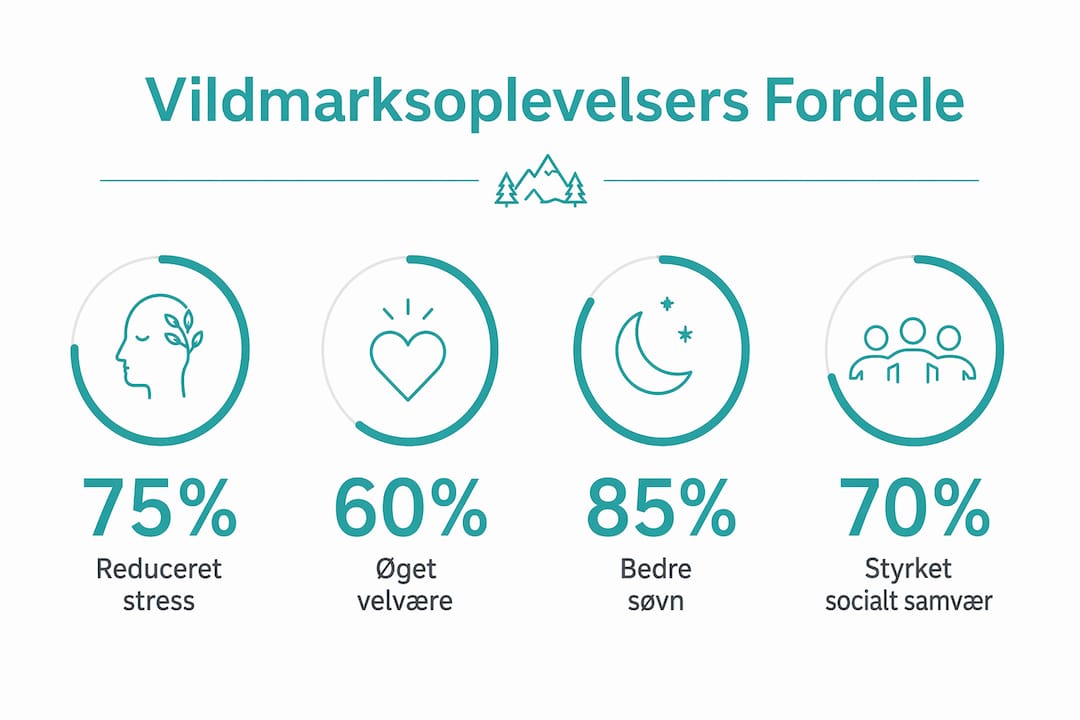
Wilderness experiences reduce stress, strengthen social relationships, and build practical skills that you actually use in everyday life. This is not a claim based on gut feeling — Danish and European research point in the same direction.
- Mental health Time in diverse nature reduces stress levels and promotes recovery in a way that urban nature rarely matches.
- Social benefits: Shared outdoor experiences build trust and camaraderie that last longer than a corporate team event in a conference room.
- Personal development: You learn to plan, solve problems, and handle the unexpected — and these skills stay with you.
The following paragraph supports these three points with research from Aarhus University and the EU project RESONATE, concrete examples from wilderness centers, and practical advice on how to get started.
Why does nature affect us — biological and psychological mechanisms
Nature stimulates the nervous system against calm. It is not a metaphor, but physiology. Ph.D. in Nature Psychology Simon Høegmark explains that high biodiversity The sender's nervous system signals safety, which supports calmness and mental recovery. A forest with many bird species, varied sounds, and changing light provides more than just an aesthetic experience — it tells the body that the danger is over.
There are several mechanisms. Sensory stimulation from nature — sound, smell, texture — draws attention away from rumination and into the present moment, an effect similar to mindfulness, but occurring without instruction. Physical movement in uneven terrain activates muscle groups that are rarely used on asphalt, and social presence without screens and agendas lowers the cortisol that otherwise keeps us alert.
Stimulus → nervous system → restitution is the simple model. But the crucial link is the quality from the natural environment. Research indicates that weekend and vacation recreation In larger, contiguous natural areas, there are greater mental health benefits than short walks in urban-adjacent nature. A half-hour walk in a city park is not the same as a weekend in Mols Bjerge.
Aarhus University's ongoing Research project on nature-based health interventions Currently working on mapping out why, how, and under what circumstances natural experiences affect people with stress, anxiety, and depression — and on developing scalable programs based on that knowledge.
What do you gain socially from going into the wilderness?
A group course in nature quickly changes the dynamics between people. When you are together to light a fire, find your way, or set up a shelter, hierarchies and roles from everyday life fade away. What remains is the task and each other.
Evaluations of municipal nature programs like "Healthy in Nature" show that local networks and safe social frameworks It is crucial for whether the participants stay. Without them, attendance drops faster than in traditional fitness programs. It says something about what keeps people engaged: not just the activity itself, but the community around it.
Typical outcomes from group-based wilderness courses:
- Increased trust to one's own abilities and to the others in the group
- Better communication — one learns to clearly say what one needs
- Sense of community It occurs naturally, not as a result of practice.
- Less loneliness over time, especially for those who participate regularly
- Stronger teamwork skills Because the tasks require coordination, not competition
The bonfire plays a special role. It's not romance — it's function. The bonfire community extends the stay, provides a natural gathering point, and makes overnight stays during cold hours comfortable enough that even inexperienced participants stay. It's the kind of concrete detail that determines whether a beginner will come back.
Professional tip: Choose a course with a fixed group instead of open single days if you want the social benefit. Continuity is what builds relationships.
What personal skills are developed through wilderness experiences?
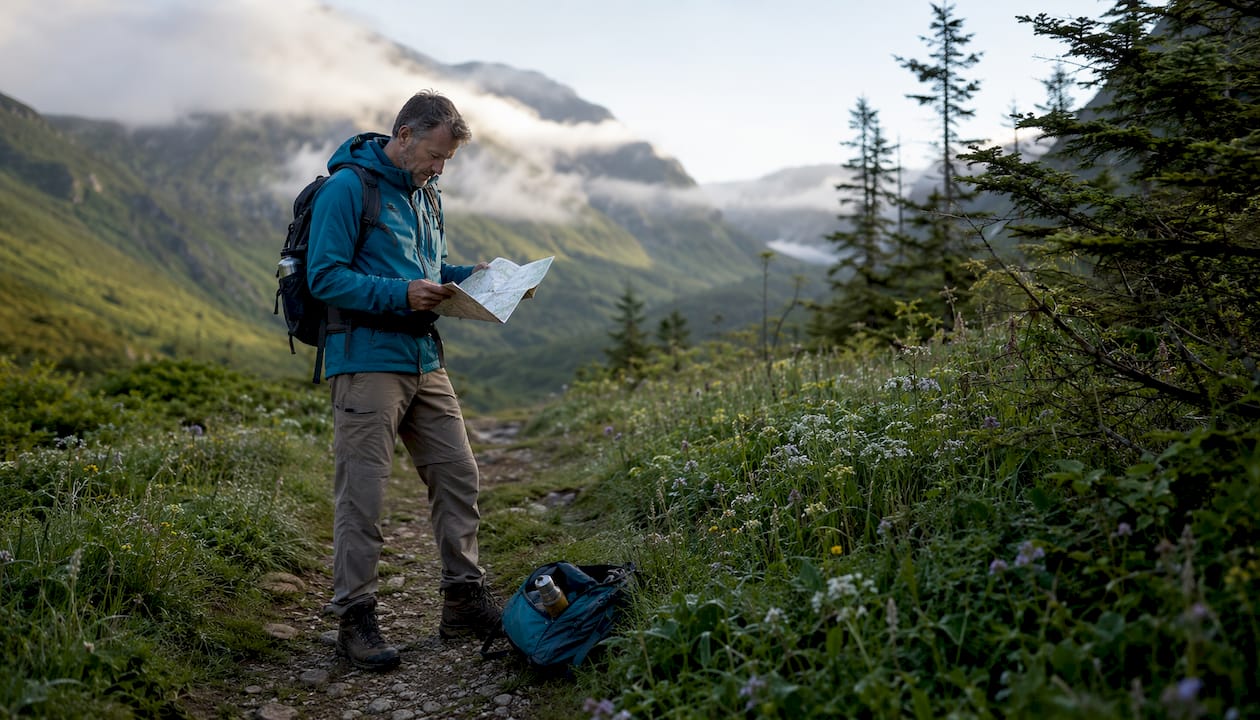
Mastery is not an abstract concept in the wilderness. The first time you navigate without GPS, cook over an open fire, or sleep outdoors in the rain, and it actually goes well — it sticks in your body as self-confidence. Not the kind that requires an audience, but the quiet kind that endures.
The transfer effect is real. Planning a multi-day trip in nature requires exactly the same skills as managing a project at work: risk assessment, resource management, and the ability to adjust when conditions change. Stress management in the wilderness — staying calm when the weather turns or equipment fails — is the same regulation practice you need in a stressful work situation.
The long-term effects are documented. Regular wilderness experiences are associated with better sleep, increased fitness, and a more robust immune system because the body moves more and stress hormones are kept down over time. It is not a cure, but a lifestyle component that matters.
Professional tip: Write down three things after each trip: what went well, what surprised you, and what you would do differently. Reflection significantly accelerates learning.
What types of wilderness experiences are available in Central Europe?
From an afternoon in the forest to a week-long guided expedition — the format determines what you get out of it and who it suits.
| Activity type | Beginner level | Time consumption | Safety considerations |
|---|---|---|---|
| Day trip in forest/coast | Very low | 3–8 hours | Minimal; tell someone where you are going |
| Forest bathing (Shinrin-yoku) | No requirements | 1–3 hours | None in particular |
| Guided weekend tour | Low | 2 days | Guide handles emergency preparedness |
| Wilderness course (shelter, fire, navigation) | Low to moderate | 2–5 days | Course leader responsible; check insurance |
| Self-organized multi-day | Medium to high | 3–7 days | Route planning, emergency equipment, communication |
| Guided expedition | Varies | 5 days | Professional guide required |
The Wilderness Center in Denmark is a concrete example of an activity center that offers several of these formats — from shorter course programs to guided tours with overnight stays. Such centers are especially valuable for beginners because the equipment is included and safety is professionally managed, as seen in Northwoods resort for outdoor lovers.
The Outdoor Council's position paper emphasizes that access to wilder nature requires good infrastructure and management plans — something to check before an independently organized trip in unfamiliar terrain.
How do you get started with your first wilderness trip?
Choose a guided beginner activity the first time. Not because you can't do it yourself, but because a guide removes the logistical barriers that would otherwise stop most people: what do I pack, is it safe, what do I do if something goes wrong? Once you've tried it once with professional support, the threshold to do it yourself is much lower.
Packing list for a day trip or guided weekend tour:
- Waterproof outerwear (jacket and trousers)
- Tight clothing — avoid cotton close to the body
- Solid hiking boots or shoes
- Water and food for the whole day plus backup
- First aid kit (plasters, wound spray, painkillers)
- Navigation device — short and compass, not just phone
- Flashlight or headlamp
- Emergency contact and informed route to a home-guarding person
Bridge Rejsidanmarks Checklist for a day trip in Denmark As a starting point, and adapt it to your specific trip.
Typical price and duration classes
- Day trip (self-organized): often almost free, except for transportation and food
- Guided day trip: prices vary depending on the provider and activity
- Guided weekend trip: prices vary and often include accommodation and meals
- Wilderness course (several days): costs depend on equipment and instructor
Price examples can be found on the providers' websites or through planning platforms.
The two most common barriers are time and money. The issue is solved by starting with a day trip — three hours in a nearby forest count. Economy is addressed by starting self-organization and using municipal services or associations that often offer free or inexpensive programs.
Who offers wilderness experiences, and how do you find them?
The supply is broader than most think. Here are the main categories:
- Wilderness Center (fx Wilderness Center): guided courses, course packages, and equipment rental. Best for beginners and groups who want everything included.
- Nature schools and outdoor schools: Focus on learning and skills, often with an educational approach. Suitable for families and school classes.
- Private guides and nature guides: Flexible and personalized programs. Find them through the Outdoor Council's guide register.
- Associations and volunteer networks: the low-cost option The Scout Corps, hiking groups, and local nature associations organize regular trips.
- Municipal health courses "Healthy in Nature" and similar offers are available in many municipalities and are often free or heavily subsidized.
Forest creation as a societal investment is a politically prioritized area in Denmark, and public access to new forest areas is continuously expanding. This means that the opportunities for wilderness experiences near most Danish cities are increasing.
Rejsidanmarks Guide to nature experiences in Denmark Collects specific destinations, seasonal filters, and practical tips — a good place to start if you want to find something near you. For inspiration for Weekend activities in nature It also provides concrete suggestions sorted by season and participant profile.
What does research say about the effects of wilderness experiences?
The evidence base is growing, but not uniform. Here are the most important current contributions.
Aarhus University's project on the impact of nature on stress, anxiety, and depression — launched in November 2023 in collaboration with the University of Copenhagen, DEFACTUM, and Marselisborg Center — is working to develop a program theory for when and how nature-based interventions work. The goal is scalable courses that can be offered as a real alternative to traditional treatment.
The EU project Resonate receives 6.3 million Euro from Horizon Europe investigates how nature-based therapies can be integrated into the healthcare system through social prescribing — that is, doctors and social workers actively recommending nature-based programs as part of the treatment. The project establishes so-called "Resilience Hubs" in Salzburg, Padua, and Barcelona.
Statistics: The Outdoor Council's knowledge sheets document that 52% of visitors to Rude Forest report animal or bird observations during their visit — in Mols Bjerge, the proportion is 72%. These figures illustrate that the experiential value of wilder nature is concrete and perceptible to most visitors.
| Source | focus | Level of evidence |
|---|---|---|
| Aarhus University (2023) | Stress, anxiety, depression — mechanisms and implementation | Ongoing, peer-reviewed |
| RESONATE / Horizon Europe | Social prescribing, integration in the healthcare system | Large EU project, ongoing |
| Outdoor Council's knowledge sheets | Audience experiences in Danish nature | Documented field data |
| University of Southern Denmark / Outdoor Council | Retention in municipal nature courses | Evaluation, municipal level |
Overall picture: the effects are well-documented at the group level, but individual results vary. The research is strongest on stress reduction and well-being; long-term effects on clinical conditions are still being studied.
Wilderness experiences as a norm — not as an exception
What distinguishes those who actually benefit from nature from those who talk about it is not ambition. It is frequency. A simple trip gives a good day. Regular trips change something more fundamental.
My experience in conveying nature experiences shows that most beginners underestimate how little it takes. You don't need a week in Lapland to feel the effect. An afternoon in a Danish forest, without a phone and with a specific goal — to find a good place to sit, light a fire, follow a route — is enough to get the process started.
What stops people is not nature. It is the planning. And here it is crucial to have a resource that makes it easy to find the right format, the right place, and the right season. Rejsidanmarks Guide to the benefits of nature experiences It is a good starting point for those who want to understand more before taking the first step.
Rejsidanmark helps you plan your wilderness trip
Rejsidanmark is not a provider of wilderness tours — but the platform is the place you start when you want to find out what is available, what it costs, and what you need to bring. The platform gathers nature experiences, activity overviews, and practical checklists, filtered by season, price, and participant profile.
Konkret: brug Rejsidanmarks tjekliste til dagstur til at forberede din første tur, og brug activity catalog to find guided courses and nature destinations near you. The platform is free and requires no registration.
Further reading and key sources
- Aarhus University — nature-based health interventions Ongoing research project on nature's effect on stress, anxiety, and depression. Foundation for program theory and scalable processes.
- RESONATE / Horizon Europe EU-funded project (6.3 million euros) investigating the integration of nature-based therapies into the healthcare system through social prescribing.
- Danish Society for Nature Conservation Dissemination of research on biodiversity and mental health, including Simon Høegmark's work.
- The Outdoor Council: Position paper on outdoor activities in wilder nature, knowledge sheets about audience experiences, and evaluations of municipal programs.
- Wildlife Center (DK): Practical activity center with guided programs, course packages, and equipment rental. Find them via search on their website.
- Rejsidanmark Planning platform with nature destinations, activity overviews, and practical checklists for trip planning in Denmark.
Recommendation
- Benefits of Nature Experiences in Denmark: Complete Guide – Travel in Denmark
- The role of nature in everyday life: 40% better mood and less stress – Travel in Denmark
- Experience nature adventures: Inspiration and well-being in Danish nature – Travel in Denmark
- Why choose nature trips: benefits for body and mind – Travel in Denmark