TL;DR:
- Physical art has measurable health benefits, including stress reduction and lower inflammation levels. A cultural experience lasting at least 20 minutes positively activates the body, which improves mental well-being and signals healthy stress management. Plan your art tours focusing on original art, themes, and sufficient time for deeper understanding and well-being.
Most people associate an art tour with looking at paintings in quiet rooms. But did you know that standing in front of an original artwork actually lowers your stress level measurable? It is not a claim from an art lover with excessive enthusiasm. It is documented physiology. And that is precisely one of the reasons why the question of why go on an art trip deserves an honest and well-founded answer. This article guides you through the biological, cultural, and personal benefits of art tours and shows you how to plan your next trip in Denmark.
Why go on an art trip: what happens in the body
Many are surprised that the benefits of art tours are not only mental but directly measurable in the blood. A study from King’s College London showed that visitors to a gallery experienced a 22% decrease in cortisol by viewing original artworks for just 20 minutes. For comparison, reproductions only resulted in a decrease of about 8%. It's not a small difference. It roughly corresponds to what a short meditation can achieve.
Men's stress hormone is just the beginning. The same study documented that IL-6 decreased by 30% and TNF-α by 28% among gallery participants. These two inflammation markers are closely linked to chronic stress and a wide range of lifestyle-related diseases. Reproductions did not trigger any corresponding reaction. It is one of the most underrated insights into authentic art experiences.
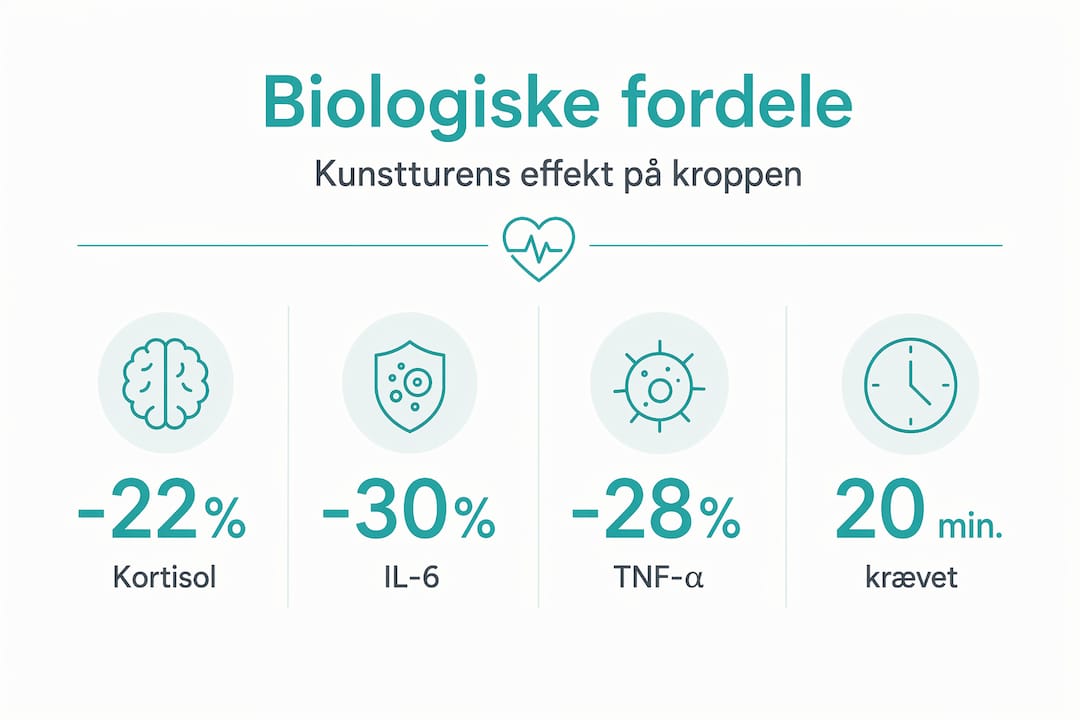
What exactly is happening? Genuine art activates multiple biological systems at the same time. The sight, the aesthetic judgment, memory, and the autonomic nervous system all work simultaneously. This explains why gallery participants showed increased heart rate variability during the viewing, a sign of a healthy and flexible stress regulation system. That's the kind of response the body doesn't produce by scrolling through pictures on a screen.
Here are the most important physiological benefits summarized:
- Reduced cortisol. The stress hormone drops significantly with original artworks, not reproductions.
- Lower inflammation. Decrease in IL-6 and TNF-α after just 20 minutes of gallbladder visit.
- Better heart rate variability. A sign that the body regulates stress more effectively.
- Increased engagement. Authentic art activates neurological and immunological reactions that images on a screen cannot evoke.
- Long-term mental health Museum visits and cultural participation It is associated with a reduced risk of depression, loneliness, and dementia in long-term studies.
Professional tip: Allocate a minimum of 20 minutes per gallery. It is the time frame that the research shows provides the measured stress reduction and biological response. See it as an investment in your body, not just your spirituality.
Art as a key to cultural understanding
There is a special form of insight that only occurs when you view art in the right context. A painting is never just a picture. It is a time document, a cultural argument, a reaction to the society in which the artist lived. And that is precisely why experiences on an art tour can change the way you understand history.
Take the beach motif as an example. Johannes Larsen Museum in Kerteminde all exhibitions that specifically focus on the beach motif in Danish art from 1830 to 1910. It may sound narrow, but it is the opposite. The beach was during that period a new phenomenon as a recreational space. The industrialization pushed people towards the coasts. The artists P.S. Krøyer and Anna Ancher documented this cultural change with brush and canvas. When you see these works gathered and in context, you understand not just the painting. You understand a historical shift in how people used and thought about nature.
Art is not a decorative spectator of history. Art is history seen from within.
It is precisely this dimension that makes artistic journeys something other than sightseeing. The tourist running through a museum in an hour only sees the surface. The visitor who chooses a theme or motif and follows it through an exhibition leaves the museum with a new understanding of time, place, and people.
A narrative focus during the art tour significantly increases the depth of the experience. It functions like an anchor, holding your attention and giving you something to reflect on afterward. Choose a theme before you arrive: a motif, an era, an artist, or a question you want answered. You will find that the journey sinks much deeper.
Plan your art trip in Denmark
Visiting art museums is not about having an art history background. It's about choosing correctly and giving yourself time. Here is a practical approach to get started well.
-
Choose museums with original collections. Danish museums combine art with historical and cultural communication in a way that enhances learning and engagement. Prioritize museums with permanent collections of original works over places that primarily display reproductions or digital installations.
-
Set a theme for the visit. Decide on a focus before you arrive. It can be impressionism, Danish Golden Age painters, marine motifs, or female artists. A theme gives the trip structure and makes the after-experience richer.
-
Allocate at least two hours per museum. It may seem far, but research is clear that a minimum of 20 minutes per gallery is necessary to achieve the physiological effect. An entire museum deserves more. Haste makes is the greatest enemy of the art tour.
-
Read the communication texts. It may seem time-consuming, but the museum's own texts are written to provide context. They explain when and why a work was created, and it fundamentally changes the experience.
-
Combine the museum with a local visit. Many of the best art museums in Denmark are located in cities and areas with a strong cultural identity. Kerteminde, Skagen, Silkeborg, and Humlebæk all contain museums that are deeply connected to the local nature and history. It provides a holistic experience that makes the trip memorable.
-
Note or take photos of what moves you. Not to share on social media, but for your own sake. Stopping to pause and articulate what captures you about a work deepens understanding and anchors the experience.
Professional tip: Avoid visiting more than two museums in the same day. Fatigue reduces the ability to see and feel artworks. Quality beats quantity on an art trip every time.
Art, reflection, and well-being on the journey
An art tour is not just a cultural checkpoint on your holiday plan. It can serve as a form of active mindfulness, a way to take a break from the noise of everyday life and step into a different kind of awareness. It is one of the most underrated experiences on the art tour.
Think about it: When you stand in front of a large painting and really look at it, you stop checking your phone. Thoughts about work and practical chores do not intrude. You are present because art demands it. It is no coincidence that many describe museum visits as a feeling of calm that resembles meditation.
Here are ways a art tour enriches the overall travel experience:
- Emotional stimulation. Art provokes, moves, and surprises. These are experiences that settle in the body and not just in the intellect. Art experiences strengthen mental health and increase life satisfaction according to long-term studies.
- Personal development. Seeing art from other cultures or periods challenges your own preconceptions and provides new perspectives. It is a gentle form of self-development that does not require a book or a course.
- Connection to the site. An art museum is rarely placed randomly. It reflects the town and the landscape it is in. To visit, for example Skagen Museum Provides an understanding of light and nature that never arises from reading about it.
- Social experience. Art can be shared. Talking about a painting with another person, about what you see and feel, creates a special form of closeness and community.
- Balance on the journey. Cultural trips in Europe can quickly become crowded with sights. A couple of hours in a good museum create a natural rhythm and give energy for the rest of the day.
An art tour does not require you to be an expert. It only requires that you are curious and willing to give yourself time. It is the simplest definition of an art tour for beginners.
With perspective: take art seriously enough to sense it
I have spent many years traveling with art as my starting point, and the one mistake I see again and again is haste. People buy the ticket, pass through all the halls, glance briefly at the most famous works, and leave satisfied. They have "seen" the museum. But they haven't sensed it.
It's the difference between eating a meal and tasting it.
When I visit a museum, I consciously choose three to five artworks to spend a lot of time on. Not ten minutes. About a quarter of an hour each. I read the communication, stand back and then close, and I ask myself: what did the artist want? It is an exercise that changes everything.
The research confirms this. Authentic art engages multiple biological systems at once, and that reaction takes time to develop. You can't force it forward in two minutes in front of a Rembrandt.
My recommendation is simple: next time you plan a trip, whether in Denmark or elsewhere, include one museum in the plan as a real focus point for the day. Not like a quick stop. As a conscious experience that you prepare for and give yourself time in. You will return home differently than you came.
— Tommy
Plan your art trip with Rejsidanmark
Rejsidanmark makes it easy to find the experiences that suit your trip. The platform gathers practical guides, recommendations, and descriptions of cultural attractions across Denmark so that you don't have to spend hours researching yourself. Whether you're looking for Danish art museums or want to know what awaits you in a specific city, you'll find it all in one place.
If you're traveling around Denmark to see art and culture, practicality is also important. Rejsidanmarks Guide to local transportation Helps you navigate the country efficiently, whether you use train, bus, or rental car. And if you want inspiration for which cultural activities await beyond the museums, here is an overview of cultural activities in Denmark a good starting point.
FAQ
What is an art tour?
An art tour is a trip or a day visit with art and cultural experiences as the primary focus, typically including visits to museums, galleries, or art historical sites. It can be a one-day trip in Denmark or a longer cultural journey in Europe.
Why are original artworks better than reproductions?
Original artworks trigger measurable biological responses, including a 22% decrease in cortisol and a reduction in inflammation markers, which reproductions cannot induce. The body reacts to authentic art in a way that cannot be replicated by images on a screen or print.
How much time should one spend in an art gallery?
Research shows that a minimum of 20 minutes per gallery is necessary to achieve the measured stress reduction and biological engagement. It is recommended to spend at least two hours in a full museum to have a deeper experience.
Is art history only for those with an art historical background?
No. An art tour for beginners only requires curiosity and a willingness to take your time. Museums offer interpretive texts and context that make the experience accessible to everyone, regardless of prior knowledge of art.
Which Danish museums are suitable for a first art tour?
Johannes Larsen Museum in Kerteminde, Skagen Museum, and Danish art museums in general offer strong combinations of original collections, local cultural dissemination, and beautiful surroundings that provide a cohesive and memorable experience.