In short:
- Traveling is a relaxed way to travel in Denmark and Europe without airport logistics.
- Plan routes, transfers, and tickets thoroughly to ensure a stress-free experience.
Traveling is the most relaxed way to get around in Denmark and Europe. You sit comfortably, watch the landscape glide by, and arrive in the middle of the city center without airport logistics. With new direct connections like ComfortJet from Denmark to Berlin and Prague, the possibilities for train travel in 2026 are better than ever. Good planning is the key: the right ticket choice, a well-thought-out route, and knowledge of practical details make the difference between a stressful and a truly good trip.
How to travel around by train: plan routes and connections
The best train journey starts with a clear overview of the network. Denmark is well connected internally via DSB, and from Copenhagen you can reach major European cities directly or with just one transfer. ComfortJet connects Denmark with Berlin in about 7 hours and Prague in about 11 hours. It makes train travel a real alternative to flying for many destinations.

Apps and websites are indispensable for route planning. DSB's own app covers the Danish routes well. For international routes, experienced train travelers use platforms such as Trainline, Omio, and the national operators' own sites like Deutsche Bahn and ÖBB. These provide you with an overview of departure times, shifts, and prices across borders.
Switching between trains requires attention. Experienced travelers recommend a 30–60 minute buffer during transfers, especially when switching between different stations in the same city. In Paris, there is, for example, a big difference between Gare du Nord and Gare de Lyon. Find the arrival platform and the nearest escalator in advance via the train app's carriage plan.
Also think about what you want to experience along the way. A train journey from Copenhagen to Munich with a stop in Hamburg gives you two cities for the price of one trip. Feel free to plan a stopover of 1–2 days rather than rushing through.
- Use DSB's app for Danish routes and Trainline or Omio for international routes
- Plan the shift with at least 30–60 minutes of buffer
- Check train numbers and platform facilities in the app before departure
- Consider a layover as part of the experience
Professional tip: Download the transport company's app and save your ticket offline before departure. The mobile network may be unstable in tunnels and across borders.
What types of tickets are available, and how do you buy them?
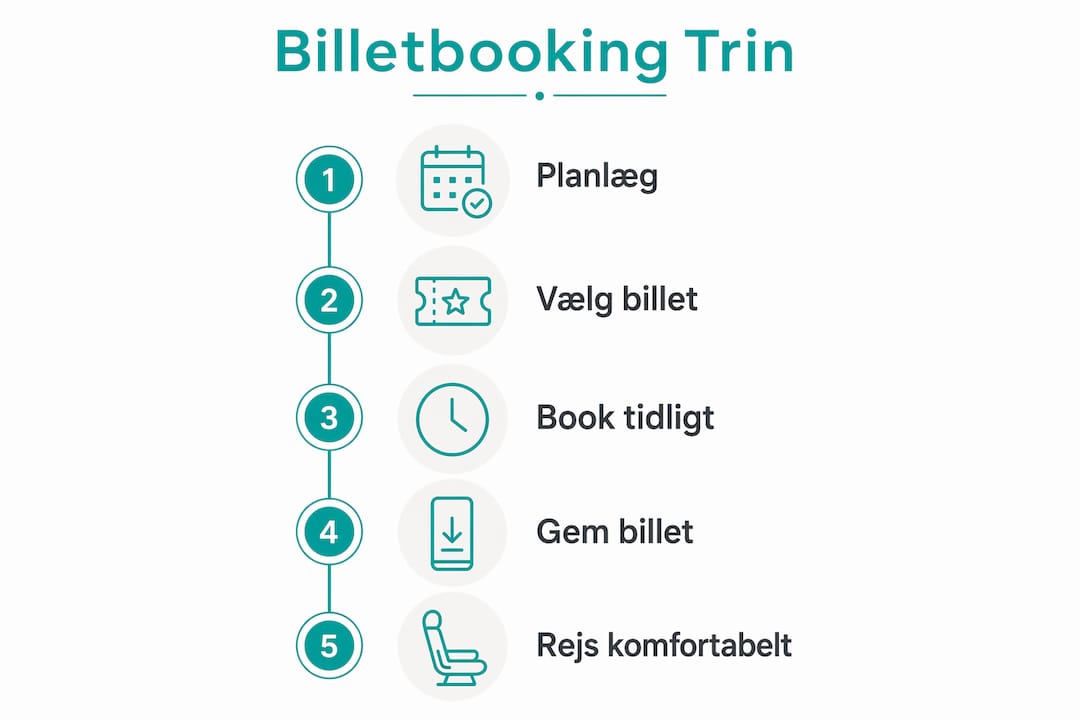
The ticket choice is the most important financial decision on a train journey. There are three main types: single tickets for specific trains, regional tickets for a region, and Interrail/Eurail passes for travel across Europe. Each type suits different travel patterns.
Comparison of the three ticket types
| Ticket type | Best for | Advantages | Disadvantages |
|---|---|---|---|
| Single ticket | A specific stretch | Low price with early booking | No flexibility |
| Regional Ticket | Day trips and short excursions | Flexible within an area | Does not apply to long-distance |
| Interrail Pass | Many countries and routes | Great flexibility | Additional reservation fees |
The booking window for long-distance trains and night trains typically opens 90–180 days before departure. Popular departures to Berlin, Amsterdam, and Paris sell out quickly. Book as early as possible if you are traveling during the peak season from June to August.
Night trains are a special category. Reservation fees for night trains vary from approximately. 10 € for a seat and over 70 € for comfortable sleeping placesA train carriage is often cheaper than a cheap hotel in the city center. Always calculate the total price: train ticket plus reservation fee compared to flight plus hotel.
Interrail users can save money by booking directly with national operators such as Deutsche Bahn and ÖBB instead of through the Interrail portal. The reservation fees are often lower this way. Combine an Interrail pass for the long distances with single tickets for regional trips for the best price balance.
How to find the cheapest tickets:
- Book 90–180 days in advance for long-distance trains and night trains
- Travel on Tuesday or Wednesday instead of Friday and Sunday
- Compare the price of the Interrail pass plus reservation fee with a single ticket
- Check the national operators' own websites for lower reservation fees
- Choose a cot bed over a crib if comfort is not essential
Professional tip: Set a calendar reminder for the day the booking window opens for your desired departure. Popular dates sell out a few weeks after opening.
Practical travel tips for comfort and efficiency on the go
Pak let. It's the simplest advice that makes the biggest difference on a train journey. A suitcase with wheels is cumbersome on stairs and narrow gangways between carriages. A backpack or a small trolley that you can lift yourself gives you the freedom to change quickly and stress less.
The choice of wagon and cabin type depends on your needs. Silent compartments are found on most long-distance trains and are ideal if you want to work or sleep. Family cars have space for strollers and play corners. Order the right carriage already when purchasing tickets, as popular compartments fill up quickly.
The train journey is not just transportation. It is part of the experience. Sit by the window, take out a book, and let the landscape tell its own story.
Brug actively the train timetable. You can see which end of the platform your train is at and plan where to stand. It saves time and stress, especially during short shifts. Apps like Deutsche Bahn's DB Navigator and ÖBB's app display this in real time.
Delays happen. EU regulations give you the right to compensation for delays on international routes: 25% refund for delays of 60–119 minutes and 50% for delays over 120 minutes. Always keep your ticket and take screenshots of delay notifications as documentation. Seek compensation via the train company's website after returning home.
- A backpack or small trolley that you can lift yourself
- Choose quiet compartment for work and sleep, family wagon for families with children
- Use the train schedule function in the train app to find your carriage on the platform.
- Gift tickets and delay documentation for potential compensation
- Have an offline map app ready for the destination, as roaming may fail at border crossings.
How do you avoid the most common mistakes when traveling by train?
The most common mistake is too short shift times. An 8-minute transfer sounds possible on paper, but is unrealistic if the train is delayed by 5 minutes and you have to change platforms. A buffer of 30–60 minutes is not a waste of time. It is insurance against stress and missed trains.
Another classic mistake is traveling in the peak season without having booked in advance. July and August are the most expensive and busiest months on the popular European routes. Do you travel in the low season or on weekdays like Tuesday and Wednesday?, so that ticket prices are lower and the trains are calmer. This applies both within Denmark and on international routes.
Night trains are an underrated means of travel. Night trains are best for distances between approximately 700 and 1,500 km., where you save a hotel night and arrive rested at your destination. Choose your cabin type carefully: a shared sleeping car is cheap, but a private cabin provides peace, especially for couples and families. Night trains save both hotel costs and travel time, but the level of comfort must match your needs.
Flexible planning is your best friend as a beginner. Book accommodation with free cancellation so you can change plans if the trip takes an unexpected turn. A delay can turn into a spontaneous afternoon in a city you hadn't planned to visit.
- Always allocate a 30–60 minute buffer for train transfers
- Book tickets 90–180 days in advance for popular routes
- Travel Tuesday or Wednesday for lower prices and better seats
- Choose night trains for routes of 700–1,500 km to save on hotel nights
- Book accommodation with free cancellation for flexibility
Professional tip: Consider delays as an opportunity rather than a problem. Flexible travelers with open plans experience much less stress and often discover unexpected places along the way.
My experiences traveling around by train
I have traveled by train in Denmark and Europe for many years, and the most important lesson is this: trains are not just transportation. It is a form of travel that rewards patience and curiosity.
The first time I took the night train from Copenhagen to Vienna, I was skeptical about the comfort. But a sleeping car compartment with three other travelers, a glass of wine from the restaurant car, and eight hours of sleep later, I arrived in Vienna ready to explore. No airport, no waiting time, no taxi fare from the airport. It was a revelation.
Flexibility has saved many of my trips. I always book accommodation with free cancellation for the first days of a new trip. Once, a planned change in Hamburg turned into a spontaneous overnight stay because the city was just too good to leave the same day. It can only be done if you are not locked into rigid plans.
Night train is my preferred means of travel for distances over 700 km. It's not always the cheapest, but when you include hotel price and travel time, it's almost always the smartest choice. Choose a private compartment if you are traveling alone or are easy to wake. You sleep better and arrive more refreshed.
— Tommy
Plan your next train journey with Rejsidanmark
Rejsidanmark gathers the best tips, routes, and experiences for you who want to explore Denmark by train. Whether you're planning a day trip from Copenhagen to Odense or a longer round trip through Jutland, you'll find practical help for every step. Start with Our guide to Denmark for a complete overview of transportation, accommodation, and attractions. If you need a structured plan, ours provides step by step vacation plan Create a solid foundation. Also use our Checklist for a day trip to ensure that you don't forget anything important before you get on the train.
Frequently Asked Questions
What is the best app for planning train trips in Europe?
Trainline and Omio cover most European routes and display prices across operators. For national routes, DSB's app is the best in Denmark, while Deutsche Bahn's DB Navigator is strong for German and international routes.
When should I book tickets for long-distance trains?
Book 90–180 days before departure to secure the best prices and seats. Popular departures to Berlin, Paris, and Amsterdam sell out quickly after the booking window opens.
What is the difference between a lying carriage and a sleeping carriage in a night train?
A sleeping car has flat beds in a divided dome compartment and is the cheapest night train option. A sleeping car has private or semi-private compartments with more comfort and space. Reservation fees vary from approximately. 10 € for a seat and over 70 € for comfortable sleeping places.
Do I have the right to compensation if my train is delayed?
EU regulations give you a 25% refund for delays of 60–119 minutes and 50% for delays over 120 minutes on international routes. Save your ticket and take screenshots of delay notifications as documentation.
Which train should I take from Denmark to Berlin?
ComfortJet connects Denmark directly with Berlin in about 7 hours. Book via DSB or Deutsche Bahn and allow plenty of time for any transfers along the way, especially if you are traveling with luggage.
Recommendation
- Public transportation in Denmark – trains, buses, metro, and ferries – Travel in Denmark
- Trinvis guide to local transportation in Denmark for tourists – Travel in Denmark
- How to take public transportation in Copenhagen efficiently – Travel in Denmark
- Practical travel tips – Things you need to know when traveling in Denmark – Travel in Denmark