
In short:
- Good holiday planning with children starts 3 to 6 months before departure to ensure the best prices and facilities. Family-friendly destinations should be safe, have relevant activity offerings, and be easily accessible. It is important to plan transportation, pack smart, and build in buffer time to handle unexpected situations during the trip.
Trinvis travel planning for families with children is the most effective method to ensure a stress-free and successful family vacation because it breaks down the preparation into manageable steps tailored to the children's needs and rhythms. Good holiday planning with children typically starts 3–6 months before departure, so you secure the best prices and the right facilities. This guide covers everything from choosing a destination and accommodation to packing, transportation, and handling unforeseen situations. You receive practical advice that works in practice, whether the children are 2 or 12 years old.
Trinvis travel planning for families with children: How to get started
Vacation planning with children requires a different approach than planning for adults alone. Children have fixed routines, shorter attention spans, and a need for rest, which a good travel plan should take into account. The best approach is to work step by step from the general to the specific.
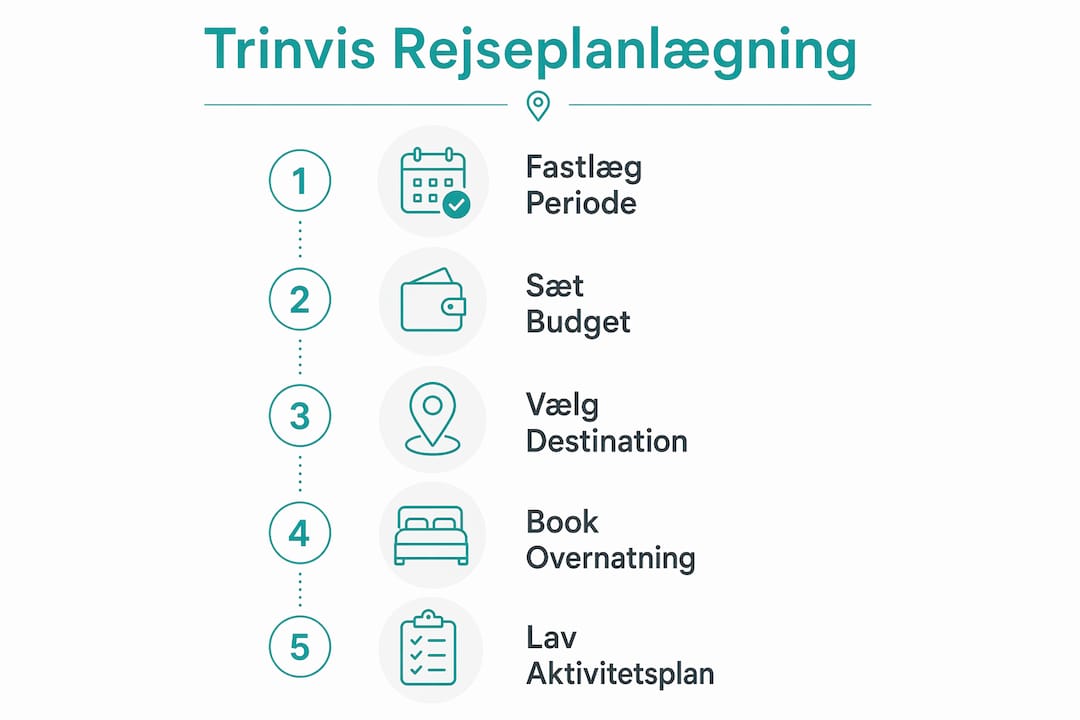
Start by determining the holiday period and a realistic budget. Decide on the type of destination first before booking accommodation and transportation. You plan activities last, when the framework is in place. This order prevents you from booking a hotel far from the activities the children actually want to do.
Rejs i Danmark offers a comprehensive step-by-step plan that guides you through the entire process from the initial idea to departure.
How to choose the right destination and accommodation for families with children?
The right destination for a family with children meets three criteria: it is safe, it has activities suitable for the children's age group, and it is logistically manageable. Denmark offers many great opportunities, from Legoland in Billund to nature experiences on Bornholm and beach holidays along the West Coast.
Criteria for a good family-friendly travel destination
Choose destinations where family-friendly activities are concentrated within a short distance. It saves transportation time and reduces fatigue. Always check if the accommodation has:
- Children's pool or playground on the property
- Family rooms or adjoining apartments
- Proximity to supermarket and pharmacy
- Opportunity to heat food for the little ones
Many campsites and holiday centers in Denmark, such as Lalandia in Billund or Rødby, are specifically built for families with children, featuring water parks, play zones, and activity programs included in the price.
Free and inexpensive activities count
Free entry for children Under 18 years old is valid at many Danish museums during the summer season 2026. This means that a family with two children can significantly save on the experience budget by choosing museums instead of commercial amusement parks. The Strandings Museum in Thorsminde is a good example of a museum that offers family-friendly activities throughout the summer.
Also consider 7 family-friendly destinations In Denmark, which Rejsidanmark has compiled with relevant facility overviews and age recommendations.
How to best plan transportation and travel routes for young children?
Transport is the point where most family vacations go wrong. A one-way flight can easily turn into a round trip. Otte-timers door-to-door journey including transportation to the airport, check-in, waiting time, and baggage handling. It is crucial to plan the actual travel time, not just the transportation time itself.
Step-by-step transportation plan for the family
- Calculate the actual door-to-door time. Include transportation to the station or airport, waiting time, and any transfers. A realistic timeline is more important than the official travel time.
- Choose the mode of transportation based on the children's age. The flight time for children under 3 years should be kept under 5–6 hours to minimize stress. Car or train is often better for the little ones.
- Plan stops every 2–3 hours. It is recommended for car trips 20–30 minute breaks to prevent fatigue in both children and drivers
- Adjust the departure time to the child's routines. Feel free to drive at night or early in the morning so the little ones sleep most of the trip.
- Enter a backup route into the GPS. Unexpected roadworks and traffic jams are the rule, not the exception, during the summer holiday.
- Make the travel bag easy to access. Snacks, change of clothes, and entertainment should be placed on top and not in the trunk.
Professional tip: Add an extra 30% to all time estimates. Children's fixed routines such as naps and meals disrupt the schedule more than most parents expect. It's better to arrive early and have time to relax than to arrive stressed and delayed.
How do you create an activity plan with family-friendly experiences in Denmark?
A good activity plan balances structure with flexibility. Too many activities in one day cause resistance and stress, while too few activities leave children bored. The key is to switch between active experiences and free play.
Select activities based on age and interest
Children under 5 years old thrive best with short experiences of 1–2 hours followed by free play. Children over 8 years old can handle longer museum visits but still need breaks outdoors. Balance between museums and free play In green spaces, children's well-being and happiness increase significantly. A tightly packed program with museums alone creates resistance.
Involve the children in the planning. Let them mark a cross on a map of Denmark at the places they want to visit. Brief markings and point systems reduce uncertainty and impatience during the journey because children feel a sense of ownership over the program.
Examples of family-friendly activities in Denmark
| Activity | Age group | Price | Placement |
|---|---|---|---|
| Experimentarium | 4+ years | Paid entry | Hellerup, Copenhagen |
| Stranding Museum | All ages | Free under 18 (summer 2026) | Thorsminde, West Jutland |
| Legoland | 2–12 years | Paid entry | Billund |
| Nature playgrounds | All ages | Free | Land over |
| IKONO Immersive Experience | 6+ years | Paid entry | Copenhagen |
Rejsidanmark has detailed descriptions of Experimentarium og IKONO Immersive Experience with prices and age recommendations
Build flexibility in from the start
Never plan more than two fixed activities a day. Let the third activity be open so you can adapt it to the weather and the children's mood. Always have a list of indoor alternatives ready for rainy days.
How is the best way to pack and prepare for the family trip?
Smart packing significantly reduces stress during the journey itself. The most effective method is to pack by activity rather than by person. It means that everything for sleep is gathered together, everything for meals is gathered together, and everything for diaper changing is gathered together.
Packing list for families with children
- Emergency kit in the carry-on bag Bleer, medicine, change of clothes, and snacks for the first hours. A mini-emergency kit In the carry-on luggage is essential during delays.
- Packing cubes by function: Bridge organized package units for diapers, food, and sleep. Packing by activity rather than person makes it easier to find things without rummaging through the entire suitcase.
- Medicine and health articles: Pak fever-reducing medication, plaster, and any permanent medication in a separate bag, which is always accessible.
- Weather-adapted clothing Check the weather forecast for the entire holiday period and pack in layers rather than heavy jackets.
- Entertainment for transport Tablets, books, and small toys for the transportation stages. A small backpack that the child carries themselves.
Professional tip: Use a digital checklist, e.g., Google Keep or Notes on your phone, and share it with your partner. Put a cross continuously on the days leading up to departure. It prevents the classic situation where you discover at the airport that the teddy bear has been left at home.
Remember to divide medicine and critical articles into two separate tasks. If one piece of luggage goes missing, you still have the most important thing.
How do you handle unforeseen situations and ensure well-being during the trip?
Even the best plan faces resistance. Flight is delayed, the weather changes, and children are tired at the wrong times. Families that fare best are those that have planned for the unexpected.
Build buffer time into all parts of the journey. It applies not only to transportation but also to check-in, meals, and activity changes. Children take twice as long as adults on all crossings.
The biggest mistake parents make is underestimating children's need for fixed routines. Flexible planning with buffers is not a sign of poor planning. It is good planning.
Proactively manage fatigue and mood swings. Acknowledge the child's feelings rather than rushing. A short rest at the hotel in the middle of the day often saves the rest of the afternoon.
Use a simple point system to motivate the children. Give points for helpfulness, patience, and courage to try new things. The point can be redeemed for a small reward at the end of the holiday. Point systems motivate children and make the journey more fun for the whole family.
Always have a plan B ready. Find the nearest indoor attraction, the nearest pharmacy, and the nearest restaurant with a children's menu. Write them down in your phone before departure so you don't have to hurriedly search for them when the need arises.
What I have learned after many family trips in Denmark
I have planned family trips in Denmark for many years, and the most surprising thing about good planning is that it is more about letting go than about controlling. The vacation I meticulously planned with activities every hour was not the best. The holiday where we had two fixed activities a day and let the rest flow was the one the children still talk about.
What really makes a difference is involving the children early. Not only in the choice of activities, but in the preparation itself. When we let our oldest child mark places he wanted to visit on a map of Denmark, it changed his entire attitude towards the trip. He was not a passenger. He was a co-organizer.
I have also learned that most travel problems occur at transitions. Not during the activities themselves, but in the 20 minutes it takes to get out of the hotel in the morning. Build time in there. Let the breakfast take the time it takes. Stress at the beginning of the day ruins the rest.
A concrete piece of advice, which only comes from experience: always pack one more activity in your carry-on than you think you'll need. Delays happen, and a child with a new little toy is a patient child.
— Tommy
Rejsidanmark helps you plan the family vacation in Denmark
Rejsidanmark gathers the best family-friendly experiences, attractions, and practical planning tools in one place. The platform provides you with filterable overviews of attractions sorted by age, price, and season, so you can quickly find what suits your family best. Bridge Rejsidanmark's guide to Denmark as the basis for the entire planning, and supplement with the detailed Packing list for the Denmark trip, which is tailored for families with children. Book accommodation and activities in good time to ensure the child-friendly facilities that make the difference between a good and a really good holiday.
Frequently Asked Questions
When should you start planning a family vacation?
Travel planning for families with children should start 3–6 months before departure. It ensures the best prices and access to family-friendly accommodations with the right facilities.
Which mode of transportation is best with small children?
Car or train is often best for children under 3 years old. Flight time should be kept under 5–6 hours for the youngest, and the actual door-to-door travel time should always be included in the planning.
How do you involve children in holiday planning?
Let the children mark destinations on a map and choose one activity per day. Short marking and point systems reduce impatience and give children ownership of the trip.
What should always be in the hand luggage with children?
The hand luggage must contain diapers, medicine, change of clothes, and snacks. A mini emergency kit with these items ensures that unexpected delays do not turn into crises.
Are there free museums for children in Denmark?
Many Danish museums offer free admission for children under 18 during the summer season. It allows families with children to save on the experience budget and prioritize more visits.
Recommendation
- Trinvis plan for summer vacation Denmark: Get the perfect holiday – Travel in Denmark
- Step by step plan for holidays in Denmark: Make the most of your trip – Travel in Denmark
- Step-by-step guide to museum visits in Denmark – Travel in Denmark
- How to plan a trip to Denmark with the whole family – Travel in Denmark