The Viking Age was a turning point that paved the way for centralized royal powers, intensified trade, and long-lasting cultural connections between Scandinavia and the rest of Europe. The period laid the foundation for state formation, Christianity, and a trade network that extended far beyond the Nordic region. Archaeological and historical sources document this development in detail, but the picture has often been oversimplified and politically exploited in retrospect, which requires a source-critical approach.
Core phenomena of the Viking Age: raids, trade, and shipping
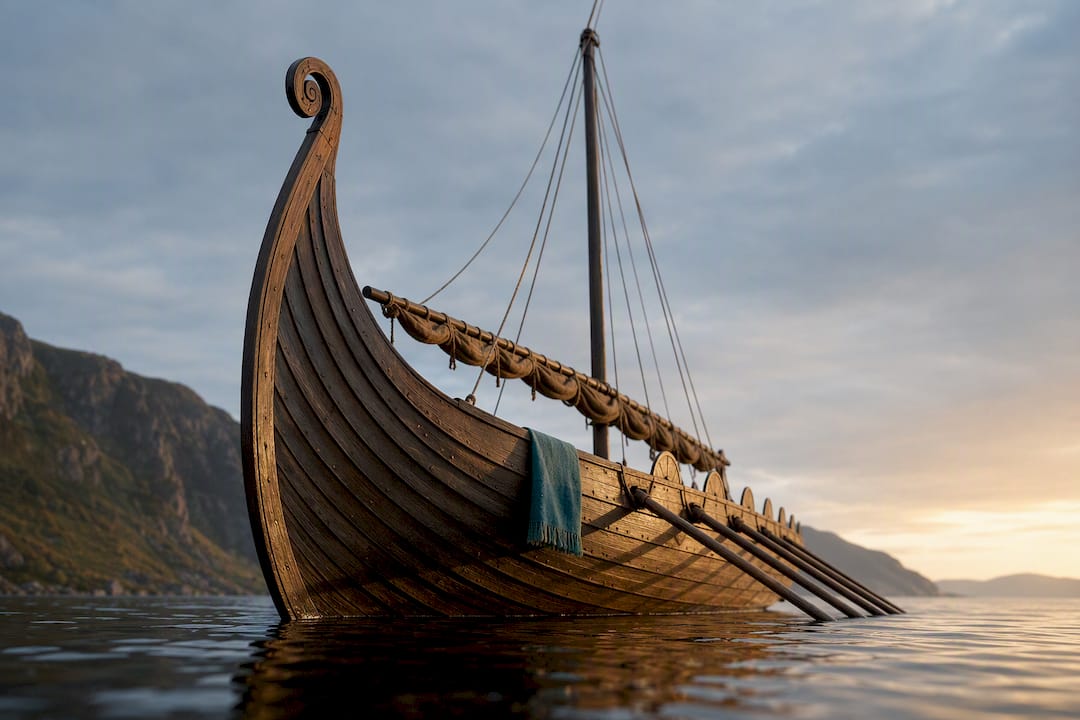
The ship was the most important technology of the Viking Age and at the same time a social status symbol. The clinker-built hull with its shallow draft made it possible to sail both on open sea and up narrow rivers, opening routes that no previous society had exploited to the same extent. A ship also required crew, ownership, and organization, and thus shipbuilding and voyages became part of the social hierarchy: the one who could equip a fleet could also gather power around themselves.
The groups were far from uniform. Some were pure plundering raids, others were trade journeys, and some ended with settlement in foreign lands. It is a crucial nuance because the common image of the Viking as a pure warrior overlooks the fact that trade and migration constituted just as much of the activity. Modern research shows that intensive trade across the North Sea existed earlier than long believed, and that contacts were not solely violent. raids.
The evidence for this contact network is found in the goods that are discovered far from their place of origin:
- Arab silver coins in Scandinavian burial sites testify to trade connections eastward.
- Glass beads and metal objects from Eastern Europe appear in Danish and Norwegian finds.
- Rabbits and fur from the North have been found in continental European trading places.
Modern archaeological methods show that trade contacts over long distances existed before the traditional start of the Viking Age., which changes the understanding of the early chronology of the period. It means that the Viking Age did not emerge as a sudden explosion of violence in 793, but rather as a gradual intensification of networks that already existed.
State formation and political centralization in Scandinavia
The income from expeditions and trade financed something new: a political apparatus that could maintain power over larger areas than the individual chieftain's farm. Wealth from plunder, tribute, and trade enabled ambitious leaders to reward their armies, build fortifications, and control trade routes, laying the foundation for real kingdoms over generations.
The Jelling Monuments are the clearest example of how power was communicated physically. The burial mounds, the stone ship, and the runestones served as a kind of political statement in stone: here, the royal house demonstrated both the connection to past rulers and the transition to a new order. The Runestone, which Harald Bluetooth had erected, directly links the royal lineage to the conquest of Denmark and Norway as well as the introduction of Christianity, making the monument one of the clearest expressions of state-building as a narrative from the period.
Some central patterns in the formation of the state recurred in several Scandinavian regions.
- Control over trading posts gave kings access to customs and resources.
- Ringborge and defense installations demonstrated military capacity and the ability to mobilize labor.
- Alliances through marriage and war follow bound local chieftains to the royal power.
The Viking Age marked a fundamental turning point in the formation of the Scandinavian kingdoms, and by the end of the 11th century. By the century, large parts of Scandinavia had converted to Christianity, which changed the social structures towards a more centralized one. empireHowever, the reach of the kings was uneven: some areas became permanently integrated, while others only periodically recognized a overlord, and the borders shifted in accordance with each king's military and political fortune.
Religionsskiftet: fra nordisk religion til kristendom
The transition from Nordic religion to Christianity was not a sudden conversion, but a prolonged process in which the two belief systems coexisted side by side for generations. The material sources clearly show this overlap: some runestones bear both cross motifs and traditional formulas, and some jewelry finds combine Thor's hammers and crosses in the same design, as if the owner did not perceive any contradiction between the two.
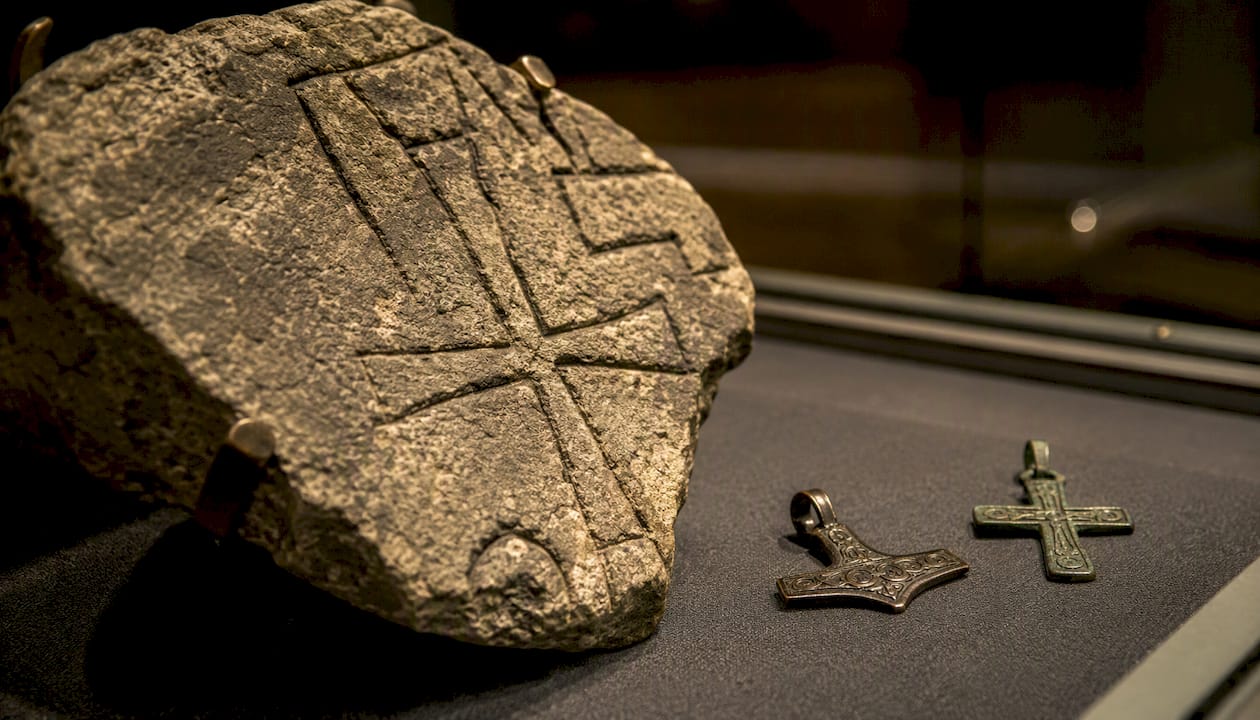
The baptism had a clear political dimension. A king who allowed himself to be baptized gained access to a European network of alliances, recognition, and administrative models that the Nordic religion could not offer in the same way. Harald Bluetooth's own Christianization and the subsequent Jelling inscription are examples of how faith and the legitimization of power went hand in hand. A Christian king could also use the church as an administrative tool to gather power locally, where the nobles had previously been stronger.
Regional differences were significant.
- Parts of Denmark used Christian symbols in combination with pagan motifs for several decades.
- Norway and Sweden experienced a slower and more uneven transition than the central Danish areas.
- Local cult sites were often transformed into churches rather than completely eradicated, suggesting a pragmatic rather than brutal transition in many places.
This gradual and sometimes hybrid process makes religious change one of the clearest examples of how political and religious transformation during the Viking Age progressed in tandem.
Society, economy, and daily life in the Viking Age
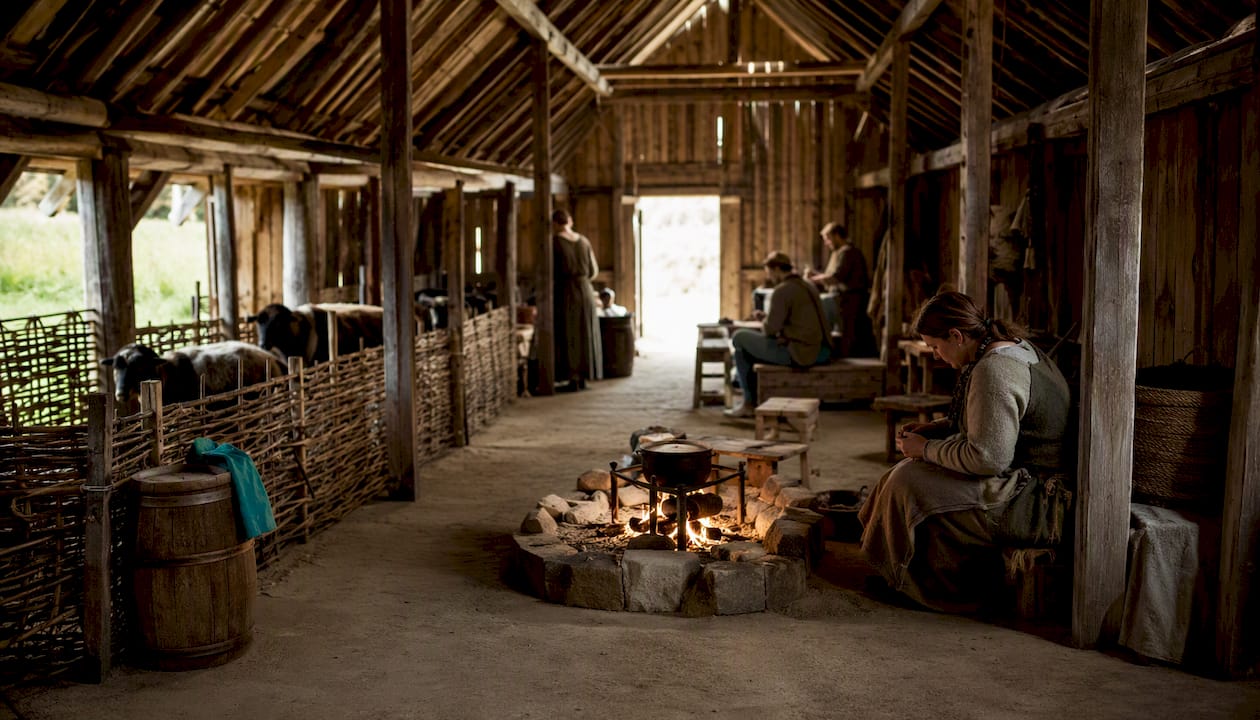
Behind the warriors and kings lay a society that was largely built on agriculture. Most people in Viking Age Scandinavia lived by cultivating grain, keeping livestock, and managing a farm, and it was this surplus that ultimately financed both raids and royal authority. Farms were typically organized around a farmstead with longhouses, where family, servants, and livestock often shared the roof.
Craftsmanship developed into its own specialization as trading places grew. Towns like Ribe and Hedeby served as centers for blacksmithing, textile production, and trade, where goods from distant regions were exchanged and processed locally. This specialization created a layer of craftsmen and traders who lived off something other than agriculture, which in itself was a social novelty compared to earlier periods.
The society was stratified, and the status determined both rights and duties.
- Men controlled land, war followings, and often trade relations.
- Free farmers constituted the vast majority and had legal status at the assemblies.
- Slaves and servants were outside the rights of freedom and performed a large part of the practical work on farms and in crafts.
This social structure was far from static. Trade and expeditions could provide a free farmer with access to wealth and status, which otherwise required inheritance, making Viking Age society more socially mobile than many later periods in the Middle Ages.
Archaeological evidence and modern methods: what the sources actually show
Much of what we today consider certain knowledge about the Viking Age does not come from contemporary texts, but from modern scientific methods applied to archaeological material. These methods have fundamentally changed how historians understand the period.
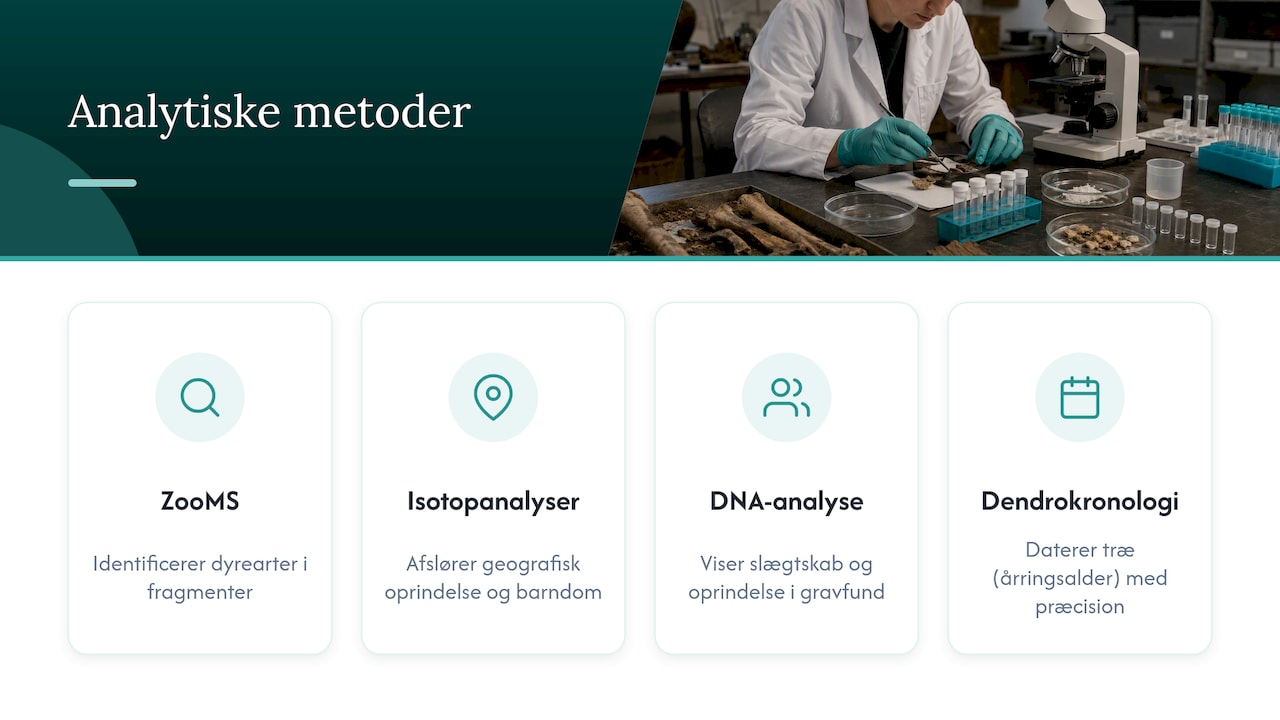
ZooMS, a proteomic technique, can identify animal species in bone and leather fragments that are too degraded for traditional analysis. The method has shown that trade goods and ship supplies can be traced back to specific regions, providing a more accurate picture of where the goods actually came from. Isotope analysis of teeth and bones can reveal where a person spent their childhood, thereby tracking migration at the individual level rather than only through grave goods. DNA analyzer adds an extra layer by showing kinship and origin in grave finds, while dendrochronology, that is, tree-ring dating, makes it possible to date shipwrecks and buildings with great precision.
The combination of ZooMS and isotope analysis shows that intensive trade across the North Sea and contacts with distant regions existed before the traditional start of the Viking Age., which alters the established chronology of early foreign contacts. Another example is the shipwreck Roskilde 6, where dendrochronology and material analyses have provided detailed information about the construction period and wood usage, enhancing the understanding of the development of ship technology.
These methods have forced historians to revise older interpretations that were primarily based on written sources created by the victims of the Vikings or their descendants generations later. While older representations often depicted a picture of sudden, pure violence from around the year 793, the material evidence now points to a more gradual and trade-driven development.
Professional tip: When you visit an exhibition about the Viking Age, look for signs mentioning the specific analysis method behind an artifact, as this is often a sign that the presentation is based on current research rather than older assumptions.
The Post-Viking Age: Myths, National Identity, and Political Use
The image of the Viking, as most people know it today, is largely shaped by the 19th century. more of the century than of the Viking Age itself. The historians and authors of romanticism reinvented the Viking as a national symbol as the Nordic countries' nation-states sought a common past to build identity around. This reinterpretation gave the Viking heroic and often exaggerated traits, which later became difficult to distinguish from the actual historical source base.
Modern research indicates that future images of the Vikings are often contemporary constructions, shaped by the society that retells them, rather than a direct reflection of the Viking Age itself, and that this image has become actively used in identity creation and nationalismIt is a point that extends far beyond academic discussions because the same mythologizing in recent times has been misused by extreme groups that have taken Viking symbols and detached them from their historical context to serve an ideological narrative.
The Viking image is not a fixed historical fact, but a story that has been shaped and reshaped by each generation that has needed it.
Professional institutions therefore actively work to create more nuanced narratives, among other things by:
- Clearly distinguish between source-based knowledge and later popular cultural interpretation in exhibition texts.
- Highlight trade, migration, and everyday life alongside the more dramatic war stories.
- Contextualize the runestones and symbols so that they cannot be used detached in modern political contexts.
The modern public often remembers the Vikings through myths rather than sources, and historians therefore recommend that museums and other institutions clearly mark the boundary between research and storytelling to prevent history from continuing to be used as a political tool.
How to experience and learn Viking history in Denmark in practice
Denmark has several dissemination centers where it is actually possible to encounter source-based Viking history instead of just the myth. Here is a simple route through the main stops:
- Start at the National Museum in Copenhagen, where the large Viking collections and permanent exhibitions provide an overall overview of the period's artifacts, society, and religion.
- Continue to the Viking Ship Museum in Roskilde, where original ship finds and reconstructions demonstrate the practical and social significance of ship technology in detail.
- Stop by Bork Viking Harbour or one of the country's ring fortresses to experience reconstructed buildings and structures in their landscape context.
- Consider a regional side trip to the historic Haithabu and Danewerk, which are listed as UNESCO World Heritage Sites as a testament to trade and border functions during the Viking Age.
When assessing the professional quality of an exhibition, it is worth looking for whether the texts refer to specific findings, analysis methods, or research results rather than just general claims. A good exhibition also explains when something is interpretation and when it is securely sourced knowledge.
Practical planning improves the visit: check the seasonal opening hours, as many outdoor facilities have reduced winter hours, and feel free to ask the interpreters directly which findings a given reconstruction is based on. You can find more specific recommendations in our Overview of Danish Viking Museums and in the guide to what to expect from a Viking Museum.
A concluding perspective: why Viking history is still relevant
God storytelling sharply distinguishes between research and myth, something the Viking Age needs more than any other period. Travel experiences can make this research concrete and immediate, but only when the communication remains source-based and critical. When you visit an exhibition or a site, it is worth approaching it with an inquisitive eye rather than a finished idea of who the Vikings were.
— Tommy
Travel in Denmark as your guide to Viking history
Planning a visit that actually provides source-based insights can be time-consuming if you have to figure out for yourself which museums and sites are worth prioritizing. There are portals that gather research in one place, so you can find relevant targets more quickly and plan a route that fits your time and interests.
Some portals offer features such as:
- Interactive map to find Viking-related museums and sites near your route
- Filtering options by season, price, and age groups so the trip can suit the whole family
- Practical guides to historical attractions that go beyond the Viking Age.
If you want to include a specific museum visit in your travel plan, you can start with our Guide to planning a trip to Denmark and build further from there.
Sources
The article is based on material from the National Museum and the Viking Ship Museum, UNESCO's description of Haithabu and Danewerk, as well as research on trade routes and the posthumous use of Viking history, including Oxford's research on historical memory and ScienceAlert's review of trade routes.
- Ceremonial opening of the exhibition "The Vikings" — Joachim Gauck
- Oxford research: modern uses of the early medieval past
- ScienceAlert: Viking trade routes study
Frequently Asked Questions
What was the most important significance of the Viking Age for Denmark?
The Viking Age laid the foundation for a centralized royal power, a common Christian faith, and a trade network that connected Denmark with the rest of Europe. This development is most clearly seen in the Jelling Monuments and in the Christianization under Harald Bluetooth.
How did the transition from Norse religion to Christianity take place?
The transition was gradual and spanned generations, where Christian and pagan symbols often appeared side by side on the same objects. The kings used Christianization politically to strengthen their legitimacy and to forge ties with European alliances.
Which modern methods have changed our understanding of the Viking Age?
Methods such as ZooMS, isotope analysis, DNA analysis, and dendrochronology have made it possible to trace trade goods, migration, and ship constructions with great precision. They have among other things shown that long-distance trade existed earlier than previously thought.
Where can you experience authentic Viking history in Denmark?
The National Museum in Copenhagen and the Viking Ship Museum in Roskilde offer the most comprehensive source-based exhibitions, while Bork Viking Harbour and the country's ring fortresses provide a more reconstructed experience. The historic Haithabu and Danewerk are also listed as UNESCO World Heritage Sites as a testament to the trade and border function of the Viking Age.
Why is the Viking image in popular culture often misleading?
Part of the modern Viking image originates from the 19th century. A century's romantic reinterpretation rather than from contemporary sources. Research indicates that this image is often a contemporary construct used in identity formation and nationalism, rather than a direct reflection of the Viking Age itself.