TL;DR:
- A child-friendly city prioritizes children's rights, well-being, and participation in decision-making.
- Certifications like UNICEF require systematic work and real improvements.
- Family daily life is improved with shorter waiting times, better offers, and safer environments.
Many familiar people assume that all Danish towns offer the same environment for children. But the reality is completely different. What a city specifically offers in terms of safety, daycare, leisure activities, and children's participation varies significantly from municipality to municipality. UNICEF Child-Friendly Municipalities It is a certification program that sets precise requirements for what it takes to call oneself child-friendly. In this article, we take a closer look at what the concept actually covers, which cities meet the requirements, and what it specifically means for families in everyday life and on vacation.
Main Points
| Point | Details |
|---|---|
| Child-friendliness is broadly defined | Child-friendly cities focus on children's rights, well-being, and influence, not just experience offerings. |
| Certification is not everything | UNICEF's brand requires targeted work, but daily practice and family experiences depend on genuine local efforts. |
| Advantages for the family | Child-friendly cities provide better access to daycare, safety, and a rich leisure life for children. |
| Check the local conditions | It is important to personally check whether the child-friendliness suits your family and needs. |
What does it mean for a city to be child-friendly?
When we look at why not all cities are the same, it is important to define what child-friendliness actually means. The concept is not just about having a playground nearby or a few museums with children's discounts. It is much more fundamental than that.
A child-friendly city is a place where children's rights, well-being, and voices are actively prioritized in the municipality's decisions. It means that children are not just passive recipients of municipal services, but genuine participants in local democracy. The municipality listens to the children, involves them in planning, and ensures that their perspectives are reflected in policies and priorities.
UNICEF's certification program places children's well-being and rights at the center of everything from urban planning to school policy. The program is based on the UN Convention on the Rights of the Child and requires the municipality to be able to document concrete results in a number of areas. It concerns everything from access to health services and education to protection against violence and discrimination.
Here are some of the key elements that characterize a child-friendly city:
- Safety and security: Children can move freely and safely in the local area without constant supervision from adults.
- Well-being and mental health The municipality actively works to prevent maladjustment and offers support to vulnerable children and families.
- Involving children: Children have real influence on decisions concerning their daily lives, for example through children's councils or hearings.
- Access to leisure and culture There are available and diverse offers for children of all ages and with different interests.
- Light and inclusion All children, regardless of background and ability, have access to the same opportunities.
A child-friendly city is not just a place that is nice for children to visit. It is a place that actively works to ensure children thrive, have rights, and are heard.
It is important to distinguish between a city that is family-friendly I understand, and a city that is child-friendly I understand UNICEF. Many cities offer good family-friendly experiences without a systematic focus on children's rights and participation. You can read more about child-friendly experiences around Denmark, which are available regardless of the municipality's certification status.
The difference is therefore not just a matter of supply, but of attitude and systematic approach. A certified child-friendly city has committed to continuously evaluating and improving its efforts for children, and families can feel this in practice.
How is a child-friendly city certified?
When one understands the concept of child-friendly cities, it becomes natural to investigate how this status is achieved. It's not something a municipality can simply declare itself to be. The process requires documentation, evaluation, and genuine commitment from the municipality's management and employees.
To achieve UNICEF certification, a municipality must undergo a structured process that typically spans several years. The municipality shall map the situation of children, identify challenges, and set concrete goals for improvements. Then interventions are implemented, and the results are documented and evaluated externally.
Billund was the first to achieve UNICEF certification in 2020, and since then Aalborg and Gladsaxe have followed. It is not a coincidence that these specific municipalities have achieved status. They have all invested significant resources in mapping children's conditions and creating real improvements.
Here is a comparison of typical initiatives by certified and non-certified municipalities:
| Area | Certified municipalities | Non-certified municipalities |
|---|---|---|
| Child involvement | Systematic and documented | Varies a lot |
| Well-being survey | Regular and binding | Occasional or absent |
| Political anchoring | Strong and crosswise | Depends on political will |
| Access to offers | Broad and inclusive | Varies depending on the economy |
| External evaluation | Mandatory | Rare |
For families considering moving to a new city, certification status can be a useful benchmark. It signals that the municipality takes children's conditions seriously and is willing to be held accountable for its results. But it is not the only factor that should weigh heavily in the decision.
Professional tip: Ask your future municipality directly if they are working with the UNICEF program or similar initiatives. Many municipalities have good initiatives without having the official certification, and local engagement is often just as important as a certificate.
Whether you live in a certified city or not, there are plenty of child-friendly attractions Throughout Denmark, which provides children and families with fantastic experiences together.
Advantages for families: Everyday life in child-friendly cities
When we understand which cities are child-friendly, it is important to look at how it affects daily life. The benefits are not just abstract principles. They appear in very concrete situations that families encounter every single day.
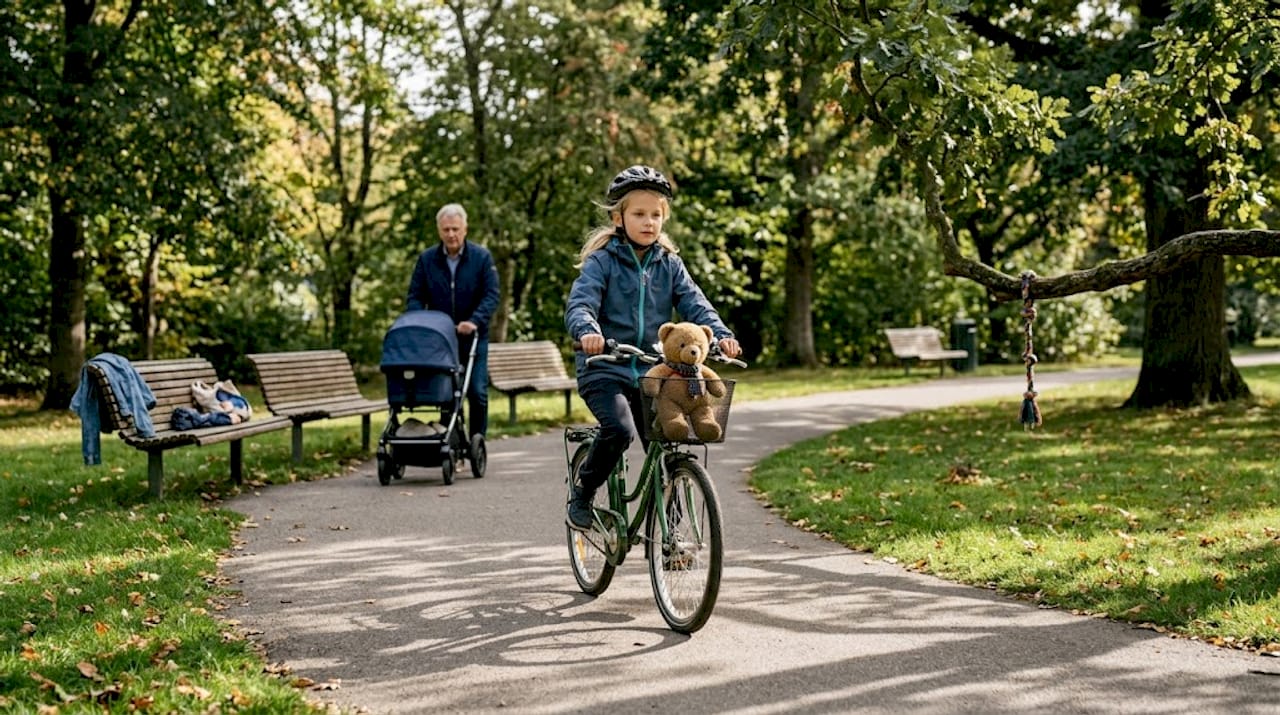
One of the most tangible benefits is access to daycare and leisure activities. Child-friendly cities including among others better access to daycare and a high level of well-being, which directly eases everyday life for busy parents. The waiting list is shorter, the quality is higher, and there is greater variation in the offers.
Furthermore, there is a clear difference in the local camaraderie. I buy with a strong focus on child-friendliness, there are typically more active communities where neighbors know each other, and children can play freely in the local area. It creates a sense of security that is hard to put into words, but that families feel clearly.
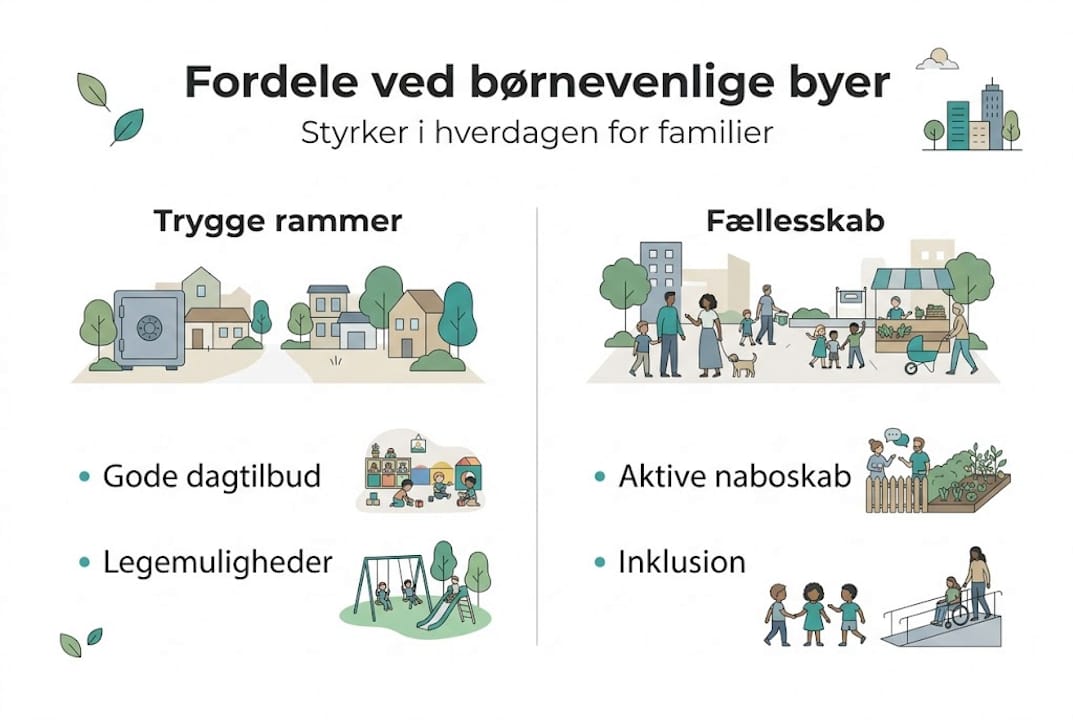
Here are some of the concrete benefits families experience in child-friendly cities:
- Shorter waiting time for daycare services and more flexible opening hours
- Better leisure activities for children of all ages, from sports clubs to cultural activities
- Safer school environment with a focus on well-being and prevention of bullying
- My green and child-friendly urban space with secure bike lanes and parks
- Stronger network for parents and families in the community
The numbers support the picture. In Skanderborg, 36% with familiar children, which is above the national average. It's not a coincidence. Communes that prioritize children and families attract exactly these groups, and this creates a positive spiral of engagement and investment in the local community.
For families seeking inspiration for holidays and excursions, it makes good sense to start with the cities that have already shown that they prioritize children. Explore family-friendly destinations In Denmark, or find one Experience with children It suits your family's interests and age.
It is also worth noting that child-friendly cities not only benefit the children themselves. Research shows that safe and inclusive communities have a positive effect on the well-being and mental health of the entire family. Parents are less stressed, and it affects the children.
Challenges and nuances in focusing on child-friendliness
Even in the best family contacts, challenges and nuances arise when it comes to child-friendliness. It would be naive to draw a picture without shadows.
One of the most prominent challenges is the uneven practice across the country. The practices of the municipalities vary significantly, for example, when it comes to decisions about child placements. Some municipalities place relatively many children outside the home, while others with similar challenges choose other solutions. It shows that the municipalities' approach to children's welfare is far from uniform, even within the same legislation.
Here are the most important nuances to keep in mind:
- Certification is not the same as quality. A municipality can have the papers in order without having created real change for the children.
- Resources play a crucial role. Wealthy municipalities find it easier to implement ambitious programs than municipalities with tight budgets.
- Child involvement can become symbolic. If children's councils and hearings do not genuinely influence decisions, they are more for show than democracy.
- Geographical inequality is real. Families in rural areas often have fewer services than families in larger cities, regardless of certification status.
Certification requires systematic work and genuine involvement. Without it, the label is just a stamp without substance.
Success depends on genuine engagement and not just systematic approach. It is an important point for families who use certification status as a basis for decision-making. Treat it as a starting point, not a guarantee.
Professional tip: Visit the municipality's website to see if there are specific examples of children's involvement, current well-being surveys, and political priorities for the children's sector. It provides a much more accurate picture than certification alone.
For families who want to experience the cities in an active and engaged way, can nature walks for children is a fantastic way to get to know a new city, regardless of its official status.
What is often overlooked in child-friendly cities?
After reviewing both the strengths and weaknesses of child-friendly cities, it is natural to turn our attention to the insights that many overlook. What we see at Rejs i Danmark is that families too often let themselves be guided by overall rankings and certifications rather than assessing what actually suits them. there family
A man can score highly on all parameters and still feel wrong to you. Maybe you are a family that prioritizes nature and tranquility over urban amenities. Maybe you have a child with special needs that requires specific services. Official markings rarely take these individual differences into account.
Our recommendation is to use certifications and statistics as a starting point, not a definitive answer. Visit the cities, talk to local families, and observe how children actually move and thrive in the urban space. It tells more than any statistic. And remember, you can contribute to making your city more child-friendly by engaging locally, participating in hearings, and supporting initiatives for children. Explore child-friendly activities Throughout Denmark, let your own experiences guide you.
Find child-friendly experiences and plan your next trip
If you are inspired to explore more child-friendly cities, there are plenty of concrete guides to get started with. At Rejs in Denmark, you will find a wide selection of examples of child-friendly attractions spread across the entire country, from large cities to smaller gems that are often overlooked. Whether you're planning a weekend trip or a longer summer vacation, you can use our guides to find activities suitable for children's ages and the family's interests. Start with Plan a trip to Denmark with the family and use our practical Checklist for Denmark trip To ensure that you don't forget anything important. Have a good trip.
Frequently Asked Questions
Which Danish cities are officially child-friendly?
Billund, Aalborg, and Gladsaxe are certified child-friendly municipalities in Denmark, and several municipalities are actively working to achieve the same UNICEF certification.
Is there a difference between family-friendliness and child-friendliness?
Yes, child-friendliness in UNICEF's sense specifically concerns children's rights and genuine inclusion, while family-friendliness is a broader concept that covers offerings and security for the entire family.
How is daily life affected in a child-friendly city?
Child-friendly cities create safe, well-being-promoting environments with better access to daycare, leisure activities, and active communities, which are felt directly in the everyday life of families.
Are there disadvantages to certification schemes?
Variations in the practices of municipalities show that certification does not guarantee consistent quality, as implementation and actual engagement vary significantly from one municipality to another.
Recommendation
- The role of child-friendly experiences – The value and development of holidays – Travel in Denmark
- 7 examples of child-friendly attractions for families – Travel in Denmark
- Benefits of Family Experiences – Strengthen Togetherness and Learning – Travel in Denmark
- Why Experience Children's Denmark – Memorable Family Time – Travel in Denmark
- Family Friendly Safari South Africa: Safe, Fun Escapes