TL;DR:
- Denmark is rich in historical sites, ranging from castles to ruins and old town centers. Elections should be based on cultural heritage, facilities, and regional insight to provide a meaningful experience. In many places, such as Kronborg and the Jelling Stones, preparation and respect are required for their vital conservation challenges.
Denmark is full of historical sites, and that makes the choice difficult. What should one prioritize when each castle, each ruin, and each old town core has its own unique story? This article provides you with concrete examples of historical sites worth visiting, from majestic Renaissance castles to prehistoric monuments and medieval urban environments. You will receive practical visitor information, a comparison of the strengths of the places, and inspiration to plan a trip that perfectly matches your interests.
Important criteria for choosing the right historical sites
Before heading to a historic site, it's wise to have a few considerations in place. Not because it makes the experience more complicated, but because it makes it much more meaningful.
Historical significance and cultural depth It is the first parameter. A place with UNESCO status or national protection status typically carries documented stories that provide a solid foundation for your experience. It's not the same as saying that a local and lesser-known place is inferior; on the contrary, hidden gems can surprise with an atmosphere that's hard to find at the major tourist spots.
Visitor facilities means more than most people expect. Opening hours, the possibility of guided tours, accessibility for people with mobility impairments, and the presence of a visitor center can make the difference between a confusing experience and one that sticks in the memory.
Here are the most important criteria to consider before you decide:
- Historical and cultural significance (conservation, UNESCO, national cultural heritage)
- Visitor facilities such as opening hours, entrance, and guided tours
- Variation in the type of place (castle, ruin, urban environment, archaeological site)
- Experience opportunities such as museums, events, and natural surroundings
- Family-friendliness or appeal to specialized interests
- Location and transportation options
If you allocate time to two or three places in the same region, you'll get much more out of the trip. A day in North Zealand can easily combine Kronborg Castle with a city walk in Helsingør and an overnight stay nearby.
Professional tip: Consider combining a large well-known place with a smaller local place in the same area. It provides a natural contrast and often the best sense of a region's historical layers.
1. Kronborg Castle: Hamlet and the Military Glory of the Renaissance
Kronborg Castle near Helsingør is probably Denmark's most famous castle and one of the most prominent historical destinations in all of Scandinavia. The castle was built from 1574 to 1585 under Frederik II as a military fortress and symbol of Danish power over the Øresund. It burned partially in 1629 but was rebuilt by Christian IV in an even more impressive style.
It's not just the architecture that draws visitors here. Shakespeare's Hamlet is inextricably linked to the place, even though Shakespeare probably never set foot in Helsingør himself. The literary connection has made Kronborg a global cultural icon. The castle has been on UNESCO's World Heritage List since 2000, and in April 2026, the opening hours are daily from 10 to 17 with an entrance fee of 130 DKK for adults and free admission for children.
One of the most atmospheric experiences is the guided tours in the casemates, the underground tunnel system that historically served as soldiers' quarters in the 17th century. The seats are limited, and groups require advance booking.
Professional tip: Reserve your seat well in advance, especially during the high season from June to August. It is one of the experiences many visitors regret having overlooked.
Read more about Kronborg Castle Experiences at Rejsidanmark, including practical information about accommodation in Helsingør.
2. Rosenborg Castle: royal history in the middle of Copenhagen
Rosenborg Castle is unexpectedly centrally located in Copenhagen, surrounded by the King's Garden, and is one of the most accessible examples of historical sites for those visiting the capital. The castle served as a summer residence for Christian IV and today hosts the Danish crown jewels as well as a rich collection of royal art objects and furniture from the 17th to 19th centuries.
The unique thing about Rosenborg is that it is almost frozen in time. Many of the interiors are preserved in almost original condition, which gives a sense of life in the past rather than a museum environment arranged for the purpose. The combination of the castle's architecture and the green garden around it makes it a place that works for both culture enthusiasts and families with children.
Rosenborg is particularly well suited to be combined with a trip to Inner Copenhagen, and Rosenborg Castle on Rejsidanmark gives you an overall overview of experience opportunities and practical planning.
3. Frederiksborg Castle: the architectural masterpiece of the Renaissance
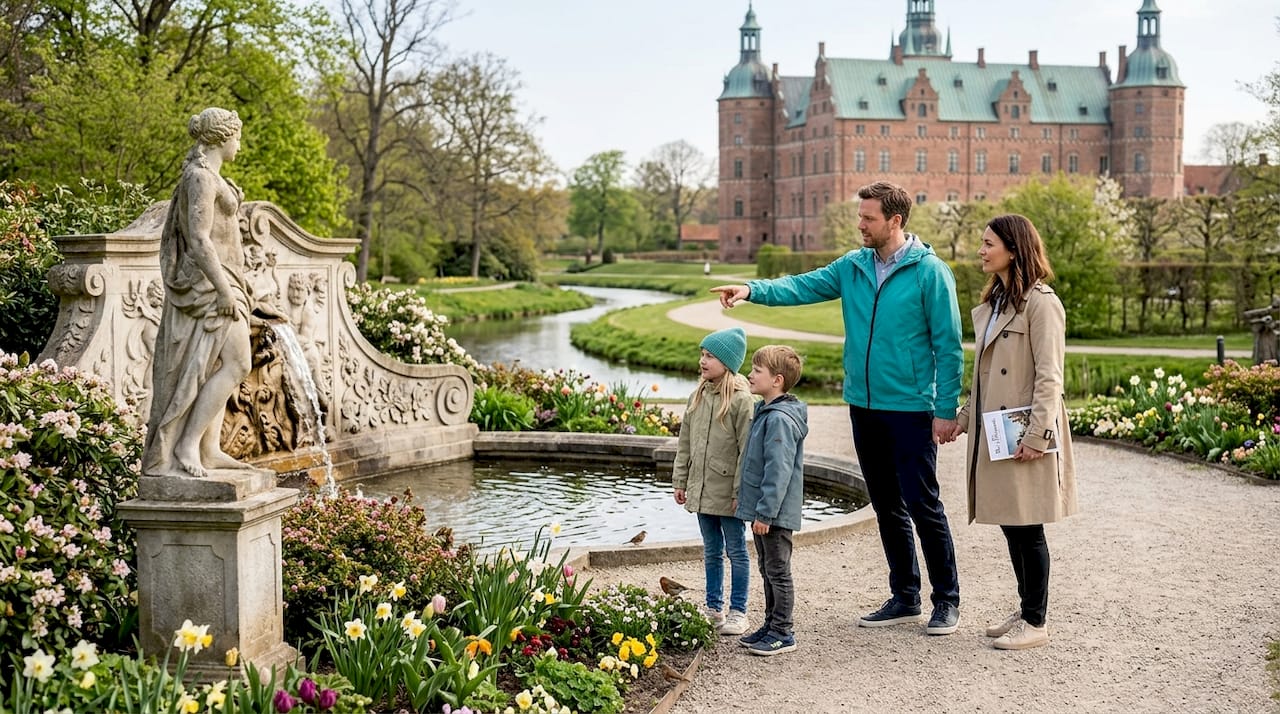
Frederiksborg Castle in Hillerød is one of the most photographed castles in Denmark, and it's hard to understand why until you see it reflected in the lake below. Christian IV ordered it to be built in the early 1600s as a magnificent expression of royal power and aesthetics. Today, the castle houses the National History Museum and is one of Denmark's most important collections of portraits and historical artifacts.
The castle's Renaissance architecture clearly differs from the heavier and more decorative Baroque style, and a visit here provides a good understanding of the aesthetic ideals that dominated the Danish royal court in the 17th century. The gardens behind the castle are reconstructed Baroque gardens that are open to the public and free to visit.
Learn more Visiting options for Frederiksborg Castle at Rejsidanmark, where you also find tips for excursions in the Hillerød area.
The Jelling Stones: Denmark's baptism certificate in stone
The Jelling Stones in Jelling, Vejle Municipality, are not a castle and not a ruin. They are something much older and more fundamental. The two runestones, erected by Gorm the Old and Harald Bluetooth in the 10th century, are considered Denmark's baptismal certificate because Harald Bluetooth's stone bears the earliest known mention of Denmark as a name and contains a declaration that he Christianized the Danes.
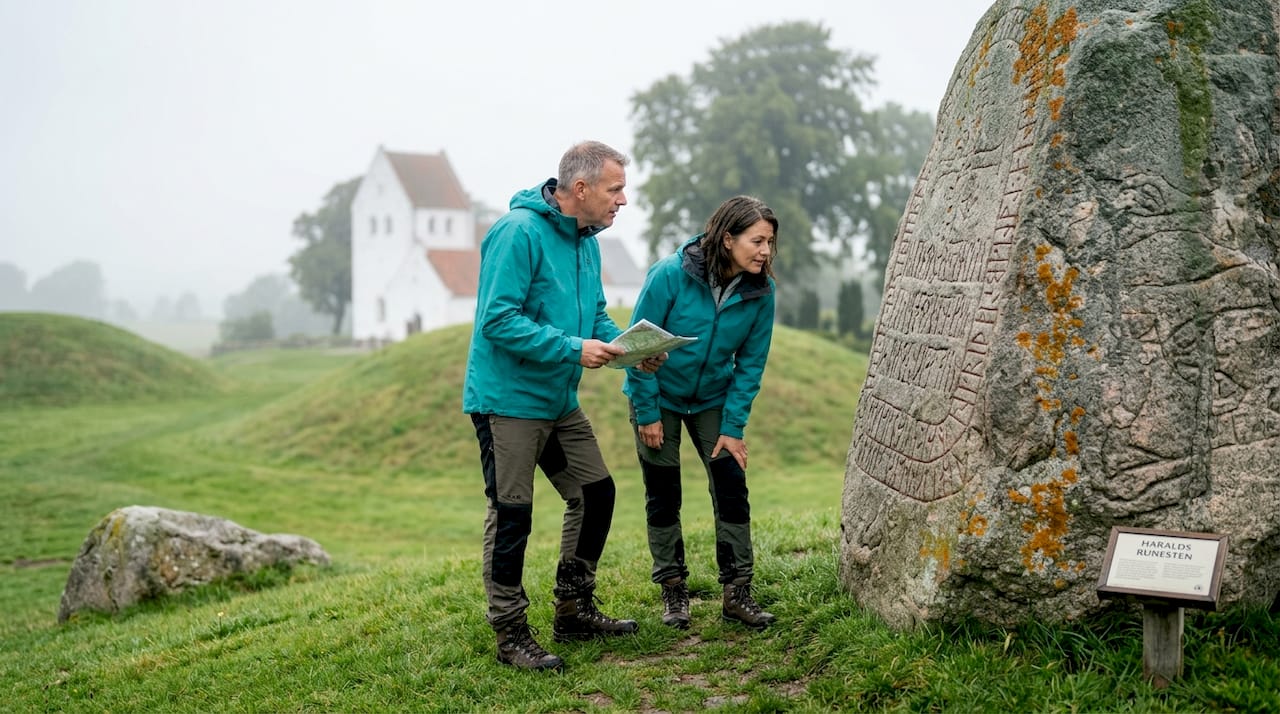
The stones are surrounded by two large burial mounds and a church, and the entire complex is listed on UNESCO's World Heritage List. It is one of the places where prehistoric monuments in Denmark are accessible to everyone and open all year round. Access to the stones is free, and there is a visitor center with exhibitions about the Viking Age and the Jelling Dynasty.
The special thing about the Jelling stones is that they do not require imagination to appear impressive. They are there, solid and fearless, and they have stood there for over 1,000 years.
5. Dragør: medieval town center by the Øresund
Dragør south of Copenhagen is one of the places many Danes know by name but have never really explored. They should change that. The city is known for its yellow stuccoed houses and cobblestone streets, and the historic city center is unusually well-preserved. Dragør was once an important herring port and maritime town in the 1700s and 1800s, and this is still reflected in the maritime atmosphere and the layout of the low, winding streets.
A walk in Dragør requires neither tickets nor a guidebook. It is worth walking along the harbor, up the narrow streets, and around the old church to understand what it was like to live and work in a Danish maritime town 200 years ago. Dragør Museum complements the trip with local stories and artifacts from the city's golden age.
6. Ebeltoft: half-timbered houses and North European color history
Ebeltoft on Djursland is an example of a historic Danish market town that has managed to preserve its character, even though tourism has increased significantly. The city's town hall from 1789 is one of the most photographed medieval town halls in the country, and the half-timbered houses along the streets create an atmosphere that feels authentic rather than reconstructed.
The special cultural-historical find in Ebeltoft is the Dye House, which is considered one of the oldest preserved merchant town dye works in Northern Europe. The building and its exhibitions provide a rare insight into a craft that is otherwise almost extinct from the preserved cultural heritage. It's the kind of place that appeals to visitors who want more than the familiar sights.
The Ministry of Culture designated 16 Danish city centers in 2016. as national cultural environments for the preservation of historic city centers. Ebeltoft and Dragør are both among these designated towns, stretching from Tønder in the south to Sæby in the north.
7. Trøjborg Castle Ruin: a protected ruin under pressure
Trøjborg Castle Ruin in Southern Jutland is one of the most interesting and least known examples of Danish castle ruins. The ruins date from the 14th century and are protected as a historical monument. But it is threatened. Changes in groundwater levels It means that the wooden stakes the ruin rests on risk rotting, and technical interventions such as sheet pile walls are required to stabilize the foundation.
There is a problem that actually affects many historical ruins in Denmark. The piles must be constantly water-saturated to prevent rotting, and variations in the groundwater level pose a real threat to the preservation. The politicians in Tønder Municipality have started to intervene, but it illustrates how fragile the tangible cultural heritage really is.
As a visitor, it is important to know that access to and around the ruins may be restricted due to conservation reasons. Trøjborg is a place you visit for the atmosphere and history, not for the facilities. It, on the other hand, gives an experience of untouchedness that the grand castles cannot match.
Professional tip: Always check local visiting rules and access conditions for ruins and protected ancient monuments before you go. Some places have seasonal restrictions that are not always clearly visible online.
8. Overview: comparison of historical sites in Denmark
Choosing between castles, urban environments, and ruins mainly depends on what you seek in your experience. The table below provides a quick overview of the most important parameters:
| Location | Historical value | Visitor facilities | Family friendliness | Price level |
|---|---|---|---|---|
| Kronborg Castle | Very high (UNESCO) | Excellent | High | Moderate (130 DKK adults) |
| Rosenborg Castle | Very tall | God | High | Moderate |
| Frederiksborg Castle | High | God | High | Moderate |
| The Jelling Stones | Very high (UNESCO) | God | High | Free |
| Dragør town center | High | Limited | Moderate | Free |
| Ebeltoft town center | High | Moderate | Moderate | Make it free |
| Trøjborg Castle Ruins | High | Limited | Lav | Free |
Families with children will typically get the most out of the large castles with guided tours and museums. Culture enthusiasts who seek depth rather than accessibility will find the historic city centers and ruins much more rewarding. Nature lovers will discover that many of the protected ancient monuments and ruins are located in beautiful natural surroundings that are worth visiting in themselves.
Would you like a broader overview of historical family experiences In Denmark, you will find a comprehensive guide at Rejsidanmark with practical information sorted by interests and age groups.
What many visitors miss
I have visited many of Denmark's historical sites over the years, and the thing that consistently surprises me the most is not the size of the places or their UNESCO status. It's the layers hidden behind what you immediately see.
At Kronborg, it's easy to settle for the outer courtyard and the large halls. But the cellars, the underground room that smells of stones and damp and holds the stories of the soldiers who spent their winters there, that is a completely different experience. The problem is that many visitors do not book in time and miss the opportunity. It is symptomatic of how we generally relate to historical sites: we look at the surface and believe we have understood it.
The same applies to the cities. Dragør is easily mistaken for a cozy excursion, but if you go into Dragør Museum and read about the town's role as a maritime center and the dramatic decline when the Øresund trade changed, you will suddenly understand what you are looking at when you walk along the cobblestone streets.
My sincere recommendation is to set aside time to read about a place before you go there. It doesn't have to be in-depth academic literature. A few pages about the place's central story are enough to turn a visit from a photo into an experience.
The Danish cultural heritage is not a list of places with opening hours. They are living stories about people, power, trade, and faith, and the places we visit today are the physical remnants of them. They deserve our attention and curiosity, not just our cameras.
— Tommy
Plan your trip to historical sites in Denmark
Visiting historical sites in Denmark requires some planning, but it doesn't have to be complicated. Most of the places mentioned in this article are accessible by public transport, and combination tours in the same region are an effective and experiential alternative to driving from place to place without context.
Rejsidanmarks Comprehensive guide to local transportation Provides you exactly what you need to plan your route from city to historical site and beyond, whether you are traveling by train, bus, or bicycle. If you want deeper insight into the places you visit, professional guides are often what elevate a good trip to a memorable experience. At Rejsidanmark, you can also read about The guide's role in travel planning or find inspiration on how to put together a trip that combines culture, history, and local life in the most rewarding way.
FAQ
What are the most famous historical sites in Denmark?
Kronborg Castle, the Jelling Stones, and Rosenborg Castle are considered some of the most famous historical monuments in Denmark. Kronborg and the Jelling Stones are both listed on UNESCO's World Heritage List.
Are there free historical sites to visit in Denmark?
Yes, the Jelling Stones, the historic city center of Dragør, and the Trøjborg Castle Ruin are examples of historic sites in Denmark that are free to visit.
When should you book guided tours of Kronborg Castle's casemates?
Guided tours of the catacombs are limited in capacity and require advance booking, especially during the high season from June to August.
Which historic cities in Denmark have preserved medieval urban environments?
Dragør and Ebeltoft are both examples of historic towns in Denmark with particularly well-preserved cultural environments, designated by the Ministry of Culture in 2016 as national cultural heritage sites.
What threatens the preservation of historical ruins in Denmark?
Variations in the groundwater level are one of the primary threats, as many ruins rest on wooden piles that require constant water saturation to prevent rotting. Trøjborg Castle Ruin is a concrete example of this problem.
Recommendation
- Travel in Denmark – find the best experiences, sights, and hidden gems – Travel in Denmark
- Historical Landmarks: Inspiration for Family Experiences – Travel in Denmark
- Cultural Heritage Sites in Denmark: Your Guide to Historical Experiences – Travel in Denmark
- 7 inspiring examples of cultural activities in Denmark – Travel in Denmark