TL;DR:
- Family activities create presence and stronger relationships through active shared experiences. Regular experiences fulfill children's basic needs for autonomy, competence, and relatedness, which promotes well-being. Planning should focus on simplicity, flexibility, and inclusive roles for all age groups.
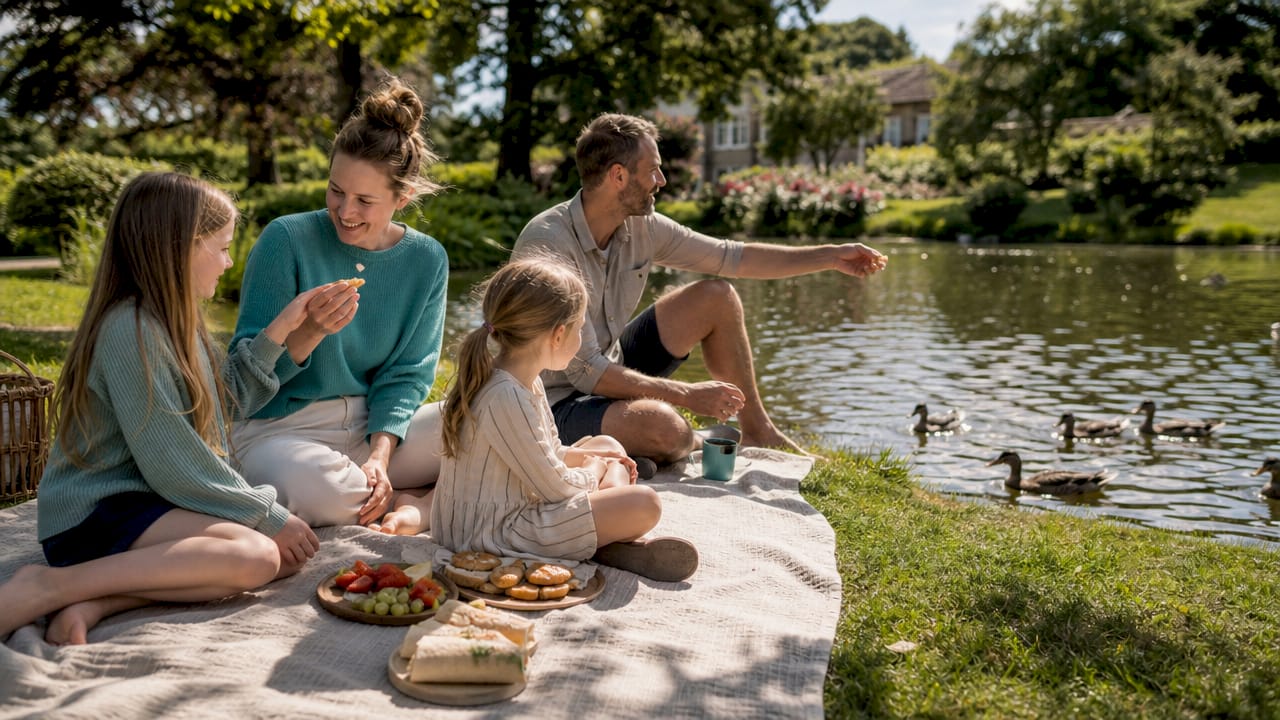
Family activities are defined as practical shared experiences where the whole family actively participates and creates closeness with each other. It's not about sitting in the same room, but about doing something together that creates memories and strengthens relationships. Shared experiences create presence It brings families closer together, whether the activity costs money or is free. Family activities' significance lies not in the size of the experience, but in the quality of the time you spend together. This guide explains exactly what the concept covers, what types exist, and how you plan them so that they actually work.
What do family activities mean for well-being and relationships?
Family activities strengthen relationships by giving the family time for interaction without the everyday distractions of work, screens, and logistics. Shared moments create memories, which binds families in the long term and provides a common reference point that everyone can return to. Those are the kinds of memories children remember as adults, and that adults remember as the best moments.
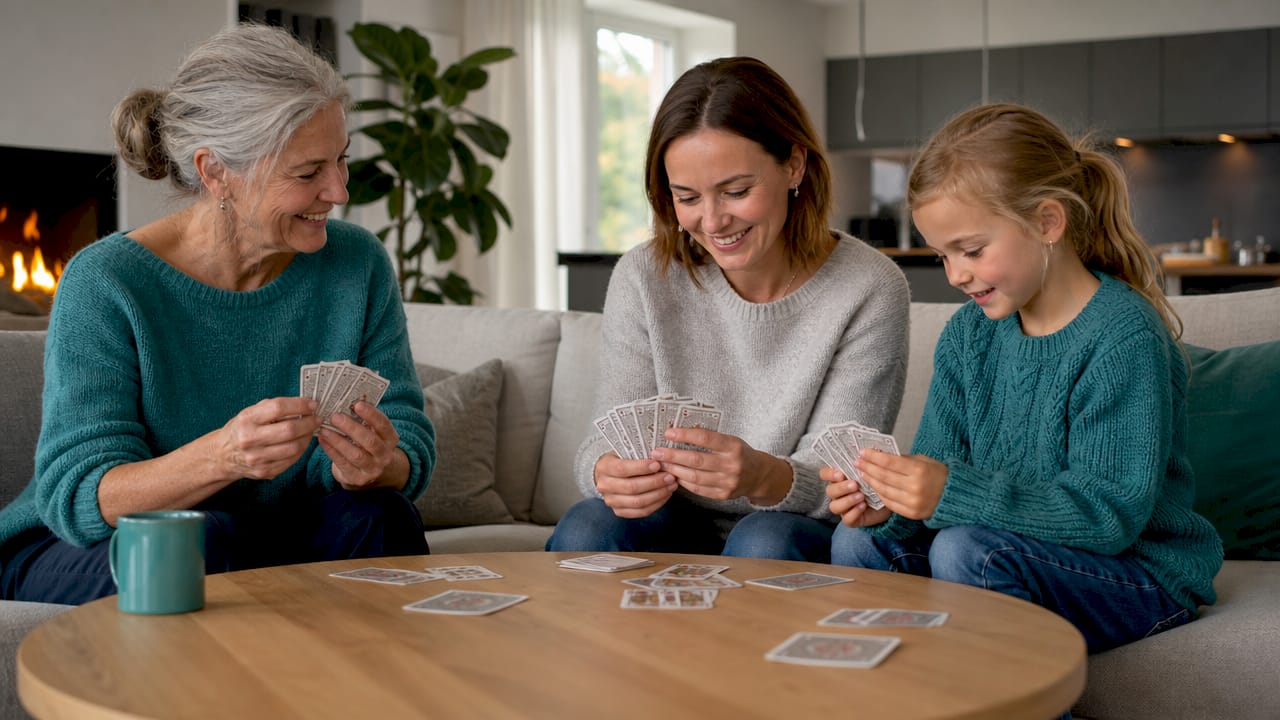
The activities also serve as a break from everyday stress. When the family gathers around a specific task or experience, the focus shifts from individual concerns to the collective. It is not a random effect. Shared activities reduce stress by creating space for presence and conversation, which rarely occur spontaneously in a busy week.
ROCKWOOL Foundation has investigated young people's well-being and concludes that psychological basic needs such as autonomyCompetence and attachment are crucial for whether young people thrive in the family. That means family activities are not just about coziness. They are a tool to fulfill the needs that all people, especially children and young people, require to be met.
The value of family activities often lies more in the atmosphere and togetherness than in the size or cost of the activity. This realization changes how one should think about planning: it is not the great adventure, but the present moment that matters.
The specific benefits of regular family activities include:
- Stronger emotional bonds between parents and children
- Better communication and understanding across generations
- Increased self-esteem in children who experience contributing and mastering something
- Shared memories and stories that give the family a common identity
- Reduced stress and more calm in everyday life for all family members
What types of family activities are there, and how do you choose?
Types of family activities naturally fall into four categories: creative, active, cozy, and nature-based. Each category appeals to different temperaments and age groups, and the best approach is to rotate between them so that all family members regularly experience something they find meaningful.
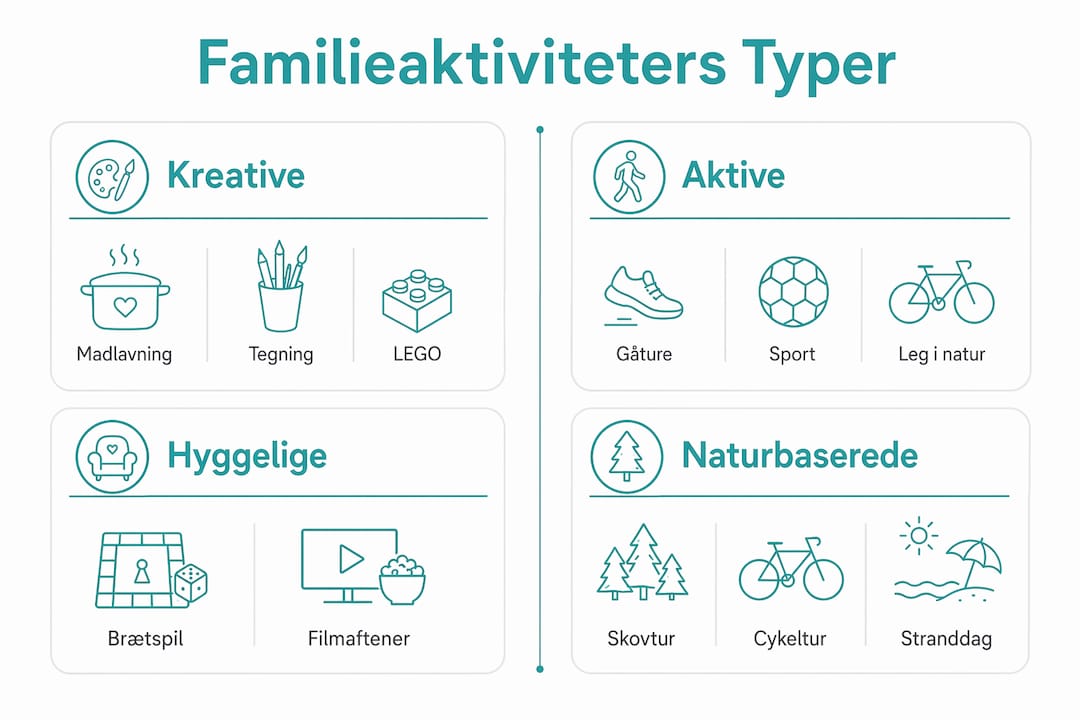
Creative activities Cooking together, drawing, building with LEGO, or making a photo album engage hands and imagination. They are especially good on rainy days and function as family activities at homethat does not require transportation or a budget. Active activities Some bike rides, swimming, ball games, or hikes in nature provide movement and fresh air, and they are easy to scale to different physical levels. Enjoyable activities Playing board games, movie nights with popcorn, or shared reading create calm and closeness. Nature-based activities Some bonfire evenings, birdwatching, or visits to the beach give the family a shared experience of something greater than everyday life.
| Activity type | Examples | Best for |
|---|---|---|
| Creative | Cooking, drawing, LEGO | Rainy weather, all ages |
| Active | Bike ride, hiking, ball games | Good weather, energy |
| Nice | Board games, movie night, reading | Later, ro |
| Nature-based | Eve of the ball, beach, birdwatching | Weekender, seasons |
The choice of activity should be based on what includes all family members. An activity that is perfect for a ten-year-old can feel exclusionary for a teenager or a two-year-old. The solution is not to find one activity that everyone loves, but to give everyone a meaningful role in the chosen activity.
Professional tip: Let the children take turns choosing the week's family activity. It gives them ownership and significantly increases engagement because they have invested in the decision.
How to plan family activities effectively?
Planning family activities is a logistics task, and it should be treated as such. God planning takes stress levels into accountWeather, task distribution, and a realistic budget, so that the experience does not collapse under practical problems. The most common mistake is planning too much and ending up with a stressed family that is more exhausted than before the activity.
Follow this order when planning:
- Choose the right week. Find a week with low stress levels and maximum energy in the family. An activity planned in the middle of a busy workweek with many deadlines rarely ends well.
- Check the calendar and the weather. Pay attention to special events, school activities, and the weather forecast. The weather is not a detail. It is a crucial factor for outdoor activities.
- Create a realistic budget. Decide in advance how much the activity may cost, and stick to it. Many of the best family activities are free or inexpensive.
- Divide the tasks. Let everyone contribute to the preparation. I pack the backpacks, another plans the route, a third is responsible for snacks. It creates a sense of community even before the activity begins.
- Make a Plan A and a Plan B. Write both plans visibly down for all family members If the weather fails or someone gets sick, there is no panic because the alternative has already been decided.
| Planning stage | What you do | Why it works |
|---|---|---|
| Choose the right week | Find the lav-stress period | My surplus provides better presence |
| Check the weather and calendar | Open the weather forecast actively | Avoids disappointments and cancellations |
| Set budget | Decide the maximum amount in advance | Removes conflicts along the way |
| Distribute tasks | Give everyone a role | Creates engagement and ownership |
| Plan A and Plan B | Write both down visibly | Reduces decision fatigue |
Professional tip: Limit yourselves to 2 to 3 core activities per. Day and building breaks are included in the plan. A busy day with too many activities causes stress instead of presence.
Communication is the element most families underestimate. Talk about the activity in advance, what you expect, and what happens if something doesn't go as planned. Family members who communicate about plans experience fewer conflicts along the way and greater joy in the activity itself.
How do you adapt activities for different age groups?
Activities for the family work best when all participants have a role that suits their age and abilities. Differentiated roles and challenges ensures that a five-year-old and a fifteen-year-old can both participate in the same activity without anyone getting bored or overwhelmed. It requires a bit of creativity, but it's not difficult.
A concrete example: A family trip in the forest can assign the little one the task of finding three different types of leaves, the older child can navigate with a map, and the parents can be responsible for the lunchbox and safety. Everyone contributes, everyone masters something, and no one sits passively on the sidelines.
Community does not arise automatically in open, unstructured activities Danish Educational Journal emphasizes that adult leadership and framing are necessary to ensure that all children are socially included. This is especially true in groups with a wide age range, where the oldest children can naturally tend to dominate.
Practical tips for adapting activities:
- Give teenagers responsibility instead of instructions. He thrives on leading rather than being led.
- Create shorter versions of activities for the little ones. A 20-minute walk is better than a two-hour one that ends in tears.
- Small microadventures: short, local experiences close to home that don't require much planning. An evening bonfire in the garden, a visit to the local museum, or a bike ride to a new playground fully counts.
- Ask all family members afterward what they liked the most. It provides data for the next activity and shows that every vote counts.
- Be flexible with the timeframe. Children under six rarely have the energy for activities lasting more than an hour and a half without a break.
Family gathering ideas don't need to be ambitious to be effective. A shared Sunday morning breakfast, where everyone helps with the cooking, is a family activity. The crucial thing is that everyone is present and actively contributing.
My experience with family activities and what really works
I have followed many families who plan activities with the best intentions and end up with a stressful day because they have planned too much and forgotten to listen to what the family actually needs. It is the most common pitfall, and it is easy to avoid.
What I have learned is that the activities that are remembered best are rarely the most expensive or most ambitious. That evening, you made pizza from scratch and everyone got flour on their noses. That was the bike ride that ended with an unplanned ice cream at the harbor. The atmosphere and presence always surpass the destination.
Overplanning is dangerous, but passivity is just as harmful. Family members who never plan joint activities gradually lose the common language and references that hold a family together. It happens quietly and peacefully, and it is only felt when the distance has already arisen.
The advice is to start small and do it regularly. A quick weekly family activity, even a short one, yields more in the long run than a big event once a year. Continuity is more important than size. And remember: it is not the activity that creates camaraderie. It is the attention and presence you bring with you.
Bridge Rejsidanmark's Family Guide to find inspiration for specific experiences in Denmark that suit your family.
— Tommy
Find family activities in Denmark with Rejsidanmark
Rejsidanmark is built for families who want to experience Denmark together and need concrete inspiration rather than general advice. On the side, you will find activities filtered by age, season, and price, so you can quickly find something that suits your family. Whether you're looking for activities for all ages or planning a full day trip, Rejsidanmark provides you with the overview you need. Start with Rejsidanmark's guide to Denmark, who gathers the best experiences and practical planning tips in one place. It is the easiest starting point for families who want to create good memories without spending unnecessarily many hours on research.
FAQ
What is the definition of family activities?
Family activities are practical shared experiences where the whole family actively participates and creates closeness with each other. The crucial thing is active participation, not just being in the same room.
Why are family activities important for children?
Family activities fulfill children's psychological basic needs for autonomy, competence, and relatedness, which ROCKWOOL Foundation identifies as central to well-being. Regular shared experiences also strengthen children's self-esteem and communication skills.
What are good examples of family activities at home?
Cooking together, board games, drawing, LEGO, and movie nights are all great examples of family activities at home. It requires no budget and can be adapted to all age groups with differentiated roles.
How to plan family activities without stress?
Choose a week with low stress levels, limit yourself to 2 to 3 activities per week. Hi, and always make a Plan B for bad weather or illness. Divide the tasks in the family so that everyone contributes to the preparation.
Can family activities be adapted for teenagers and young children at the same time?
Yes, by providing differentiated roles and challenges within the same activity, both teenagers and young children can participate meaningfully. Teenagers thrive with responsibility and leadership, while the younger ones need shorter time frames and concrete, manageable tasks.
Recommendation
- Seasonal Activities: Experiences for the Whole Family – Travel in Denmark
- Why Choose Family Vacation – Togetherness and Experiences – Travel in Denmark
- 7 inspiring examples of outdoor activities for families – Travel in Denmark
- Benefits of Family Experiences – Strengthen Togetherness and Learning – Travel in Denmark