TL;DR:
- Outdoor activities improve Danes' mental and physical well-being through stress reduction, strengthened immune system, and cognitive recovery. They strengthen social bonds, promote inclusion, and are accessible to all age groups through nature and local activities. Regular nature contact of at least two hours a week is a simple, democratic health strategy with strong evidence.
Outdoor activities are defined as planned or spontaneous physical activities outdoors in natural environments, and they play a crucial role in both mental and physical well-being in Denmark. Research shows that just weekly nature contact with timers Increases well-being regardless of age and income. Initiatives such as outdoor school activities in primary schools and nature training organized by the Rheumatism Association demonstrate that outdoor movement strengthens the body, sharpens the mind, and builds stronger social communities. Denmark, with its forests, coasts, and nature parks, provides ideal conditions to make outdoor activities a regular part of everyday life.
What health benefits do outdoor activities provide?
Outdoor activities in nature provide documented physical and mental health benefits that indoor training rarely can match. The effects range from hormonal changes to improved immune defense and cognitive function.
Stress reduction and hormonal balance
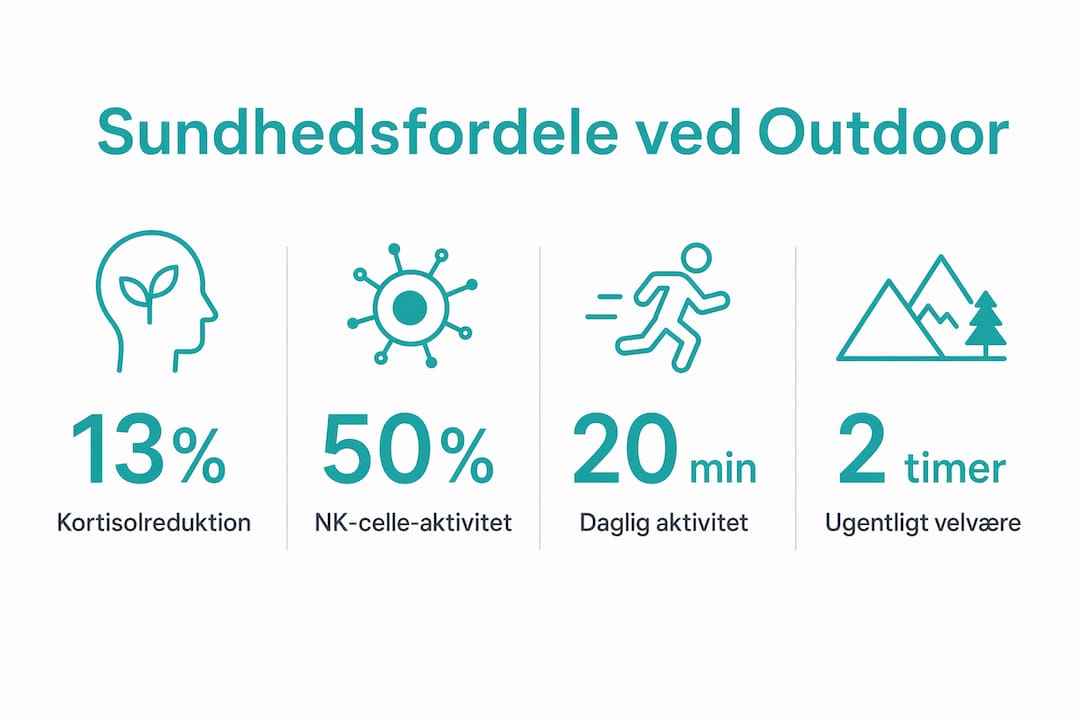
The stress hormone cortisol decreases with up to 13% after just 20 minutes in nature. It means that a short walk in the forest after work has a measurable biological effect on the body's stress level. Forest bathing, which is the Japanese practice Forest bathing In the Danish context, it is a conscious and slow presence in nature with a focus on sensory impressions. The method requires you to walk slowly, keep the phone in your bag, and actively sense your surroundings. It is not exercise in the traditional sense. It is the recovery of the nervous system.
Immune system and long-term effects
The immune system's NK cells, which are the natural killer cells that fight infections and cancer cells, increase by up to 50% after a whole day in nature, and the effect lasts for up to 30 days. It is a remarkable long-term effect that makes a single weekend stay in nature more than just recreation. It is preventive health.
Mental clarity and cognitive function
Attention restoration theory explains why a stay in nature improves cognitive resources and reduces stress. The theory describes that natural environments require a gentle, effortless attention that allows the brain's focused network time to recover. Studies show that cognitive function is improved through this very mechanism. For students, office workers, and everyone who spends many hours on screens, it is a concrete reason to prioritize outdoor breaks.
The most important health effects of regular outdoor activities:
- Reduced cortisol levels and lower stress response
- Strengthened immune system with increased NK cell activity
- Improved focus and problem-solving ability through cognitive restoration
- Improved sleep quality as a result of increased daylight exposure
- Increased production of vitamin D through sun exposure
Professional tip: Combine forest bathing with a short daily walk of at least 20 minutes to achieve measurable cortisol reduction. Let the phone stay at home or in your pocket, and focus on sound, smell, and sight instead.
How do outdoor activities strengthen social relationships in Denmark?
Outdoor activities strengthen social bonds because they create natural settings for socializing without the distractions that characterize indoor environments. A shared movement in nature lowers social barriers and promotes genuine connection.
Udeskole as a social catalyst
Udeskole is implemented in 1 in 5 Danish public schools and increases physical activity and social well-being without harming professionalism. It is a strong argument that education in nature is not a supplement to the proper school. It is an equal learning method. Children who learn outdoors report better relationships with classmates and teachers, and the physical environment provides space for students who struggle in the classroom.
Community and group activities
Outdoor group activities strengthen social bonds and promote well-being in a way that individual training does not. Organized running groups in Fælledparken in Copenhagen, family hikes in Mols Bjerge, and group kayaking along the Limfjord are all examples of how nature functions as a social arena. These activities create shared experiences and memories that strengthen relationships over time.
The social benefits of outdoor activities in community
- Increased trust and cohesion within groups
- Better communication without screen disturbances
- Stronger family relationships through shared experiences
- Integration of new citizens and tourists into local communities
- Increased motivation to continue the activity because the social element maintains engagement
Outdoor activities also play a role in Danish tourism and local settlement. Municipalities such as Silkeborg, Bornholm, and Thy actively promote their natural environments as reasons to move to or visit the area. It's not a coincidence. Nature is a competitive parameter for settlement and tourism, and family-friendly nature experiences is one of the strongest attractive forces.
How are outdoor activities adapted to different target groups?
Outdoor activities are not a one-size-fits-all. Effective natural training and outdoor movement require adaptation to the individual's functional level, age, and health situation.
Children and families
Recommended for outdoor activities for children flexibility, 1 to 2 hours duration and with the bringing of basic necessities such as extra clothing and emergency aid. Children have shorter attention spans and need variation within the activity. A picnic that includes insect hunting, campfire cooking, and a little hike maintains interest better than a long march. Rejsidanmark has gathered together concrete ideas for child-friendly activities In Danish nature, which combines play with learning.
Practical advice for planning outdoor activities with children:
- Choose activities with clear, visible goals such as reaching a specific stone or finding a particular animal.
- Plan breaks with food and drinks every 30 to 45 minutes
- Always bring extra layers of clothing, regardless of the weather forecast.
- Let the children have a say in the route or activity
- Hold the duration for 1 to 2 hours for the youngest and up to 3 hours for school children
Professional tip: Give children a specific task during the trip, such as collecting three different leaves or counting birds. It activates curiosity and keeps them engaged much longer than a simple walk.
People with arthritis and chronic illnesses
Outdoor training improves Quality of life and physical function for people with arthritis, based on a study with over 2,000 participants. Outdoor training keeps participants more engaged than indoor training because it feels like play rather than obligation. Progression should be tailored to the level of function rather than diagnosis, which means that two people with the same diagnosis can have very different starting points and goals. The Arthritis Association recommends focusing on freedom of movement and joy rather than performance.
Elderly and seniors
For the elderly, even surfaces, short distances, and social elements are crucial to making outdoor activities accessible. Organized senior walking clubs in municipalities like Odense and Aarhus show that structured programs significantly increase participation. Nature does not need to be challenging to provide health benefits. A fun walk along a river provides the same cortisol-reducing effects as a more demanding hike.
Which outdoor activities are popular and accessible in Denmark?
Denmark offers a wide range of outdoor activities suitable for all ages, seasons, and fitness levels. Here is an overview of the most accessible options:
| Activity | Season | Target audience | Difficulty level |
|---|---|---|---|
| Hiking | All year round | All | Let to the middle |
| Cycling | Spring to autumn | All | Let to the middle |
| forest bath | All year round | Adults, seniors | Let |
| Kayak sailing | Spring to autumn | Young, adults | Medium to severe |
| Winter swimming | Autumn to spring | Adults | Demanding |
| Climbing | Spring to autumn | Children, youth, adults | Medium to severe |
| Birdwatching | All year round | All | Let |
Denmark has over 11,000 kilometers of marked hiking trails, and the cycling network is among the densest in Europe. It makes active outdoor experiences accessible to almost everyone, regardless of residence. National parks such as Thy, Mols Hills, and the Wadden Sea offer structured nature experiences with guided tours and information centers.
Family-friendly activities in nature are particularly strong in Denmark.
- Natural playgrounds in state forests, operated by the Nature Agency
- Geocaching along coastlines and in forests
- Campfire sites and shelters for overnight stays in nature
- Guided bird and plant walks in nature centers
- Havkajak routes along the Jutland west coast and the South Funen Archipelago
Scenic places in Denmark Like Skagen, Møns Klint, and Rold Forest, outdoor adventures for families that combine nature with cultural history. Seasonal activities such as mushroom picking in the fall and flower tours in the spring give nature a new dimension for those seeking more than just exercise.
How do you get started with outdoor activities in everyday life?
Integrating outdoor activities into everyday life does not require large investments or dramatic lifestyle changes. It requires a plan and realistic expectations.
- Start with the close. Find a park, forest, or coastline within 15 minutes' transport from your home. Accessibility is the most important factor in creating a habit.
- Set a specific weekly goal. Exercising regularly in nature is the documented threshold for health benefits. Divide it into two trips of one hour each if that's easier.
- Prepare yourself for the weather, not against it. Invest in waterproof outerwear and good shoes. Bad weather is rarely a real obstacle with the right equipment.
- Let the phone stay in the pocket. The principles of Skovbadet regarding phone-free and sensory experience apply to all forms of nature stays. Notifications break the cognitive restitution.
- Find a partner or group. The social element significantly increases retention. A running partner, a hiking group, or a family agreement makes it harder to skip.
- Plan seasonal activities in advance. A trip to the coast in May, a mushroom trip in September, and a winter swim in January. Future plans create motivation in the present.
Professional tip: Bridge Activity planning for the spring as a basis for structuring the family's outdoor calendar. Basically, it reduces decision fatigue and increases the likelihood that the trips actually happen.
The most important equipment for beginners is sturdy hiking shoes, a waterproof layer, a water bottle, and a basic first aid kit. You don't need special equipment to get started. Nature does not impose requirements on your gear. It demands your presence.
The role of nature is greater than we think
I have followed Danish outdoor culture for many years, and what surprises me the most is not that people know that nature is good for them. It's that so many still don't use it. We have forests, coasts, and river valleys within reach of most Danes, yet we spend most of our time indoors in front of screens.
My personal turning point came when I started practicing forest bathing regularly. Not as exercise, but as a break. The first times, it almost felt artificial to walk slowly and just feel. But after a few weeks, I started to notice a difference in how I handled stress and decisions. It is difficult to quantify, but it is real.
What I find most interesting about research in the field is that two hours a week in nature is a democratic health strategy. It costs nothing, requires no subscription, and is available regardless of income. It is rare for something so simple to have such strong evidence behind it.
I believe that future Danish health policy will increasingly recognize nature as part of the treatment palette. The work of the Arthritis Association with nature training and outdoor schooling in public schools is the beginning. But the potential is much greater, and it starts with each individual choosing to walk out the door.
— Tommy
Plan your outdoor experiences in Denmark with Rejsidanmark
Rejsidanmark is your guide to finding and planning the best outdoor experiences in Denmark, whether you're looking for family-friendly nature trips, active adventures, or peaceful forest experiences. On Rejsidanmark, you will find detailed descriptions of natural attractions, seasonal activities, and practical tips for all age groups. Use our Complete travel guide to Denmark to help structure your next outdoor experience from start to finish. If you need to get around between nature's pearls, you'll also find one. Guide to local transportation It makes it easy to reach. Nature waits. The planning doesn't need to take a long time.
FAQ
What is the role of outdoor activities for health?
Outdoor activities reduce the stress hormone cortisol by up to 13% after 20 minutes in nature and strengthen the immune system with up to 50% increased NK cells after a full nature stay. They also improve cognitive function and mental well-being through attention restoration theory.
How much time in nature is enough to feel a difference?
Spending time in nature weekly is the documented threshold for increased well-being, and the effect applies regardless of age and income. You can split it into shorter sessions throughout the week.
What is forest bathing, and how is it practiced?
Forest bathing is a conscious and slow presence in nature with a focus on sensory impressions, inspired by the Japanese practice Shinrin-yoku. It requires you to walk slowly, avoid the phone, and actively sense sound, smell, and sight in the surroundings.
Are outdoor activities suitable for children of all ages?
Yes, but the activities should be adapted with short sessions of 1 to 2 hours, clear goals, and bringing extra clothing and provisions. Children thrive best with variety and participation during the trip.
Can people with arthritis engage in outdoor activities?
Research with over 2,000 participants shows that outdoor training improves quality of life and physical function for people with arthritis. Progression should be tailored to the individual’s functional level rather than the diagnosis, and the activity should feel like the joy of movement rather than performance.
Recommendation
- Benefits of Nature Experiences in Denmark: Complete Guide – Travel in Denmark
- How to choose activities in Denmark: The best experiences – Travel in Denmark
- 7 inspiring examples of outdoor activities for families – Travel in Denmark
- Outdoor adventures for young people: Guide to outdoor activities – Travel in Denmark