TL;DR:
- Green experiences are sustainable, nature-based activities that improve both the environment and personal well-being. They include certified attractions such as Green Key and the Swan Label, and can be integrated into Danish trips through conscious choices of transportation, accommodation, and activity types. Choosing green experiences in Denmark creates a lighter, more authentic, and responsible tourism experience.
Green experiences are sustainable, nature-based activities that combine a low climate footprint with documented health benefits for individuals. The term covers everything from a bike ride along the West Coast to a visit to a GREEN ATTRACTION-certified attraction, and it overlaps with the broader industry designation. sustainable tourismResearch from 2026 shows that just 20 minutes of daily nature exposure leads to measurable reduction in the stress hormone cortisol and improved concentration. For those planning trips in Denmark, green experiences are not a niche choice. They are a concrete tool for better well-being and more responsible tourism.
What do green experiences mean, and what is the definition?
Green experiences are defined as activities and travel experiences that actively minimize environmental impact and promote contact with nature. It is the shortest and most precise definition, and it encompasses three core elements: sustainable behavior, nature-based content, and conscious presence. The term is not an official legal term, but is widely used in Danish tourism as a collective term for environmentally friendly and nature-oriented experiences.
The recognized industry term for the same phenomenon is sustainable tourism, which the UN World Tourism Organization defines as tourism that fully considers the current and future economic, social, and environmental impacts. Green experiences are therefore the popular and more concrete variant of this concept, with a particular focus on nature contact and low resource consumption.
In Denmark, GREEN ATTRACTION is the most well-known certification scheme for green attractions. GREEN ATTRACTION brand Still stricter requirements for reduced chemical use, energy savings, water conservation, and waste sorting. This means that as a visitor, you can trust that a certified attraction meets specific environmental standards and does not just market itself with green words.
What benefits do green experiences offer for the environment and yourself?
Green experiences provide benefits on two levels: the personal and the collective. The two levels reinforce each other, and it is precisely this double effect that makes them particularly attractive to conscious travelers.
Health effects you can feel:
- The sensory impressions of nature activate spontaneous attention, calm the nervous system, and reduce the stress hormone cortisol. It happens without active effort on your part. You don't need to meditate or do exercises.
- The white noise of nature, such as the sound of waves and the rustling of the wind creates sensory calm and helps the brain switch to rest mode. It is a neurological reaction, not a placebo effect.
- Active listening to bird songs It significantly increases the physiological and mental benefits of a walk in nature. A study from May 2026 shows that conscious focus on bird sounds provides greater well-being than a similar walk without attention to the surroundings.
- Nature is a necessity for public health, not a luxury. Even potted plants and nature photos can soothe the brain and reduce stress, according to nature psychological research.
Environmental benefits of sustainable choices
- Choosing train, bus, and bicycle over plane and car significantly reduces your personal carbon footprint on domestic travel in Denmark.
- Support for local guides and companies Contributes directly to sustainable local development and ensures that tourist dollars stay within the community.
- Certified attractions with Green Key or the Swan Label reduce overall resource consumption and waste in the tourism sector.
Green experiences are not a sacrifice. They are an upgrade to your travel experience, while also leaving a smaller footprint.
How do green experiences differ from traditional tourist activities?
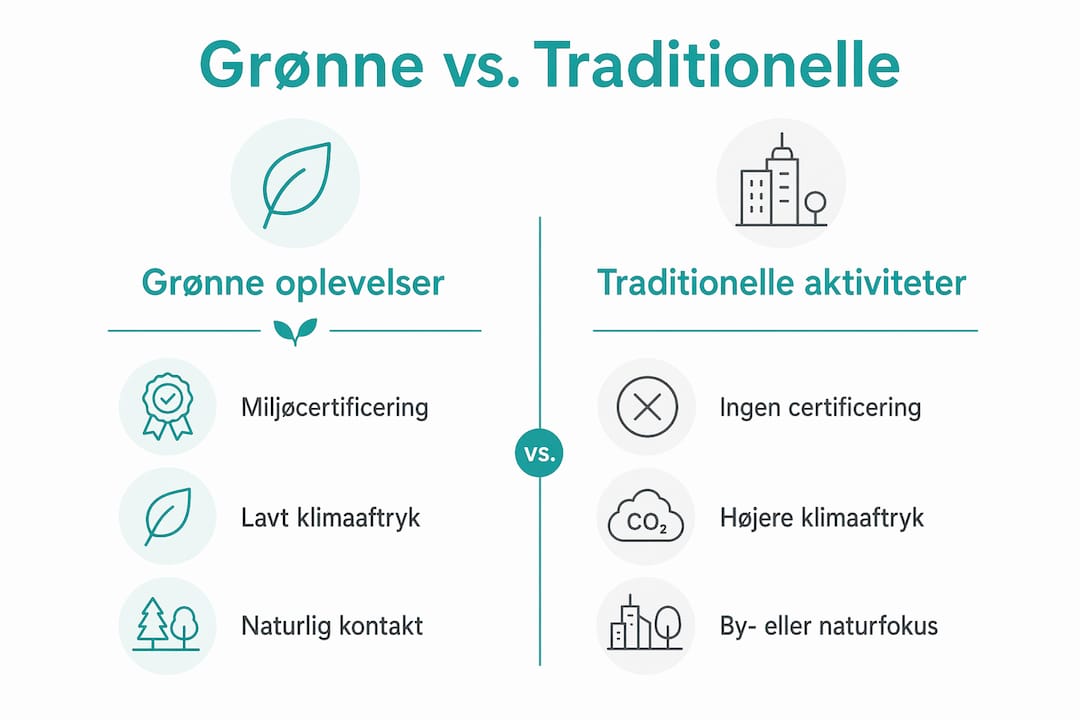
The difference between green experiences and conventional tourist offers is not just about nature versus city. It's about which standards and values govern the experience.
| Criterion | Green experiences | Traditional tourist activities |
|---|---|---|
| Environmental certification | Green Attraction, Green Key, Swan Label | No requirements |
| Transport Focus | Tog, bicycle, bus | Fly, car, tour bus |
| Resource consumption | Actively minimized | Not a prioritized parameter |
| Nature contact | Central element | Optional or absent |
| Local contribution | Prioritized | Variable |
| Authenticity | High, local anchoring | Variable, often standardized |
More Danish attractions Today, they have certifications such as Green Key and the Swan Label, which guarantee sustainable experiences with documented environmental standards. It gives you as a traveler a concrete filter when you plan your trip.
A traditional tourist attraction can certainly be scenic and entertaining. But without certification or a sustainability strategy, there is no guarantee that operations will consider the environment. GREEN ATTRACTION - the label changes it by making the requirements visible and verifiable.
Professional tip: Actively look for the GREEN ATTRACTION logo, the Green Key sign, or the Swan Label when choosing attractions and accommodations in Denmark. The three brands are not marketing. They are documentation.
How can you incorporate green experiences into your travels in Denmark?
Traveling green in Denmark does not require a complete lifestyle change. It requires conscious choices in four specific areas: transportation, accommodation, activities, and presence in nature.
-
Choose green transportation. Tog and bus cover most of Denmark and provide access to natural experiences and local communities that you will never find from the highway. Green transportation such as trains and bicycles reduces the climate footprint and opens up authentic encounters with the Danish landscape. DSB and Arriva connect most major cities and many natural areas directly.
-
Book certified accommodation establishments. Swan-labeled hotels and Green Key campsites are not more expensive than conventional alternatives, but they demonstrate lower energy and water consumption as well as responsible waste management. Booking.com VisitDenmark has both filters for environmentally certified accommodations.
-
Choose activities with a natural focus. Hiking in Thy National Park, kayaking in the Little Belt, or cycling tours on Bornholm are examples of green activities that do not require large resources and provide direct contact with the Danish natural environment. Free nature experiences are often the most memorable because they are not wrapped in commercial frameworks.
-
Support locals. Buy food at local markets, use local guides, and choose locally owned restaurants over chains. Support for local businesses directly contributes to sustainable development and gives your journey an authenticity that no tourist package can replicate.
-
Practice active presence in nature. Turn off the phone for at least 20 minutes daily when you're out in nature. Cognitive restitution occurs most effectively when you choose a passive and sensory state without the requirement to perform or decide. Listen to the birds, feel the wind, and let your eyes rest on the horizon.
Professional tip: You don't need to find diverse or untouched nature to get the full benefit. Focusing on local natural elements such as bird song in a nearby city park is sufficient to activate the brain's recovery mechanisms.
Examples of green experiences and destinations in Denmark
Denmark offers a wide range of green experiences, from the coastal nature in the west to the forests on Zealand and the cliffs on Bornholm. Here are concrete examples categorized by type:
Nature-based experiences
- Hiking in Thy National Park on Jutland's west coast, Denmark's first national park, with dunes, heaths, and a coastline without commercial buildings.
- Kayaking in the South Funen Archipelago, one of Northern Europe's most intact coastal ecosystems with over 55 islands.
- Cycling routes on Bornholm, including the 105-kilometer-long Bornholm Rundt, which combines coastal scenery, forests, and cultural history.
- Birdwatching in Wadden Sea National Park, a UNESCO World Heritage Site and home to millions of migratory birds every spring and autumn.
Certified attractions:
- The Natural History Museum in Aarhus has actively worked with sustainability standards and nature communication.
- Ree Park Safari near Ebeltoft is an example of an attraction focused on nature education and the preservation of endangered species.
- Many of Denmark's holiday parks Currently working on Green Key certification and offering nature-based activities as part of the stay.
Sustainable events and activities
- Nature guiding tours organized by the Danish Outdoor Council and local nature centers around the country.
- Outdoor festivals like Outdoor Festival Denmark that combine outdoor activities with a focus on sustainability and low resource consumption.
- Water damage at the many Blue Flag beaches along the Danish coast, where water quality and environmental considerations are documented.
What these experiences have in common is that they either carry a certification, are rooted in the natural environment, or actively contribute to local sustainable development. That is exactly what green experiences mean in practice.
Green experiences changed the way I travel
I have traveled around Denmark for many years and written about experiences from Skagen to Møns Klint. But it was only when I consciously started prioritizing green experiences that I understood what I had previously missed.
The biggest change was not the environment. It was myself. Since I started turning off my phone during hikes and actively listening to my surroundings, I noticed a difference within a few days. Not as an abstract feeling, but as concrete lower shoulder tension and better sleep. It's not self-help talk. That's what the research says, and that's what I experienced.
What I find most surprising is that you don't need magnificent nature to get the effect. A walk in Dyrehaven north of Copenhagen focusing on bird song provides the same neurological restoration as a walk in Thy National Park. It's not about where you are. It's about how you are present.
A piece of advice for you who want to start: begin with one conscious choice per trip. Take the train instead of the car to your next destination. Book a Svanemærket accommodation. Put the phone in the bag for 30 minutes while you walk. The small choices accumulate into a travel style that is better for you and for the places you visit. And you will discover that green experiences are not a limitation. They are a sharper lens through which to see Denmark.
— Tommy
Plan your next green trip in Denmark with Rejsidanmark
Rejsidanmark gathers the best green and sustainable experiences in Denmark in one place, so you don't have to spend hours finding certified attractions and nature-based activities. Whether you are a first-time guest or familiar with the country, it gives Rejsidanmark's guide to Denmark Create a solid foundation for planning a low-carbon footprint and high-nature-content trip. If you want to go directly to the sustainable options, you will find concrete advice and certified experiences in the guide to sustainable holidays. Use the filters on Rejsidanmark to sort by season, price, and age group, and find the green experience that exactly matches your next trip.
FAQ
What is the definition of green experiences?
Green experiences are sustainable, nature-based activities that minimize environmental impact and promote personal well-being through contact with nature. The term is used in Danish tourism as the popular variant of the broader industry designation. sustainable tourism.
Which certifications guarantee green experiences in Denmark?
GREEN ATTRACTION, Green Key, and the Swan Label are the three most widespread certifications for green attractions and accommodations in Denmark. GREEN ATTRACTION still has specific requirements for reduced chemical use, energy savings, water conservation, and waste sorting.
How much time in nature is enough to feel an effect?
20 minutes of daily nature exposure provides measurable health effects such as stress reduction and improved concentration, according to nature psychological research from 2026. The effect is significantly enhanced if you actively listen to bird songs and leave your phone in your pocket.
Are green experiences more expensive than traditional tourist activities?
Many green experiences such as hiking, cycling, and sea bathing are free or inexpensive. Certified accommodations are not systematically more expensive than conventional alternatives, and green transportation such as trains is often cheaper than cars for domestic travel in Denmark.
Can you find green experiences in Danish cities?
Yes. Local parks, harbor baths, and nature guiding tours in the green areas of the cities count as green experiences. Research shows that focusing on local natural elements such as bird song in an urban park is sufficient to activate the brain's recovery mechanisms, whether you are in the center of Copenhagen or in the countryside.
Recommendation
- Experiences for nature lovers: 7 places in Denmark 2026 – Travel in Denmark
- Discover the great benefits of traveling locally in Denmark – Travel in Denmark
- Benefits of Nature Experiences in Denmark: Complete Guide – Travel in Denmark
- What are seasonal experiences in Denmark? Guide 2026 – Travel in Denmark