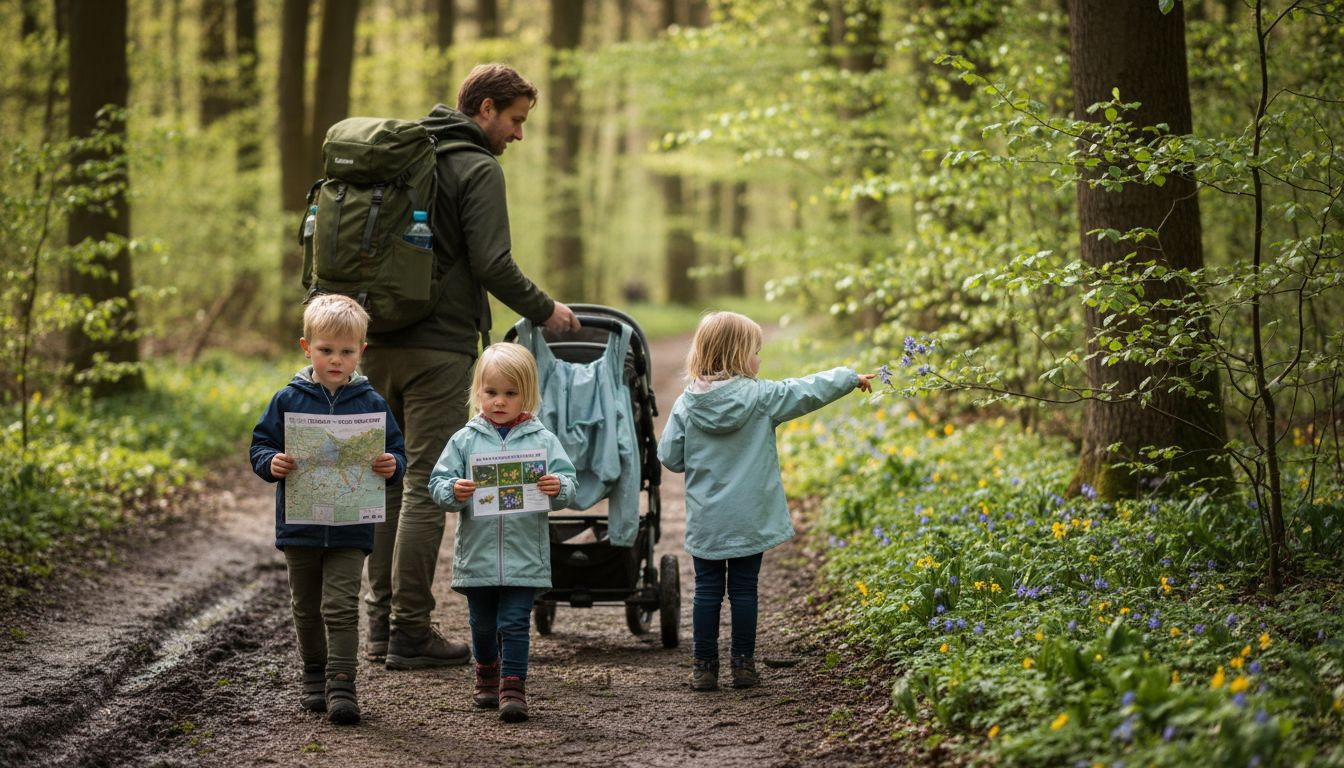
Whenever the holidays approach, many Danish families with children face the challenge of organizing activities that both engage and create shared memories. Experience routes in Denmark combine nature, culture, and gastronomy, so that the family's holiday is not just filled with random stops, but a meaningful journey where everyone can participate. With the government's 20 million kroner allocated for the development of cohesive experience routes Are there now even more inspiring and manageable opportunities to discover Denmark together without stress over planning.
Experience Routes in Denmark – The Core Concept Unfolded
Experience routes are not just randomly chosen places on a map. They are curated travel experiences that connect nature, cultural heritage, art experiences, local stories, and food culture into meaningful holistic experiences. For families with children, it means that you can follow a planned route where each destination complements the next, instead of having to assemble your itinerary from scratch.
Denmark has given significant economic priority to this type of tourism development. The government has allocated 20 million kroner to develop and market coherent experience routes across the entire country. This investment aims to ensure that tourists from abroad and Danish families can more easily discover Denmark's unique attractions without having to go away themselves in the planning process. The purpose of the routes is to create attractions that simultaneously contribute to local development and growth in smaller towns and areas outside the major tourist centers.
For families with children, it specifically means that the curriculum includes elements such as outdoor activities, culture, and gastronomy combined in a way that keeps the whole family interested. Instead of driving between random attractions, you can follow a common thread – maybe start at a nature playground, continue to a local arts and crafts center, have lunch at a farm with child-friendly facilities, and end the day at a cultural and historical site that tells Denmark's local stories in an accessible way. The development of routes is carried out in close cooperation with cultural institutions, local business actors, and digital infrastructure, so that the information is easy to find and plan around.
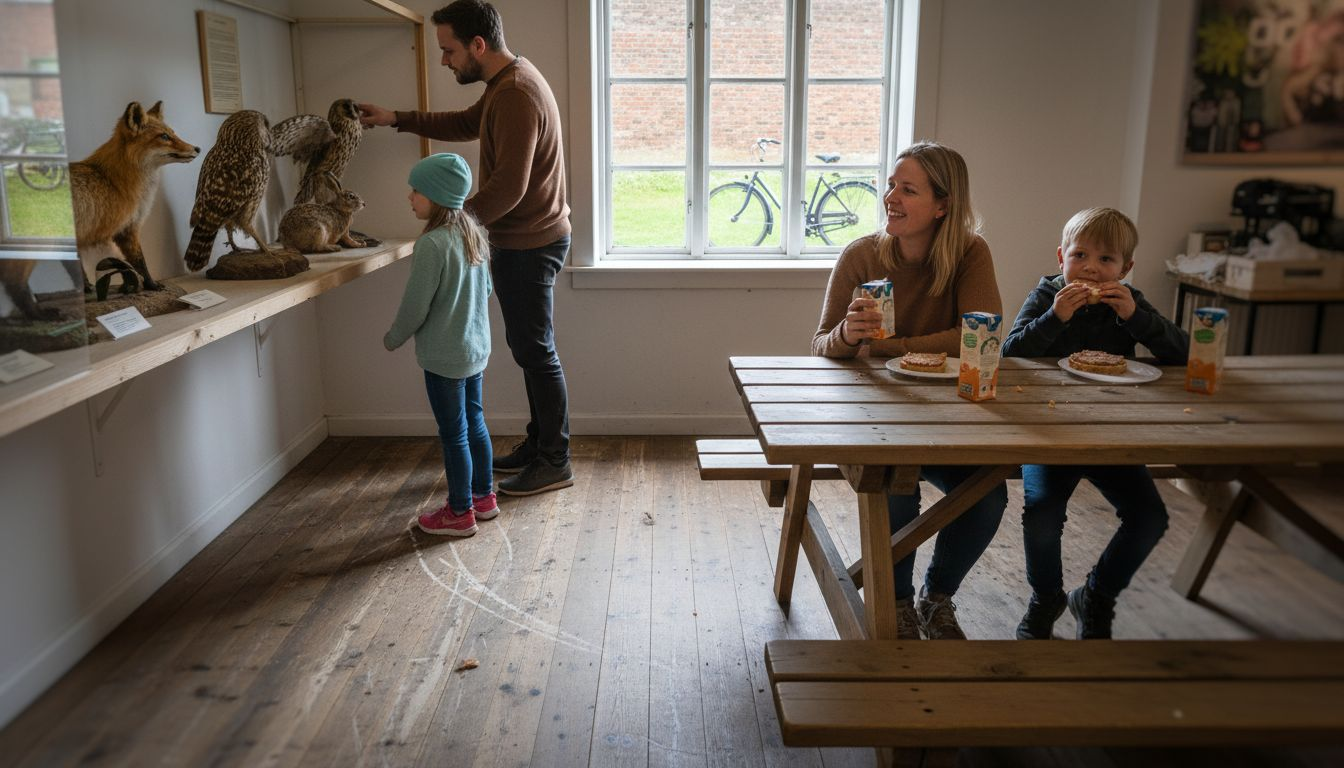
The core of the experience route concept is that they are based on context rather than isolated attractions. Each route tells a story about the area you travel through – it could be the history of Denmark's Viking Age, its artistic heritage, its melting pot of culinary cultures, or its unique natural landscapes. For families with children, this approach means that you get a meaningful travel framework where children can learn something, experience something authentic, and create memories that are connected within a larger context.
Professional advice When planning your family trip, look for routes that offer child-friendly attractions at each stage – so you avoid both frustration and unnecessary vehicles between destinations.
Different Types and Thematizations of Experience Routes
Experience routes come in many different forms, and the most important thing for you as a family with children is to find the types that suit your interests and your child's age. The theming of the gears is the key to this variability. A route can focus on geology and natural sciences, another can be entirely about art history, gastronomy, or adventure. By choosing a route with a theme that appeals to your family, you ensure that the experience will be both educational and fun for the entire children’s group.
The classic example of thematization is Geopark experience routes, where round trips build around the history of the soil layers and the formation of the landscape. Such routes combine geology, culture, and nature in a way that makes the abstract concrete. For families with children, it means that you can hike and at the same time learn how Denmark's landscape was shaped over millions of years. These routes are typically offered in several variants – short family-friendly loops of under an hour, longer day hikes for families with teenagers, and bike rides for those who prefer to move faster through the area.
In addition to geological routes, you will also find the following themes:
Below is an overview of typical route themes and the learning focus they offer to families with children:
| Schedule | Main focus of learning | Typical activity |
|---|---|---|
| Geology & Nature | Understanding of landscapes | Exploration of stones/cliffs |
| History | Insight into the past | Visits to castles and burial mounds |
| Art & Design | Creative inspiration | Round art workshops |
| Gastronomy | Experience through taste | Taste local raw materials |
| Nature & fauna | Attention to biodiversity | Bird and insect observation |
| Adventure | Fantasy and stories | Treasure hunts and theater traces |
- Historical routesFollow prehistoric paths, Viking family trade routes, or medieval castle fortifications
- Artist study squaresVisit artist towns, design workshops, and galleries on the same trip
- Gastronomy routesGuide you through local farm shops, producers' workshops, and restaurants with child-friendly dishes
- Naturalist routesFocus on fauna, flora, and biodiversity with opportunities for birdwatching and insect hunting
- Fairy tale and legend routesTells small and big stories from Danish folklore and literature
The difficulty level also varies significantly. Some routes are specifically designed for small children with play, short distances, and strollers on asphalt. Andre routes require good physical condition and are better suited for older children or families who love to challenge themselves. The length can range from 2 kilometers to over 30 kilometers depending on the purpose of the route.
The important thing is that each route tells a coherent story about the area you are exploring. Instead of seeing attraction A, then coincidentally attraction B, everything is connected by a common thread. It means that children get a context for what they see, and the experience becomes more meaningful and easier to remember.
Travel tip Before choosing a route, check the length, difficulty level, and age restrictions in advance – and remember that families with children move at a slower pace than the times indicated for adults.
How to Plan a Family-Friendly Experience Route
Planning a family-friendly experience route is primarily about understanding your family's needs, energy levels, and interests. Start by asking yourselves: how old are the children, what interests them, and how many hours can they stay focused without getting tired or bored? A route designed for 4-year-olds looks completely different from a route for 12-year-olds. Small children need frequent breaks, play, and varied activities, while older children can handle longer distances and more patient exploration.
The next step is to examine the practical aspects of the route. Planning a trip to Denmark requires that you know where you start, where you end, where the toilets and breaks are located, and whether there are places to buy food and drinks. Family households need parking, childcare equipment, and information on whether strollers or scooters can be used along the entire route. Check the weather – a 10-kilometer route in the sun is completely different from the same route in heavy rain.
Then choose the route's theme based on your children's interests. If they love adventures, choose an adventure and legends route. If they are birdwatchers in the mirror, choose a naturalistic route. Plan breaks and activities at each stop – not just to finish, but so that the children experience and learn something. Bring small gifts or activities for downturn periods.
Practical planning steps:
- Choose the route's length and difficulty level Based on the children's age and condition
- Plan the timeline with 30 percent more time than the guidance indicates
- Facility controller some toilets, breaks, playgrounds, and dining places
- Mentally prepare the children by telling them what to experience and see
- Pak Smart with snacks, water, first aid, and entertainment for waiting times
- Build flexibility in So you can shorten or extend the route as needed
Remember, it's not about covering the entire route. A good family day is about creating memories together, not about being stressed about reaching the finish line. If the children think it's fun after half the route, it's a big difference to stop there and continue another day.
Practical advice Download offline maps and pictures of the sights before you go so the children can spot things themselves and become more engaged in the experience.
Benefits for Danish Families with Children from Experience Routes
Experience routes provide Danish family households with valuable benefits that go far beyond just passing the time on vacation. They create frameworks for meaningful experiences where the whole family gets involved and learns something new together. Instead of passive entertainment, you become active participants in discovering your own country.
The most important thing for the children is that Experience routes promote learning and physical activity in a natural, fun way When you walk a historical route, children learn about Denmark's past by seeing things with their own eyes. They spot birds on a naturalist route, they learn about the formation of the Earth on a geological route, they meet artists and their works in artist towns. It is learning that sticks because it is connected to sensory experiences and adventures.
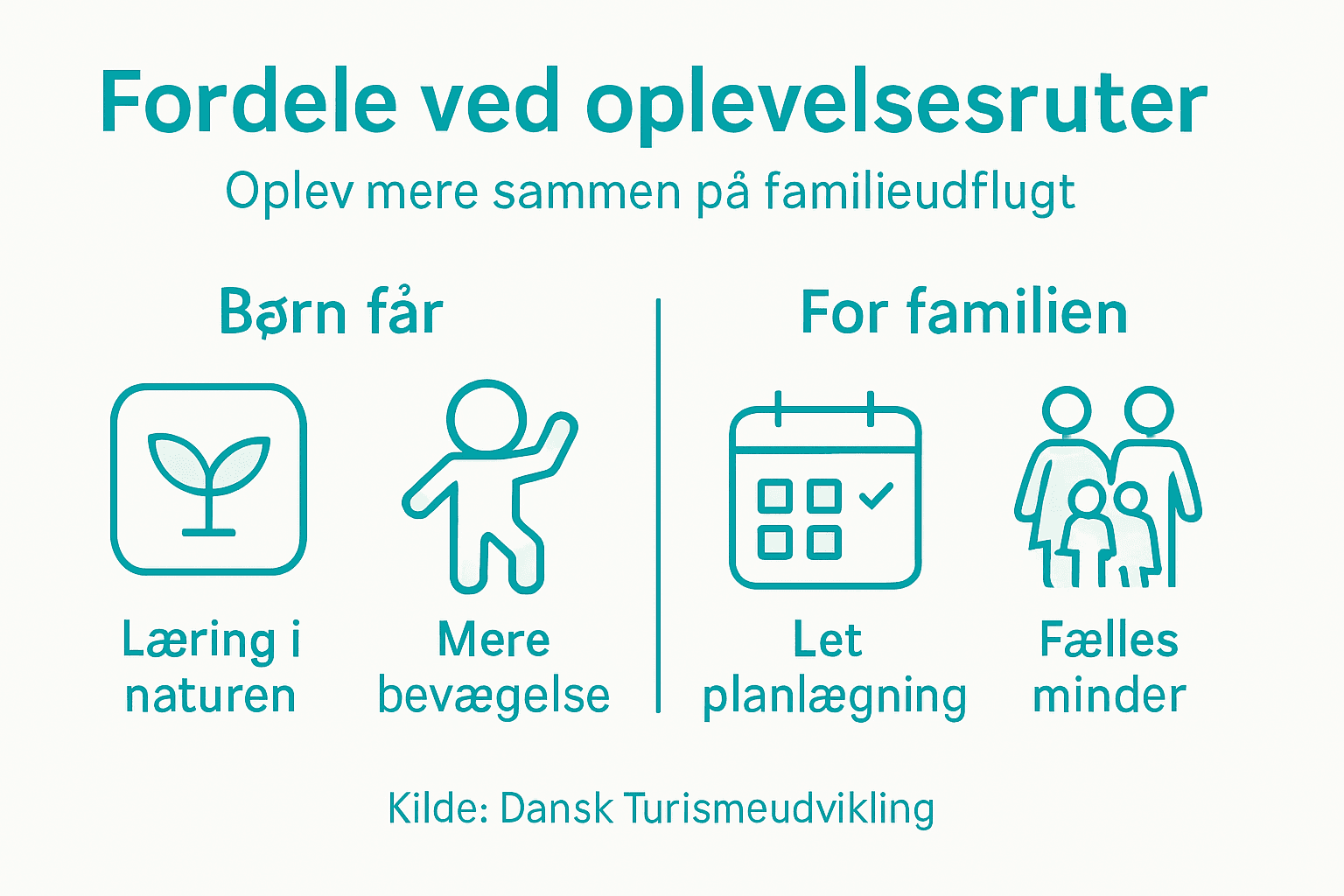
The families also receive concrete practical benefits. The structure of the routines means that you don't have to spend hours planning every detail yourself. Everything is arranged, distances are estimated, and you know what to expect. It significantly reduces stress. Additionally, the routes are typically designed to be safe and child-friendly, with rest stops, toilets, and facilities at appropriate locations. I am wandering around desperately searching for a toilet.
The table provides a quick comparison overview of family benefits before and after the introduction of Danish experience routes.
| Previous family outings | With the experience route system |
|---|---|
| Lack of a clear thread | Coherent course |
| Spontaneous planning | Time-saving preparation |
| Often logistical challenges | Coordinated stops and facilities |
| Learning was random | Planned learning content |
| Children quickly became disengaged | Activities aimed at children |
Psychological and socially, the experience routes mean the following for your family:
- Strengthened solidarityWe spend quality time together without electronics and school trips.
- New perspectivesThe children develop a relationship with Denmark and their cultural heritage in a lively way
- Unforgettable experiencesShared adventures and challenges create bonds that last a lifetime
- Effects of natureFresh air, movement, and contact with nature benefit both mental and physical health.
- Economic advantage locallyYour spending on experience routes supports small businesses and local communities you visit.
Danish tourism development focuses on sustainability, which means that the routes not only benefit your family but also the environment. It helps to spread tourism so that smaller destinations also receive tourist revenue and development, and larger areas are not overwhelmed.
Family tip Choose a route that combines something you already love as a family with something new – so it becomes both safe and exciting for everyone.
Typical Challenges and Practical Tips for Use
Although experience routes are designed to make family outings easier, you still encounter some practical challenges, which it is good to be prepared for. The most important challenge is navigation and orientation. Although the purpose of the routes is to be easy to follow, the signage can sometimes be poorly marked, or you may lose your bearings along the way. Poor signaling means that you spend time searching on your phone instead of enjoying the experience.
Another challenge is availabilityNot all routes are equally suitable to be friendly for families with small children in strollers, or for children with different abilities. Digital infrastructure improves navigation on the routes and make it easier to check practical details before departure. Make an effort to search online for the actual condition of the route before you leave.
The third challenge is the weather and the seasons. A route that is wonderful in June can be a muddy swamp in March. Some routes are closed or become unsafe due to the weather. The fourth challenge is congestion on popular routes. If you meet many other families on the same little route, the experience becomes less magical and more like a theme park.
Practical tips for handling these challenges:
- Check the directions in advanceCheck online whether the route has a good reputation for signaling, or look up reviews from other families.
- Download offline cardIf the signal is poor in the countryside, download the map on your phone before you set off.
- Call the landlordMany routes are operated by local actors such as tourism agencies. A call can provide you with important practical information about the condition, opening hours, and family-friendly details.
- Choose less popular timesGo on weekdays, especially in winter, if you want to avoid other people.
- Adjust the route to your needsYou don't need to follow the entire route. You can take a shorter version or split it up over several days.
- Invest in good equipmentGood hiking boots, rain gear, and a structured backpack make a big difference
A lasting challenge for families with children is also boredom or boredom. Small children may be uninterested in walking 8 kilometers without a particular reason. Solve it by planning interesting activities or games along the way. Give the children a task, such as finding bird species on a list, or playing Pokémon Go while you walk.
Practical advice Contact the route administrator or the local tourism office the day before if the weather looks bad, to avoid unnecessary trips and frustration.
Experience Denmark Together With Your Family and Get It All
Are you looking for an easy and straightforward way to plan your next family adventure? The article shows how experience routes ensure coherence and meaningful frameworks for families with children, but planning can quickly become a challenge when you need to match the children's age, interests, and energy levels. On Travel in Denmark We have just made this task easier for you by gathering a wealth of attractions and activities that are perfect for families.
Our platform helps you find family-friendly experience routes and destinations that offer both learning and play in one. With our card-based search, you can filter for child-friendly experiences by age and theme, so you get the route that best matches your wishes. Avoid stress and uncertainty – start your travel planning with us and create lasting memories with peace of mind. Find experience routes where the whole family can join, and make your next holiday magical and hassle-free.
Take the first step towards easier and more fun planning and find your next experience in Denmark at Rejs i Danmark today.
Frequently Asked Questions
What are experience routes, and how do they work for families with children?
Experience routes are curated travel itineraries that combine nature, culture, art, local stories, and food culture into meaningful holistic experiences for families with children. They ensure that families can follow a planned route, where each destination complements the next, making it easier to explore without having to plan the route from scratch.
What types of experience routes are available that are suitable for children?
There are various themes for experience routes, such as geology, historical routes, art and design, gastronomy, nature and fauna, as well as adventures and legends. These routes focus on different learning objectives and include activities tailored to children's interests at various ages.
How can I plan a family-friendly experience route?
Planning a family-friendly experience route requires taking into account the children's ages, interests, and energy levels. It is important to choose routes with appropriate length and difficulty, as well as to ensure there are breaks and activities at each stop.
What are the benefits of choosing experience routes for Danish family families?
Experience routes give families the opportunity to learn and be physically active in a fun way. They promote learning through sensory experiences, reduce planning stress, and create meaningful memories that strengthen family bonds.
Recommendation
- What Does Adventure Travel Mean for Family Children in Denmark – Travel in Denmark
- The role of child-friendly experiences – The value and development of holidays – Travel in Denmark
- Why Experience Children's Denmark – Memorable Family Time – Travel in Denmark
- Benefits of family outings for children and adults – Travel in Denmark
- - LoveBelfast