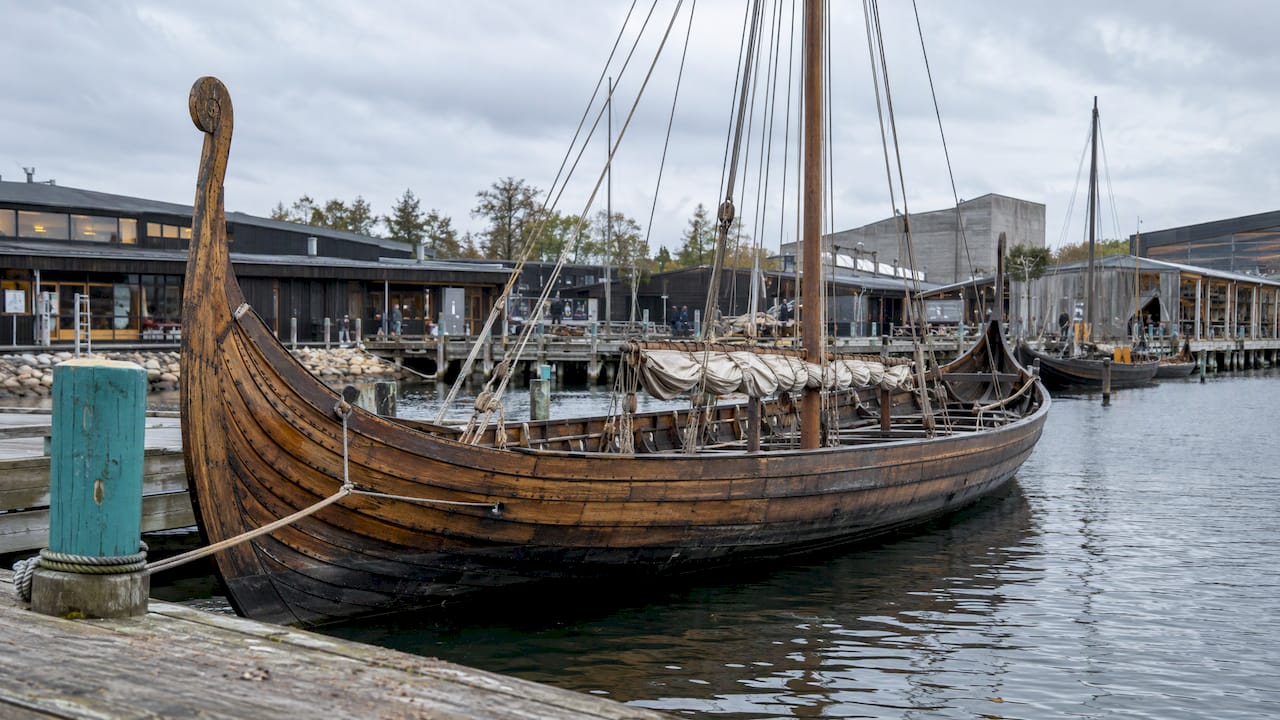
Danish Viking history is the story of the period from around the year 800 to the mid-1000s, when people from the area we today call Denmark sailed out to trade, plunder, settle, and conquer. It was also the time when Denmark was united under one king, when Christianity replaced the Nordic gods, and when the first towns and coins saw the light of day. Here you get the explanation of what the Viking Age was, who the Vikings were, what the period meant for Denmark, and where you yourself can stand by the traces today.
The Viking Age briefly told
The Viking Age is the late part of the Iron Age, from around 800 to the middle of the 1000sHistorians often mark the starting point at the attack on the Lindisfarne monastery in northeastern England on the 8th. June 793. It was not necessarily the first attack, but it is the one that posterity has remembered.
The ending is just as smooth. A common marking is Harald Hardrada's death at Stamford Bridge in 1066, but both the beginning and the end were gradual transitions rather than sharp breaks. In Norway, one sometimes traces the beginning back to about 750 to include the prerequisites for the Viking voyages.
From a Danish perspective, it is therefore most accurate to say that the Viking Age covers approximately 800 to 1050. During that period, Denmark went from being a land of chieftains and local lords to a kingdom with a Christian king, towns, and a common currency.
| Year number | What happened | Why it is important |
|---|---|---|
| 793 | The attack on Lindisfarne | The traditional start of the Viking Age |
| 826 | King Harald Klak allows himself to be baptized in Mainz | Early meeting between Danish kings and Christianity |
| 845 | The Plundering of Paris | One of the most famous Danish expeditions |
| The end of the 9th century | Settlements in England | The Vikings become farmers and rulers abroad. |
| Shortly after 9:00 | Settlements in Normandy | A new Nordic-influenced area in France |
| Around 925 | The Ladby ship is pulled ashore and becomes a royal grave. | One of Denmark's most remarkable discoveries |
| Around 965 | Harald Bluetooth raises the great Jelling stone | The name Denmark and Christianity carved in stone |
| 1013 and 1016 | The Conquest of all England | The height of Danish power abroad |
| 1066 | The Battle of Stamford Bridge | A commonly used marker of the end of the period |
What does the word viking mean?
The word comes from Old Norse viking, which denotes a person on an expedition, often over the seaIn Danish, it can be translated to something like buccaneer or pirate. To "go on a viking" therefore meant to go on a raid.
It is an important point because today we use the word for almost everyone who lived in Scandinavia during that period. Originally, it was more an occupation than a people. The British historian Alex Woolf goes as far as to write that the perception of the Viking as an identity or ethnic group is largely a newer phenomenon, and that the word functioned more as a job description.
People in Denmark called themselves Danes, and that name was already known far down in Europe before the Viking Age. The Viking was thus the Dane, Swede, or Norwegian who one summer or more took to the sea with a sword, goods, or both.
Farmers first, warriors afterwards
The image most people have of the Viking is the warrior with axe and shield. But the vast majority in the Viking Age were farmers, and far from everyone sailed out to plunder.
Everyday life took place on the farms. They cultivated grain, kept cattle, sheep, and pigs, fished, and made most things themselves. Besides agriculture, many were also craftsmen and merchants: blacksmiths, comb makers, weavers, and bead makers, who sold their goods at marketplaces.
The boundary between Viking and merchant was fluid. The Norwegian encyclopedia article on the period points out that it was often difficult to distinguish the Viking from the merchantThe same man could trade one year and plunder the next, depending on what yielded the most. Trade also required that some people specialize, and this helped create the first real cities.
Why did they go out then? The researchers point to several reasons that worked together: population growth, the need for resources and land, new trade opportunities, and the possibility of gaining wealth and prestige. The raids were not only violence. According to a recent research article, they created contact between elites across borders and new economic networks, which had significance far into the Middle Ages.
The ships made the difference
Without the ships, there would have been no Viking Age. The Vikings built several types, from small boats to the famous longships. The longships had shallow draft and able to sail in shallow water, was propelled by oars or by a large, square sail, and at night the crew could pull the ship ashore and sleep under the sail or in tents. One navigated by the sun, the stars, the waves, and the wind.
The low keel was a strategic weapon. The ships were not dependent on ports and could dock on a beach or sail far up the rivers. It gave the Vikings the opportunity to appear unexpectedly, and that is one of the main reasons why they were able to leave a strong mark on Europe for more than 200 years.
The ships were also merchant ships. Maritime navigation in the 9th century created new connections, and Trade and communities arose at the hubs of sea voyages.It was in those kinds of hubs that trading places grew into the first cities.
Tribes, conquests, and settlements
What especially defines the Viking Age, according to Danish history the great expeditions with conquests and settlements abroadFor the Danes, there are a few events that stand out particularly strongly:
- Paris 845: A Danish fleet sailed up the Seine and plundered the city. The voyage shows how far into Europe the ships could reach.
- England at the end of the 9th century: Danish armies settled in eastern England. The warriors became farmers, and the area adopted Danish law and customs.
- Normandy shortly after 900: Nordic warriors received land in Northern France.
- England 1013 and 1016: Danish kings conquered all of England and now ruled on both sides of the North Sea.
The Vikings' settlements reached far. Overall, the Scandinavian voyages went to the Faroe Islands, Iceland, Greenland, and all the way to Newfoundland in the west and along the rivers to the east. The Danish Vikings primarily focused their attention on England and France.
It is worth remembering that the Vikings who raided in the 9th century were not the same as those who ruled England and Normandy in the 11th century. Research shows that it was precisely Knud's conquest of England initiated a period of intensive state-building in Denmark and Norway. Experiences, people, and ideas from England found their way home.
From chieftains to kingdom
The Viking Age is the period when Denmark was formed. The history of Denmark highlights that the period brought Christianity, cities, a growing monarchy, and a monetary system to the country. There are four things that still shape the Denmark we know.
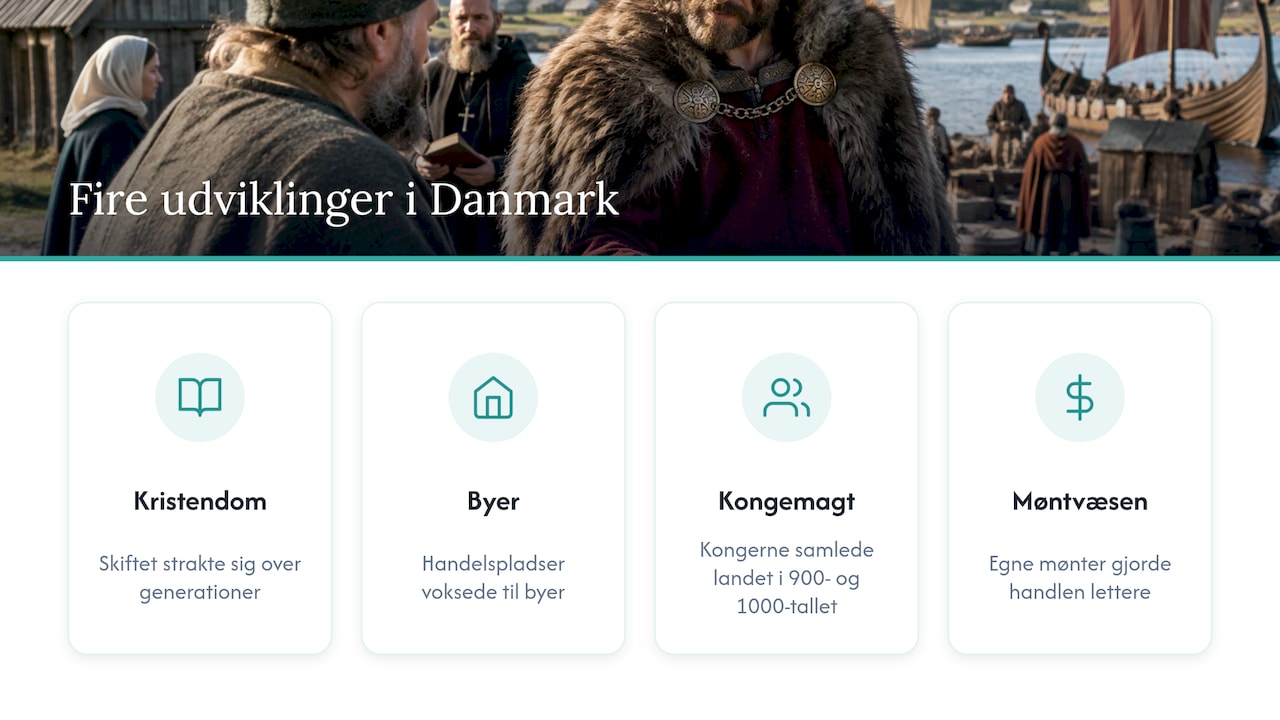
Christianity came gradually. Already in 826, King Harald Klak had himself baptized in Mainz, and archaeologists have found Christian metal objects from the period before the official ChristianizationThe shift from the Nordic gods to the Christian God was a process over many generations, not one day.
The Jelling Stone gathers the story. Around 965, Harald Bluetooth had the great runestone in Jelling raised. The inscription states that he conquered all of Denmark and Norway and made the Danes Christian. The stone is often called Denmark's birth certificate because it bears the name Denmark and is clear evidence of the religious conversion.
The royal power grew. Where power once lay with local chieftains, the kings in the 9th and 10th centuries united the country. Large structures like the Viking fortress Fyrkat near Hobro testify to a time when some could gather people and resources for large-scale construction.
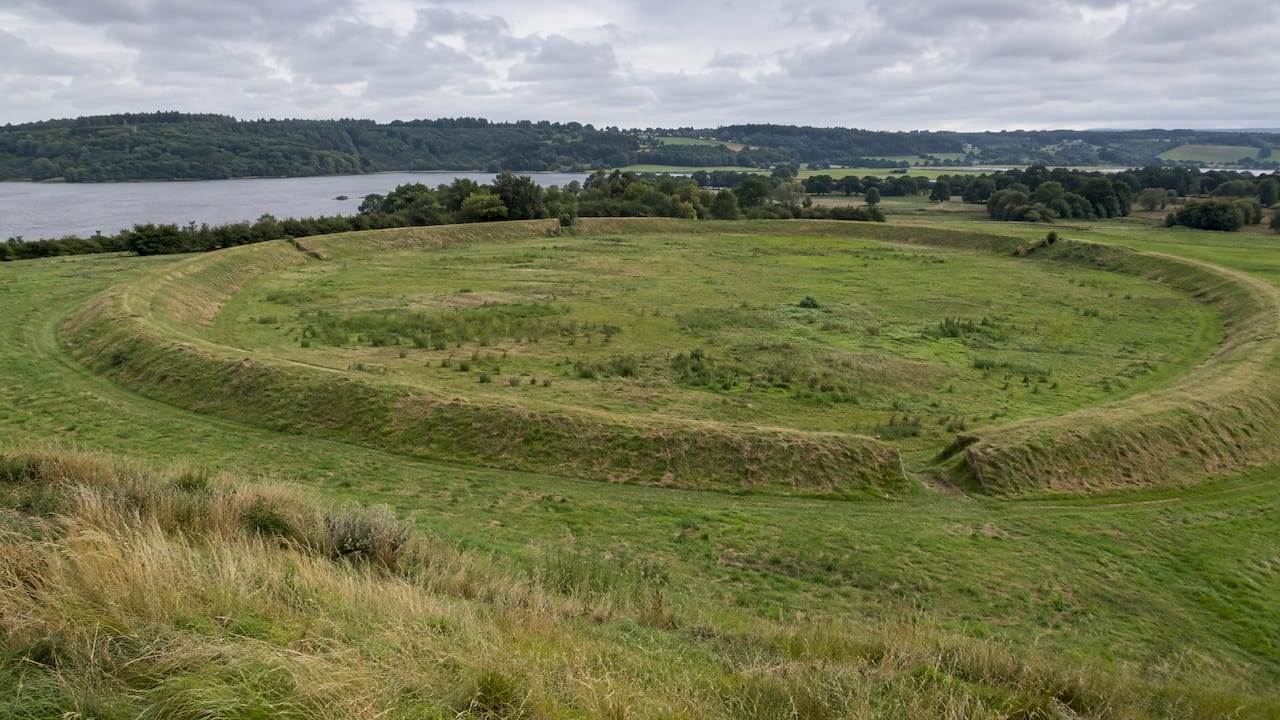
The cities and the coins came. The trading posts grew into towns, and the kings began to mint their own coins. It made trade easier and the king more visible.
Traces of the Vikings you can experience today
The Viking history is not just something you read about. Many of the places where it happened you can visit, and several of the finds are exhibited close to the site. Here are some of the most telling.
Jelling: hvor Danmark fik sit navn
In Jelling in South Jutland stand the two runestones, including Harald Bluetooth's large stone. Here you can stand by the monument that is most often mentioned when explaining how Denmark became a united, Christian kingdom. The place is a natural part of any trip through Denmark's cultural heritage sites.
Fyrkat near Hobro: the seeress's grave
At the Viking fortress Fyrkat, archaeologists found around 30 graves in the 1950s. Grave 4 was a female grave with objects indicating that the woman was a völva, a kind of sorceressAmong the finds were a metal rod and seeds from bugleweed, a poisonous plant. The grave is a rare insight into Viking Age beliefs and magic, and it shows that women could have high status.
Ladby near Kerteminde: the king in the ship
The Ladby ship was found in 1935 near Kerteminde. Studies show that the ship was pulled ashore around the year 925, and that a dead king was buried in it in a mound along with horses, dogs, and valuable goods. The find makes the concept of Viking king very concrete.
Roskilde and the museums: ships and seafaring
If you want to understand seafaring, the Viking Ship Museum in Roskilde is the place where the ships and sailing are the focus. Our guide to Viking museums for the whole family They collect museums where history comes alive, and if you want to know more about a museum, you can read our review of The Viking Museum and What You Can Experience.
If you are planning a longer trip, our list of 12 historical sites a good overview of how Viking sites can be combined with other parts of Danish history.
Find your next Viking excursion: On Rejs i Danmark, you can search on the map and filter experiences by season, price, and participants' age, so you quickly find Viking sites and museums that suit your trip. We show a price estimate per. person and refers to booking, where possible. Start in ours overview of experiences in Denmark, or see them child-friendly attractions, if you are traveling with children.
Why Viking history still matters
The Viking history has had a great significance for how the Danes see themselves. In the 19th century, the Viking Age became an important part of the construction of national identity in ScandinaviaThe story of strong ancestors who sailed out and conquered gave a sense of pride and connection.
The same research shows that the national museums in Scandinavia still use the period to tell about the nation, and that the story of Harald Bluetooth has become part of Denmark's foundational narrative. At the same time, the image of the Viking as the bearded robber is largely fabricated. The historians paint a more nuanced picture of peasants, merchants, craftsmen, women with power, and kings who built an empire.
Therefore, it is relevant to know the difference between what we know from finds and written sources, and what lives on in films, comics, and advertisements:
| Popular performance | What the research shows |
|---|---|
| All Vikings were warriors | Most were farmers, many also craftsmen and merchants. |
| Vikings were a people | The word designated someone who went on a raid. |
| The Vikings just plundered. | They traded, settled, and founded cities |
| The Viking Age ended suddenly | Both the beginning and the end were gradual transitions. |
The significance of the Viking Age today lies at least as much in what it created as in the raids: a united Denmark, a name carved in stone, cities that still exist, and a Christian culture that influenced the next thousand years. If you want to dive deeper into that very question, we have gathered more about it. The significance of Viking history for Scandinavia and Denmark.
This is how we view Viking history
We believe that Viking history is best understood when you are standing on the site. It is one thing to read that Harald Bluetooth united Denmark. It is something else to stand by the stone in Jelling and see the runes with your own eyes, or to see a ship that has been buried for over a thousand years.
That is why we build Travel in Denmark, so it is easy to go from curiosity to excursion. With the map and filters, you can find Viking sites and museums in the part of the country you are going to visit anyway, and see what the cost is per. person, and which ages the place is suitable for.
We find that families especially benefit from combining a museum with a place in the landscape, because the children get both the story and the experience of walking on the same ground as the Vikings. And for foreign guests, the Viking Age is often the best entry point to understanding how Denmark came to be.
Tommy
Frequently Asked Questions
When was the Viking Age in Denmark?
The Viking Age in Denmark is considered to be from around the year 800 to the mid-11th century, often stated as 800 to 1050. The traditional start is the attack on Lindisfarne in 793. The transition to the Middle Ages happened gradually, as the royal power and the church were strengthened.
What was the significance of the Viking Age for Denmark?
The Viking Age is the period when Denmark was united as a kingdom and became Christian. It also brought cities, a stronger monarchy, and its own coins. The Jelling stone from around 965 is the clearest testimony to that development.
Were all Vikings warriors?
No. Most people in the Viking Age were farmers, and many were also craftsmen and traders. The word viking originally referred to someone who went on a raid, not the entire population.
Where can you see traces of the Vikings in Denmark?
Among the most famous sites are Jelling with the runestones, the Viking fortress Fyrkat near Hobro, the Ladby ship near Kerteminde, and the Viking Ship Museum in Roskilde. On Rejs i Danmark, you can find the places on the map and filter by price, season, and age.
Why is it called the Viking Age?
The period is named after the Old Norse term for a warrior who sails on a raid. The name was given by posterity because the raids are what especially distinguish the period from the time before and after.
Sources
- Lex: Vikingetiden, togter, handel og kolonisering
- Danmarkshistorien: Vikingetiden, ca. 800-1050
- Great Norwegian Encyclopedia: The Viking Age
- Museum of the Viking Age: A Quick Guide to the Viking Age
- Vikingeskibsmuseet: Vikingetidens geografi
- North Jutland's Historical Museum: What is a Viking?
- DR School: Warriors or Farmers?
- Royal Museums Greenwich: Viking ships
- Nationalmuseet: The Jelling Stone
- North Jutland Museums: The Witch's Grave at Fyrkat
- East Funen Museums: 90th Anniversary of the Discovery of the Ladby Ship
- Phys.org: The Vikings were more than bearded marauders
- History Today: Goodbye to the Vikings
- Cambridge Core: War, diffusion and state formation in Scandinavia