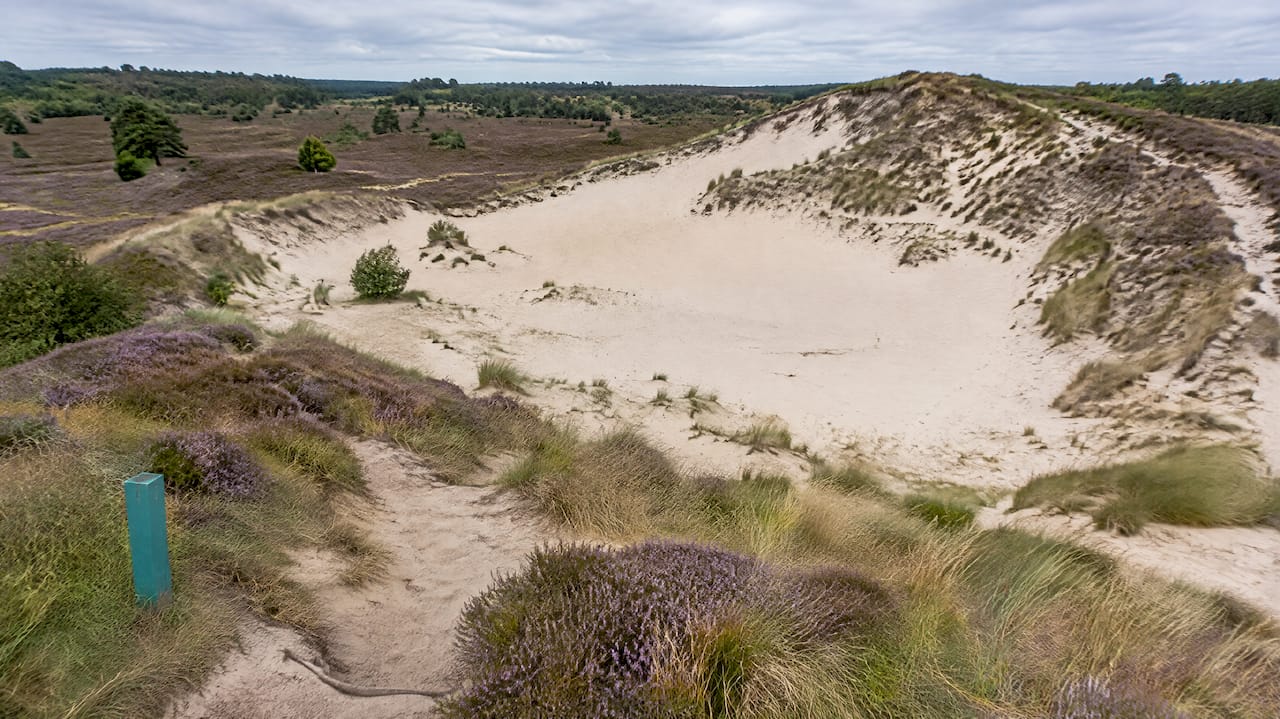
Grene Sande is a dune landscape in the middle of Jutland: white sand dunes, heather heath, and bogs, located in Gyttegård Plantation, about 5 km west of Billund on the road to Hejnsvig. The dunes are formed from wind-blown sand from the Ice Age, and the largest is a 7-meter-high parabolic dune, which you can climb via a short, marked route. It is one of the few places in Denmark where you can experience west coast-like dunes without seeing the sea. The combination of rare nature, short trips, and close proximity to Billund's family attractions makes the place worth planning for. Below you get it all: how the landscape was formed, what you can see, which routes are available, and how to get there.
Grene Sande briefly explained
If you just need an overview before you get in the car, here are the most important facts gathered in one place.
| Subject | You should know that |
|---|---|
| What is that? | Inland cliffs, heath, and bog in Gyttegård Plantation |
| Where is it located? | About 5 km west of Billund, along the road between Billund and Hejnsvig |
| Main attraction | A 7-meter-high parabolic dune that reaches 62 meters above sea level |
| Route | Four marked tours of approximately 2 to 4 km |
| Time on the trip | Typically 45 to 90 minutes |
| Parking | P1 at Grene Sande or P5 at Gyttegård Golf Club |
| Public transportation | No direct; nearest is to Billund |
| Dog | I snore, except in the dog park |
The information about routes and parking comes from The Danish Nature Agency's Practical Guide to Gyttegård Plantation, which is the official place to check if anything has changed before you leave.
How the dunes were formed
The first question many ask is: how do sand dunes end up in the middle of Jutland, far from both the North Sea and the Kattegat? The answer lies about 12,000 years ago.
When the ice retreated after the last Ice Age, the landscape lay deserted. There was sand and gravel from the meltwater, but still no forest or heather to hold it in place. The wind grabbed the sand and blew it together into dunes. According to Netavisen Grindsted's review of Grene Sande and the neighboring areas The inland dunes consist of wind-blown sand from the approximately 12,000-year-old glacial deposits.
Later, a new wave of sand drift came. For centuries, people had cleared forests and heavily used the heath, and in the 1600s and 1700s, the sand began to move again. Trap Denmark describes, that the large dune during that period migrated eastward.
What is a parabolic dune?
A parabolic dune is a dune shaped like a horseshoe or a U. The middle of the dune is pushed forward by the wind, while the ends, called the arms, remain behind because plants hold the sand there. At Grene Sande, the arms face northwest, that is, towards the prevailing westerly wind, and the dune reaches 62 meters above sea level at the southern leg.
In the open sand quarry in the middle of the dune, a so-called wind quarry, you can still see the sand move on windy days. It is precisely that movement that makes the place so rare. Most inland dunes in Denmark are overgrown today.
The sand that must move again
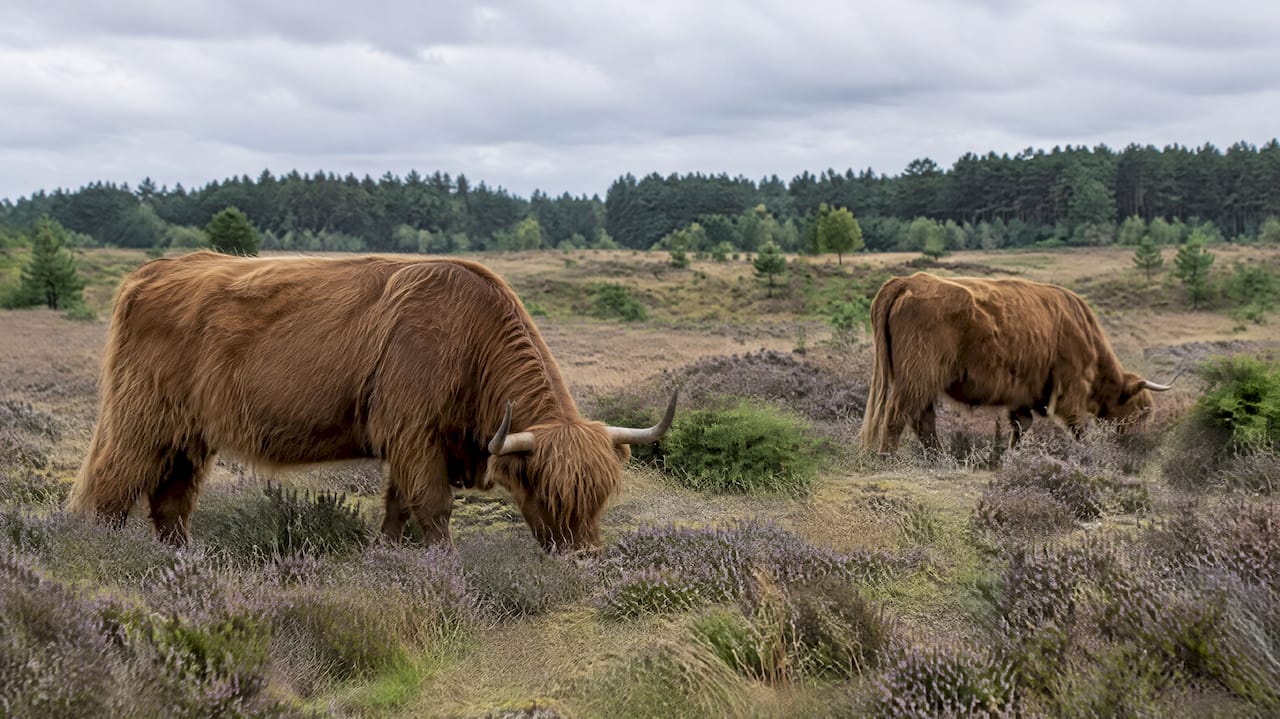
For many years, large parts of the area were planted with coniferous trees. In an EU-supported nature project from 2010 to 2016, about 70 hectares of Norway spruce were felled to restore open areas, and approximately one hectare of the migrating dune was exposed so that the sand could start drifting again. It appears from Trap Denmark's article about Grene Sande, which also mentions that the area is currently managed with year-round grazing, peat scraping, burning, and clearing of regrowth.
Therefore, you can encounter grazing animals on the heath. They keep the heather and grass down so that the landscape does not grow back into forest.
Plants and animals at Grene Sande
Grene Sande is not just a beautiful landscape. It is a habitat for plants and animals that have become rare as the heathland has disappeared from most of Denmark.
Planters you can find
Trap Denmark mentions among others these species from the area:
- Sand beard and sand spurreygrasses that can grow in loose sand and help bind the dune
- Thyme (small-leaved): low, fragrant plant in dry places
- Common wolf's-foota creeping, moss-like plant
- Spotted orchidOne of Denmark's wild orchids
- Rosemary heather, small sundew, and brittle-bushtypical species in the wet, acidic bogs
- Clockensiana deep blue flower that many nature lovers come to see
Sundew is a small carnivorous plant that catches insects on its sticky leaves. It is fun to look for with children, but it is small, so feel free to bring a magnifying glass and stay on the path.
Berry on the heath and in the plantation
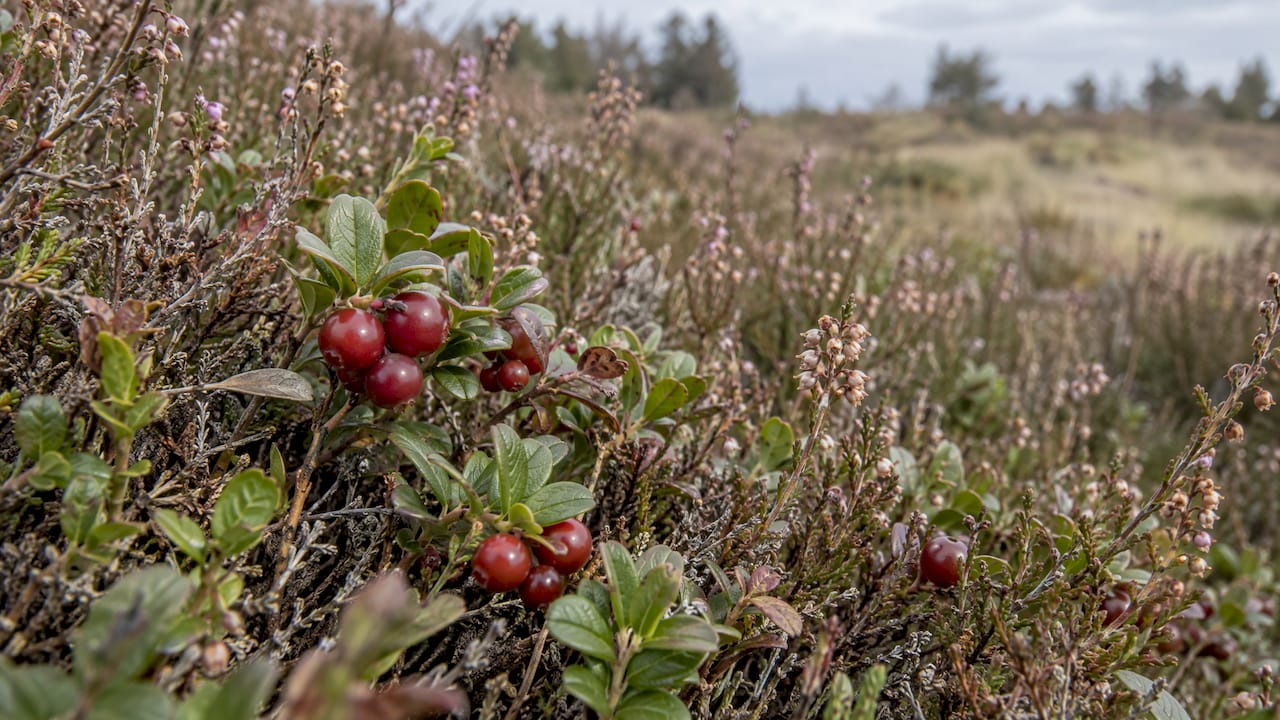
A trip to Grene Sande can also add something to the basket. Billund Municipality's outdoor map informs that you can pick lingonberries on the heath and blueberries in the plantation. The red route also passes by heathlands with lingonberries in season.
Birds and insects
The area is home to nearly 120 bird species. Among them are the skylark, red-backed shrike, crane, nightjar, great spotted woodpecker, green woodpecker, and wryneck. The nightjar is a nocturnal bird you rarely see, but on a warm summer evening you can hear its whirring song over the heath. The crane is a large, gray bird whose trumpet-like call can be heard from far away.
For birdwatchers, binoculars are the most important equipment. Go early in the morning, when the birds are most active and there are fewer people on the trails.
Hiking trails at Grene Sande
The routes are short and manageable, and that is one of the reasons why the place is so suitable for families. The Nature Agency describes four marked tours of about 2 to 4 km, which take 45 to 90 minutes.
| Route | Length | What you experience | Switch to |
|---|---|---|---|
| Red route | 2,2 km | The burrs of the parable, heather with lingonberries, damp marshes with sweet gale bushes | Younger children, short visits |
| Red route + Ørnsbjerg | approx. 3.2 km | As a red route, plus a viewpoint | Familiar with slightly older children |
| Yellow grid | 4 km | Along the dune and through open heathland | For those who want to see as much of the heath as possible |
| The Health Path | 3 km | 12 challenges along the way | Active families and fitness enthusiasts |
Red route: the short way to the dune
The red route starts westward from P1 and takes you directly to the parabolic dune. Along the way, you pass through heather-covered areas and past moist marshlands with bog myrtle, a shrub with a spicy scent. If you want more, the trip can be extended by about 1 km to the viewpoint Ørnsbjerg.
It is the route most should start with. It is short enough for small legs to keep up, and it hits the area's biggest attraction.
Yellow route: more heath and more air
The yellow route of 4 km continues along the dune and out into the open heathland. Here you get the vast sky and the feeling of being far away, even though Billund is just a few kilometers away. Allow for up to an hour and a half at a leisurely pace.
The health trail and mountain biking
The health trail is 3 km long and has 12 challenges you can use to keep your pulse up along the way. According to Billund Municipality's outdoor map There is also a mountain biking trail in the area, so cyclists can have their own route.
Good advice for the trip
- FootwearLoose sand is heavy to walk in. Choose shoes you are not afraid to get sand in.
- Water and foodThere is no cafe at P1, so pack a lunch basket before you drive.
- Stay on the pathsThe inland dunes are more vulnerable than the dunes on the west coast because they lack the natural dynamics of the sea, points out The Online Newspaper GrindstedEach step off the path wears down the plants.
- Binoculars and magnifying glassFor birds in the distance and sundew up close.
How to get to Grene Sande
Gyttegård Plantation is located 5 km west of Billund along secondary road 425 between Billund and Hejnsvig. The Nature Agency recommends parking at P1 at Grene Sande, where the red route starts, or P5 at Gyttegård Golf Club along the country road.
Without a car
There is no public transport to Gyttegård Plantation. The nearest public transport goes to Billund, which is located about 5 km from the plantation. That means you either have to cycle the last part or plan to go by car. A bicycle is a good solution if you live in Billund anyway.
Rules you need to know
Danish nature is open to many forms of traffic, but there are rules. Billund Municipality's outdoor map summarizes them as follows:
- You must walk and cycle on roads and paths in the open countryside.
- Access to private areas is from 6 AM until sunset.
- You must not stay within 150 meters of residential and operational buildings on private properties.
- Dogs must be kept on a leash, except in dog forests.
If you have a dog with you, there is a dog park in the area where it is allowed to run freely. Grazing animals on the heath are yet another reason to keep the leash short for the rest of the walk.
A bit of history: from heath farmers to state-owned nature
Gyttegård Plantation is a relatively young plantation, established just over 100 years ago in an area where heath farmers previously struggled with the poor sandy soil. According to Trap Denmark The state bought Gyttegårds Plantage and Grene Sande in 1972, but sold the forester's house and the surrounding areas to Gyttegård Golf Club in 1996. That is why the golf course today lies side by side with the dunes, and that is why you can park by the club.
The history also explains why the landscape looks the way it does: a patchwork of planted coniferous forest, cleared areas, and open heath, where nature management slowly pushes the balance back towards the original sandy landscape.
When should you visit Grene Sande?
Grene Sande can be visited year-round, and each season has its own offerings.
- SpringThe birds are starting to sing and build nests, and you have a good chance of hearing the skylark over the heath.
- SummerBright evenings provide an opportunity to listen for the nightjar. It is also peak season in Billund, so an early morning walk in the dunes is a peaceful contrast to a day at the amusement parks.
- Late summer and autumnBerry season on the heath and in the plantation, and the heather adds color to the landscape.
- WinterFew people, clear air, and sand lying exposed in the windbreak. A good trip to clear your head.
Choose a day with little wind if you want to see sand drift in practice. Choose a quiet day if you want to listen for birds.
Combine the trip with Billund and the surrounding area
Most people looking for Grene Sande are already in the Billund area or planning to be there. This is where a trip to the dunes really makes sense: as a calm half-day in the middle of a holiday filled with activities.
A good daily schedule for a family could look like this: in the morning the red route to Parabelklitten with a packed lunch on the heath, and in the afternoon an indoor or outdoor activity in Billund. If the children still have energy, is WOW PARK Billund with climbing and playing in the forest treetops a natural next stop, while Billund Minigolf suits a calmer end to the day.
If you are coming from far away and want to connect Jutland with a trip to the capital, this guide to vacation in Copenhagen and Denmark ideas on how you can plan route, budget, and accommodation across the country. And if you are looking for a place to live with the whole family, our overview gathers holiday parks in Denmark the possibilities in one place.
If you want to experience a completely different kind of sand, then go to Denmark's northernmost tip. The Tip at Skagen Often confused with Grene Sande because of the name, but it is a sand spit where two seas meet, not an inland dune.
Find more nature experiences like Grene Sande
Grene Sande is a good example of the type of experience that is easily overlooked when planning a holiday based on the biggest names. At Travel in Denmark, we gather both the well-known attractions and the hidden gems in one guide, with an interactive map, filters for season, price, and age, and price estimates per. person It makes it easy to see what is nearby and what suits your family specifically. See you later comparison of the best nature experiences in Denmark, or find more places that do not charge an entrance fee, under free experiences.
Our view on Grene Sande
When we gather experiences for Travel in Denmark, we repeatedly see that the biggest attractions take up the most space in people's plans. It is understandable, but it also means that places like Grene Sande go under the radar, even though they are only a few minutes from the most visited attractions in the country.
We believe that the best vacations blend the grand and the quiet. An hour in the dunes gives children something an amusement park cannot: sand between their toes, a carnivorous plant to look for, and a story about the ice age and migrating dunes that is easy to understand when you are standing right in the middle of it.
That is precisely why we build our guide with maps and filters, so you can see nature and attractions side by side and plan a day that suits your pace. Grene Sande is one of the places we especially want more people to discover, and at the same time a place that requires all of us to stay on the paths, so the dunes will still be there for the next generation.
Tommy
Frequently Asked Questions about Grene Sande
Where is Grene Sande located?
Grene Sande is located in Gyttegård Plantation, about 5 km west of Billund along the road between Billund and Hejnsvig in Billund Municipality. The easiest entrance is P1 at Grene Sande, where the short red route to Parabelklitten starts.
How long does a trip to Grene Sande take?
The four marked tours are approximately 2 to 4 km and typically take 45 to 90 minutes. The red route of 2.2 km is the shortest way to the large dune, and you can extend it by about 1 km to the viewpoint Ørnsbjerg.
Is it possible to get to Grene Sande by public transport?
No, there is no public transport all the way out to Gyttegård Plantation. The nearest public transport goes to Billund, about 5 km away, so you should expect to use a car or bike for the last part.
Is it allowed to bring a dog to Grene Sande?
Yes, but the dog must be kept on a leash, except in the dog forests. There is a dog forest at Grene Sande where dogs are allowed to run freely.
Are Grene Sande and Grenen the same?
No. Grene Sande is inland dunes and heath near Billund in the middle of Jutland, while Grenen is the sand spit at Skagen, where the Skagerrak and Kattegat meet. The names look similar, but they are two completely different places at opposite ends of the country.
Sources
- Trap Denmark: Grene Sande
- Naturstyrelsen: Praktisk om Gyttegård Plantage
- Billund Municipality: Outdoor Life in Billund Municipality (outdoor map 2024)
- Online Newspaper Grindsted: Grene Sande, Risbøl Sande, and Randbøl Heath
- Copenhagen and Denmark: a holiday between traditions and culture