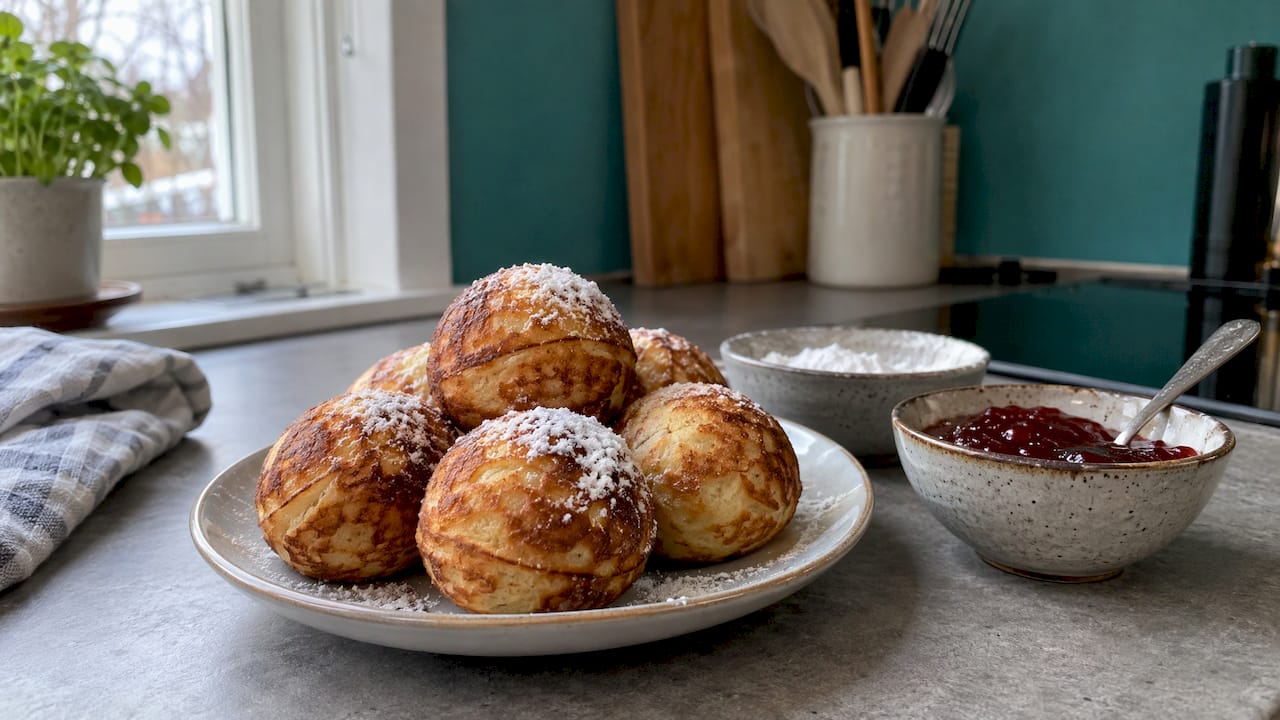
Æbleskiver were called that because they were exactly that: slices of apple. The oldest æbleskive was a slice of apple dipped in thin batter and boiled or fried in fat. Only in the 19th century did it become the round ball from the æbleskive pan, and only then within the last 100 years it became truly associated with Christmas. You can read the story here, but it tastes best where it still lives: at Christmas markets, in open-air museums, and in the parts of Denmark where the æbleskive is still filled with prunes or has brandy poured into it. Here you get the whole story from 17th-century cookbooks to today's mulled wine table, and you find out where you can experience it.
What does the name æbleskive mean?
The name is quite literal. According to Lex's article about the æbleskive Originally, the pastry consisted of a slice of apple that was dipped in thin batter and boiled or fried. Today, æbleskiver are fried in an æbleskive pan, often completely without apple, and served with powdered sugar and jam.
DR has described the original æbleskive as a thick slice of apple without core, dipped in flour and eggs and fried over the open hearth. In this way, new life was breathed into the tired winter apples, which were otherwise becoming too soft to eat raw.
That also explains a question that many foreign guests ask at the first mulled wine table: Why are they called æbleskiver when there is no apple in them? The answer is that the name survived, even though the recipe changed.
Tidslinjen: æbleskivens vej gennem fire århundreder
| Period | What happened? |
|---|---|
| 1616 | The name æbleskiver appears in a Danish cookbook: apple pieces dipped in egg and flour, fried in butter. |
| Around 1700 | The linguist Matthias Moth defines æbleskiver as a thin slice of apple, dipped in flour and egg, and fried in butter. |
| 1703 | Oldest known printed recipes in A High-Class Madame's Cookbook, which also mentions the special forehead |
| 18th century | Many recipes for "fried apple slices," often marinated in wine, lemon, and spices. |
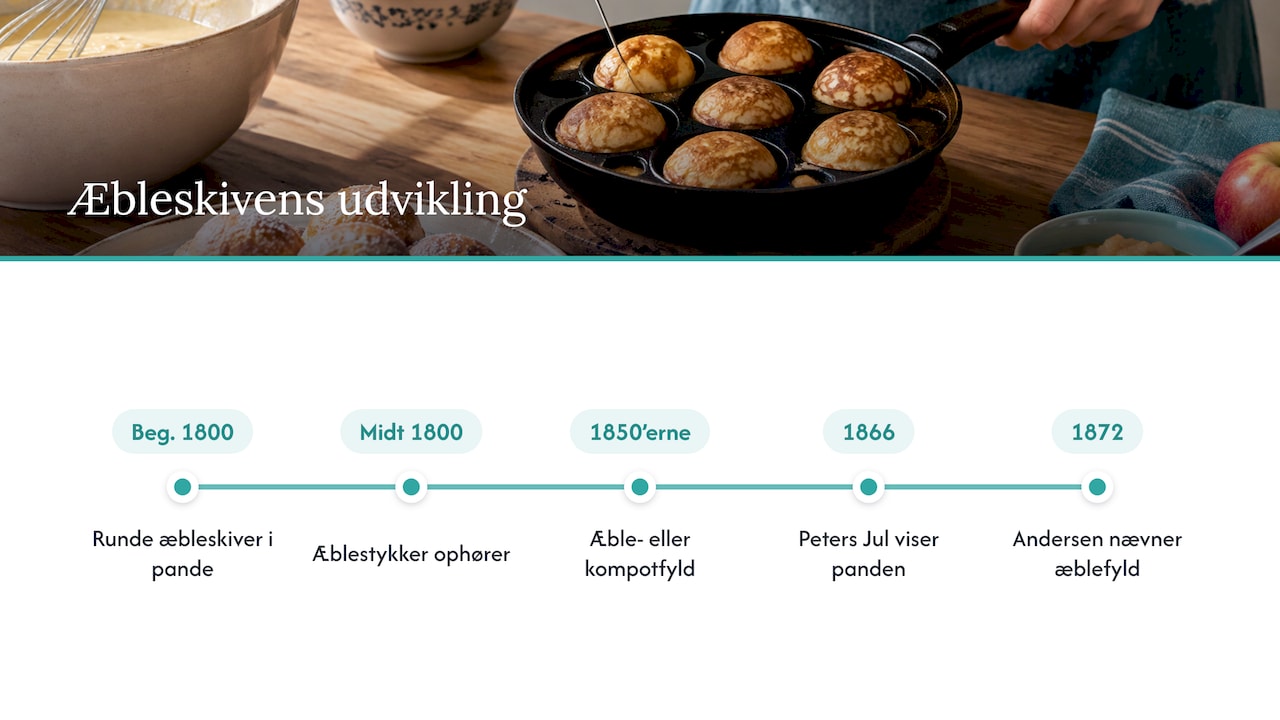
| The beginning of the 19th century | The earliest recipes for æbleskiver baked in an æbleskiver pan |
| The mid-1800s | The tradition of apple slices for æbleskiver ends. |
| The 1850s | Recipes place a piece of apple or a dollop of compote inside the round æbleskiver. |
| 1866 | The modern æbleskive from the pan is mentioned in the book. Peter's Christmas |
| 1872 | H.C. Andersen describes "apple-filled" æbleskiver in the fairy tale. The Cripple |
| Around 1900 | The recipes vary in leavening agent and in the use of sour cream or buttermilk. |
| The last 100 years | Æbleskiven becomes a permanent part of Christmas's sweet baked goods. |
The sources for each line can be found in the sections below.
From apple pancake in fat to ball in the pan
17th century: the first traces
According to DR's review of the history of the æbleskive The name æbleskiver appears for the first time in a Danish cookbook from 1616. Here it was a matter of apple pieces dipped in egg and flour and fried in butter in a pan. It resembles more an apple fritter than the ball we know today.
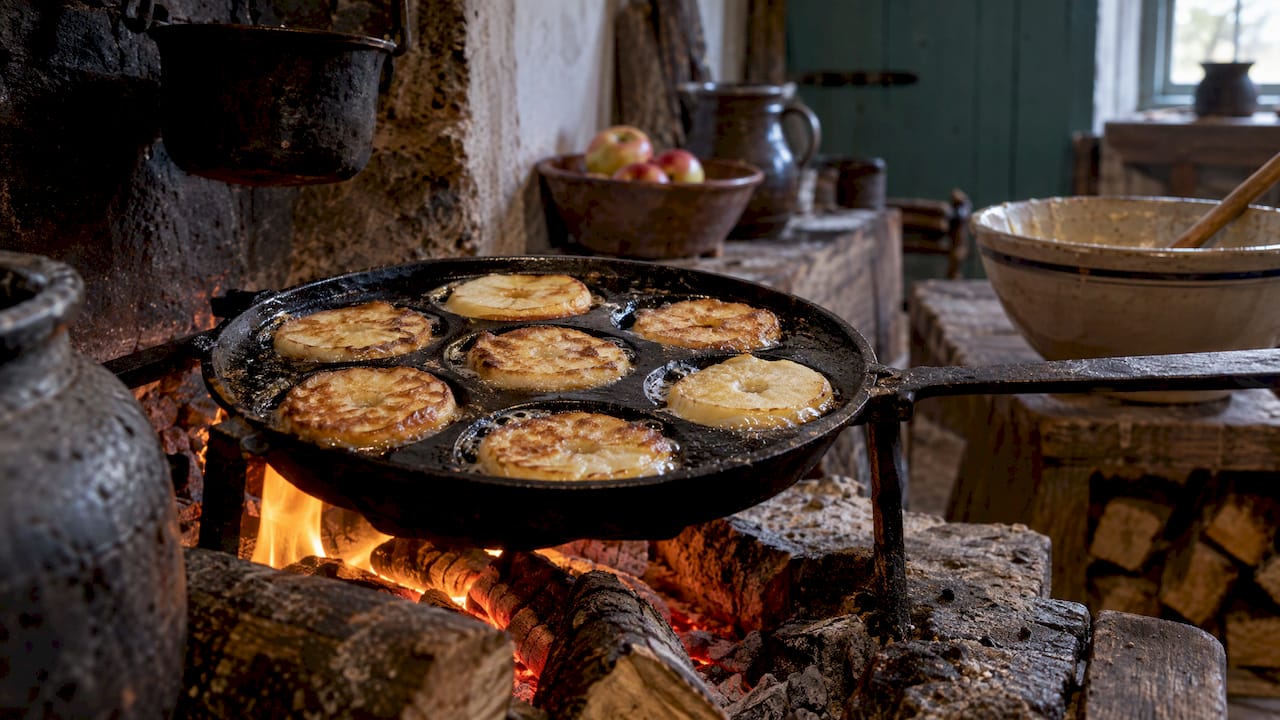
The old form did not disappear completely. Around the year 1700, the linguist Matthias Moth defined æbleskiver in a handwritten dictionary as a thin slice of apple, dipped in flour and egg and fried in butter, and according to the Danish Wikipedia article about æbleskiver The old version is still known on Als as "fried apple slices."
18th century: marinated apples and the first pan
In the 18th-century cookbooks, there is a whole variety of recipes. Lex describes how the oldest types were called "baked apple slices" or "liquid apple slice": The apple was hollowed out, cut into thin slices, dipped in pancake batter, and boiled or fried in fat. Then the slices were often left for a day in a marinade of wine, lemon juice, and spices. So it was a nice and quite expensive dish.
According to Description of Slow Food Foundations in Ark of Taste originate from the oldest known printed recipes from 1703, from the cookbook A High-Class Madame's CookbookIt presents two variants, a yeast dough apple cake and apple slices dipped in batter and fried in a pan, and it already mentions the special apple slice pan. Ark of Taste is Slow Food's international list of food traditions worth preserving, and the fact that the æbleskive is on it says something about its place in Danish food culture.
19th century: the bullet takes over
The pan with the round indentations changed everything. The earliest recipes for æbleskiver baked in an æbleskive pan date back to the early 1800s, and the tradition of apple pieces ended in the middle of the century, writes Lex. The apple so to speak moved into the dough: Historie-online.dk reports that in the 1850s there were recipes, among others from Miss. Jensen, where one places an apple piece or a dollop of compote inside the round Danish pancake balls, while they are baking.
Two well-known books show that the new æbleskive had won. In Peter's Christmas From 1866, there is a drawing by Pietro Krohn, where æbleskiver are being poured out of an æbleskive pan. And when H.C. Andersen wrote the fairy tale in 1872 The Cripple, he highlighted "apple-filled" æbleskiver for the Christmas party at a manor house. That he would mention the filling shows that apple in the apple pancake was no longer a given.
20th century: baking powder, buttermilk, and frost
Miss Jensen's cookbook from 1901 suggests that you can put a little apple porridge, a piece of cooked apple, or rhubarb compote in each æbleskive before turning it. Around the same time, the recipes varied in terms of leavening agents and the use of sour cream or buttermilk.
Today it has become common to buy frozen æbleskiver and heat them in the oven because it takes time to bake them yourself. The Slow Food Foundation points out that the knowledge of making fresh æbleskiver with yeast dough, apple filling, and butter is disappearing, especially among younger generations, and that the tradition therefore deserves to be kept alive.
This is how the apple pancake became Christmas food
Many believe that æbleskiver have always been Christmas pastries. They have not. Frederikssund Museum tellsThat the æbleskive together with the peppernut and klejne belongs to the oldest baked goods we know. All three originate from before the time of the stove, when baking was done in a pot over the hearth, and æbleskiver were baked all year round for all kinds of parties and holidays.
Christmas did, however, have a special role. In the countryside in the 1600s and 1700s, the servants received æbleskiver as a Christmas bonus, and on Christmas Eve they were distributed to the poor of the parish. In 19th-century farms, it was not uncommon for farmhands and maids to receive a certain number of apple slices as a Christmas gift from the master. Historie-online.dk compares it to a merchant's basket with treats from the employer, as the apple slices were considered a great delicacy.
Only within the last 100 years has the æbleskive become associated with the sweet baked goods of Christmas, writes Lex. Today it belongs in December along with mulled wine, and DR describes the combination as a classic way to get warm on a cold winter day. If you want to see how the æbleskiver fit into the rest of the Danish Christmas, then read our guide to Christmas traditions in Denmark and the overview of what people eat at Christmas in Denmark.
Myths about the origin of the æbleskive
There are also stories about the æbleskive that cannot be documented. The most colorful says that Vikings, after a hard battle, used their dented shields and helmets as a pan for a pancake-like batter. Another says that the custom began in the Middle Ages, where the last soft apples of the year were sliced to flavor the mulled wine and afterwards were fished out, dipped in batter, and fried.
Both stories become presented as speculations, and none of them are supported by the written sources. What we actually know is found in the cookbooks: the name from 1616, the printed recipes from 1703, and the round apple slice from the 19th century. The Viking story is fun to tell the children over the mulled wine, as long as everyone knows it's a tall tale.
Regional apple slices: taste the history around the country
The æbleskive is not one thing. Throughout Denmark, it has acquired local names, fillings, and rituals, and several of them still survive. DR and other sources have compiled a number of the regional variants:
| Own | Local variant |
|---|---|
| Southern Jutland and Ærø | Apple slices with pitted prunes or prune puree |
| Death | Apple slices baked with barley flour |
| Fine | "Pancakes with permission": wheat flour with sugar for |
| Falster | The æbleskiver are called "nuns" |
| Lolland and Falster | "Svupsakker": the æbleskive is split open, and brandy is poured on it. |
| Bornholm | "Oppenholler" or "grease cakes" with fruit compote or jam |
| If | "Fried æbleskiver" in the old form of æbleskiver |
The pig slaughtering tradition in the south is confirmed by the Slow Food Foundation, which also highlights the piglets on Lolland and Falster. When you travel around Denmark in the winter months, the regional names are a good reason to taste the æbleskiver in several places and compare. The same applies to the rest of the Danish kitchen, which we have gathered in regional specialties from all over DenmarkIf you want to approach those kinds of experiences with a conscious perspective, then read about how to enjoy local food experiences like a connoisseur, and find Danish examples in our guide to local food experiences in Denmark.
Æbleskiver outside Denmark
The æbleskive has relatives and descendants in several countries. According to the Slow Food Foundation, it has spread to northern Germany, where it is called förtchen or ballbäuchen and is typically served with apple or prune puree, often sprinkled with sugar and cinnamon.
In Southern Norway, it is known as munker, baked in a munk iron shaped like an æbleskive pan, and written sources describe munker in Arendal already at the beginning of the 20th century. The Netherlands has a flatter and smaller side dish, poffertjes.
The biggest surprise for Danish guests is perhaps the USA. DR reports, citing the National Museum, that The Americans eat æbleskiver all year round., also for breakfast. They are baked in the same type of pan, but in countless variations with fillings of cheese, vegetables, berries, or chocolate instead of jam and powdered sugar. If you come as a tourist from the USA, you are tasting the Danish original when you order æbleskiver at a Christmas market here at home.
Bake the original æbleskive yourself
If you want to taste how æbleskiver were before the pan took over, Frederikssund Museum has published a historical recipe for the original æbleskive. It is good to make with children because you can see where the name comes from.
Ingredients:
- 250 g flour
- 60 g melted butter
- 2 dl beer
- 2 dl milk
- 4 eggs
- 6-8 apples of the Belle de Boskoop variety
Here's how you do it:
- Mix the dough of flour, melted butter, beer, milk, and eggs.
- Cut the apples into slices with the hole in the middle where the core was.
- Turn the slices in the batter.
- Fry them in hot fat until they are light brown.
Hot fat requires an adult at the stove: Let the children handle the æbleskiver and dough, and let the adult take care of the frying. Serve them warm with a little sugar and a glass of mulled wine or juice, and tell the story from 1616 while you eat.
Here you can experience the æbleskive tradition
The best way to understand the history of the æbleskive is to taste it in the setting to which it belongs. In December, Christmas markets are the perfect setting for æbleskiver and mulled wine. At Rejs i Danmark we have gathered Christmas markets throughout Denmark, and we have described experiences such as the Christmas market in The Old Town in Aarhus og Christmas at Egeskov Castle, where the old Christmas traditions frame the visit. If you are new to the Danish Christmas, start with our introduction to, what Christmas markets are.
Travel in Denmark is a digital guide to experiences across the country. With the interactive map and filters for season, price, and participant age, you will find experiences that suit your family and your travel route, with a price estimate per. person and references to booking. Find your next Christmas outing among Experiences in Denmark, or see, how the short search works.
Our perspective on the history of the æbleskive
Æbleskiven is one of the best examples that Danish food culture is a living history and not a museum piece. It has gone from fried apple slices in 17th-century cookbooks to Christmas gifts for servants to today's mulled wine table, and along the way, each region has given it its own name and filling.
Therefore, we believe that history should be experienced and not just read. A quick bite in Lolland, a prune-filled æbleskive in Southern Jutland, or a bag of æbleskiver at a Christmas market tells more about Denmark than a long explanation. These are the kinds of experiences we collect at Travel in Denmark: the well-known attractions and the hidden gems, so both Danish families and foreign visitors can plan a trip where traditions are part of the journey.
Use the map to find Christmas markets and Christmas experiences on your route, and let the apple pancakes be the excuse to go.
Tommy
Frequently Asked Questions about Æbleskiver
Why is it called æbleskiver when there is no apple in it?
Because they were originally slices of apple dipped in batter and fried or cooked in fat. When the æbleskive pan came into use in the 19th century, the batter was shaped into balls, and the apple gradually disappeared. The name stuck.
How old are æbleskiver?
The name appears for the first time in a Danish cookbook from 1616. The oldest known printed recipes date from 1703, and the round æbleskive from the pan is known from the early 19th century.
Have æbleskiver always been Christmas food?
No. They were baked all year round for parties and holidays, but were also given as Christmas gifts to servants and distributed to the poor on Christmas Eve. Only within the last 100 years have they become a fixed part of Christmas's sweet baked goods.
Did the Vikings invent æbleskiver?
There is nothing in the written sources that suggests it. The story of Vikings baking in their shields and helmets is speculation, just like the tale of apples fished out of the mulled wine.
What is a svupsak?
A svupsak is a tradition from Lolland and Falster, where the æbleskive is split open and brandy is poured in. It is one of several regional examples showing that the æbleskive has different names and fillings around Denmark.
Sources
- Lex: æbleskive
- DR: Det er højsæson for æbleskiver
- DR: Få varmen med hjemmelavet gløgg og æbleskiver
- Slow Food Foundation: Æbleskive, Ark of Taste
- Frederikssund Museum: December 12, æbleskiver
- Historie-online.dk: Danish Pancakes
- Wikipedia: Æbleskiver (dansk)
- Wikipedia: Æbleskiver (engelsk)