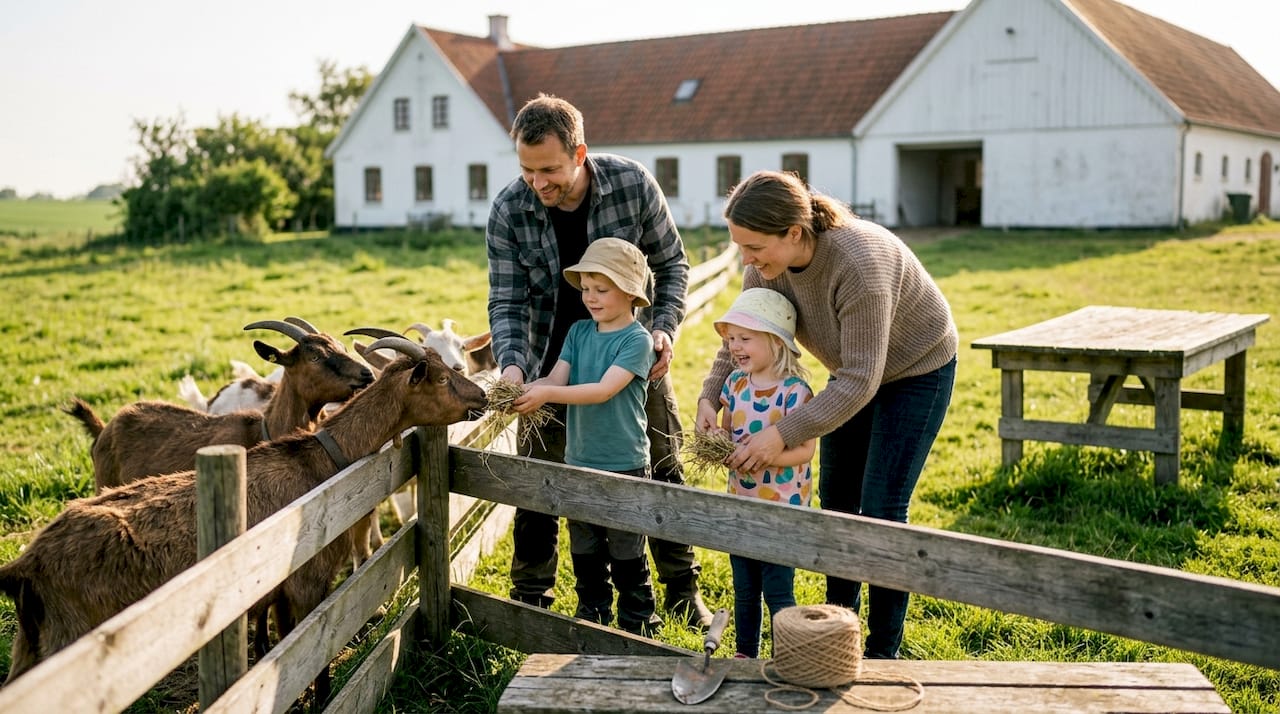
In short:
- Family stay on a farm combines practical chores, learning, and togetherness in an active rural environment. It strengthens children's sense of responsibility, social skills, and family bonds through direct contact with animals and nature. The holiday type provides space to disconnect from screens and creates unforgettable shared experiences.
Family stay on a farm is defined as a structured holiday stay where families live and actively participate in everyday life on a functioning farm with animals, fields, and practical chores. It is one of the few types of vacation that combines learning, presence, and movement in one. Children meet animals up close, adults disconnect from screens, and the family creates memories that last. The benefits of farm stay vacations are documented across nature school projects, agriturismo concepts, and farm camps, and they all point in the same direction: time on the farm provides something that a week at a holiday center can rarely match.
Why family stays on farms strengthen children's development
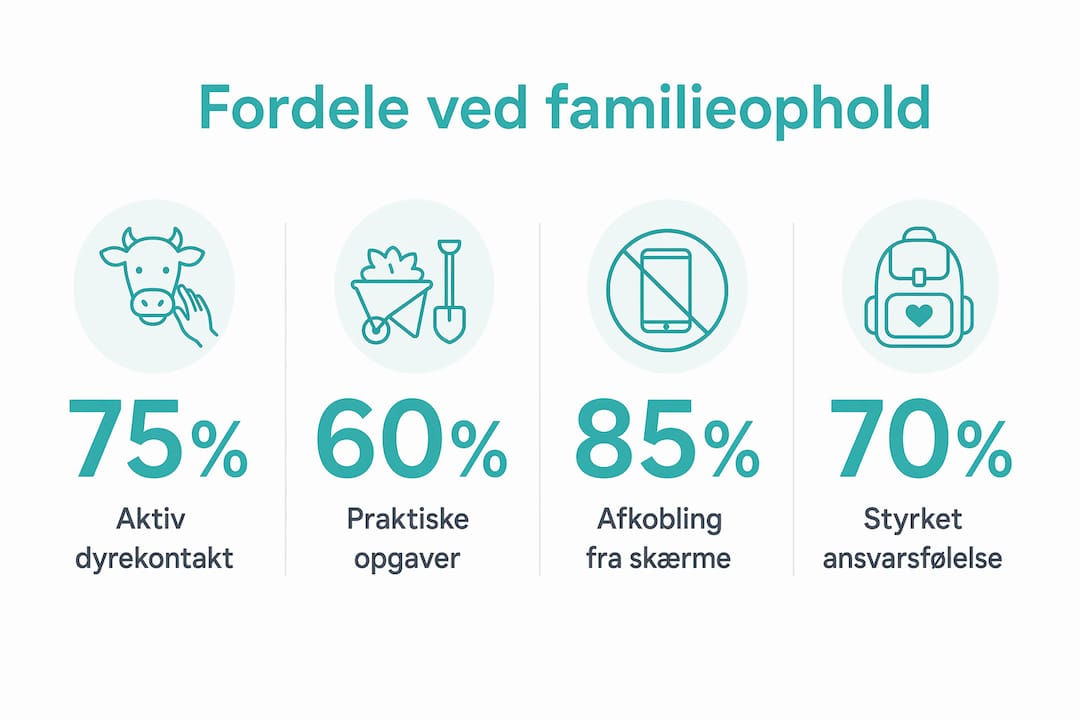
Farm stay gives children something concrete to do. They feed animals, collect eggs, help with milking, and participate in the farm's daily rhythm. It's not entertainment wrapped in a screen. It is reality, and that reality has a measurable effect.
A study that followed 1,900 familiar from pregnancy Until children were 6–7 years old, it showed that stable contact with animals increases responsibility and self-control in children. It's not enough to just have a pet at home. It is the active contact, daily care, and responsibility for a living being that make the difference.
Nature school projects confirm the same pattern. Projects supported by the Nordea Foundation with ca. 1 million kroner has shown that regular contact with animals promotes social courage in vulnerable children and reduces isolation. It is a strong result. It means that the farm's animals are not just cute to look at. They are an active tool to open children socially.
Community through practical tasks
Bondegårdscamp creates a sense of community in a way that organized sports activities rarely do. Shared practical challenges breaks down barriers and forms friendships across backgrounds. When children work side by side stacking hay or driving hens in, a natural camaraderie arises. It doesn't require an adult to facilitate the play. The task does it itself.
- Animal feeding and care increase children's sense of responsibility from day one
- Practical tasks like collecting eggs give a tangible sense of mastery.
- Shared challenges create friendships across age and background
- The farm's daily rhythm gives children structure without feeling like school
Professional tip: Choose a stay where the children have a fixed task every morning. It could be feeding the rabbits or fetching eggs. A quick task gives the child ownership and makes the stay more meaningful than an ordinary holiday.
Farmercamp is a specific Danish example. Activities such as animal feeding and tractor driving Promotes children's learning through practical participation, and a typical stay costs approximately. 550 kr. for 3–4 days inclusive food and accommodation It is an affordable price for an experience that sticks in the memory.
What does nature and rural life give to the family?
Disconnecting from digital screens is the advantage that families most often mention after a farm stay. It sounds simple. But it is harder to achieve than most believe, because it requires that there is no alternative. The farm's rhythm replaces the screen because there is always something to see, touch, or do.
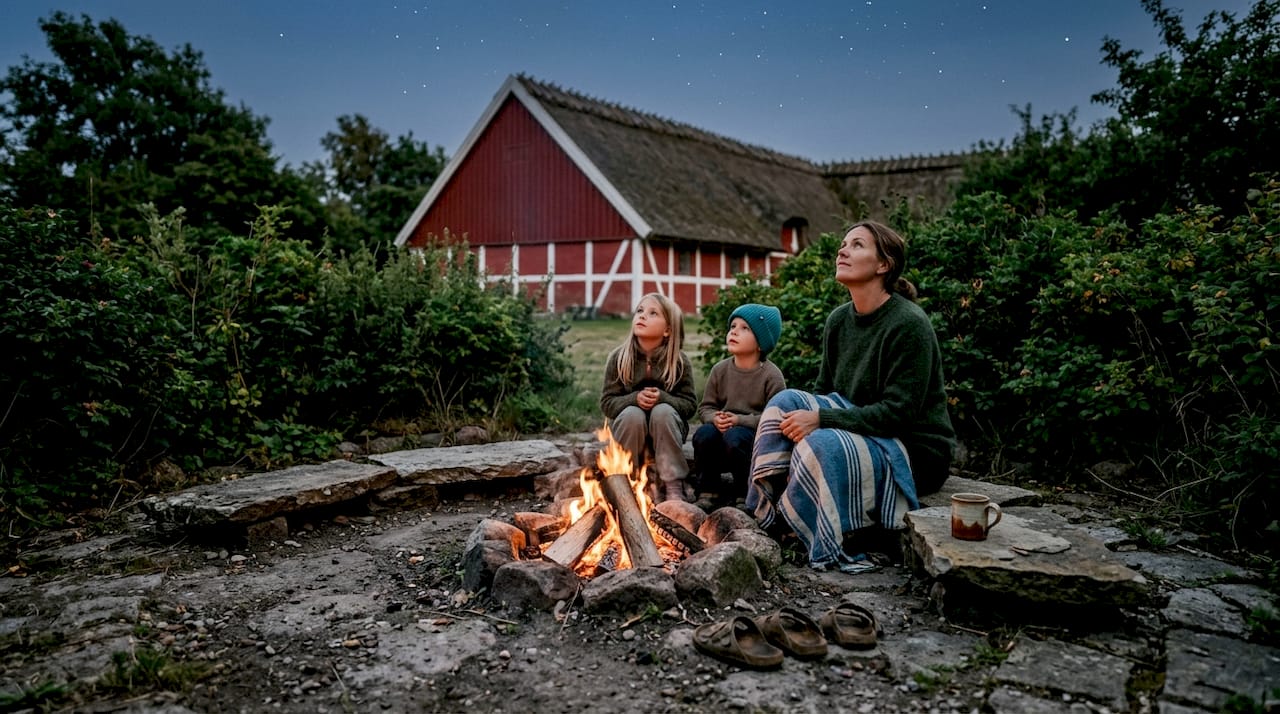
Nature guides at In2Nature reports that families often highlight activities such as bonfires and stargazing as the highlights of the holiday. It is remarkable because it involves activities that cost nothing and require no equipment. It is presence in its purest form. And that is exactly what many families lack in everyday life.
Health and movement as a natural side effect
Fresh air and physical activity are not a program on the farm. That's just what happens when children are outside all day. They run, climb, carry, and dig. Adults go for walks, help out, and breathe at a different pace. The body feels it, even though no one has planned a training session.
- Campfire coziness and stargazing create calm and presence without screens
- Fresh air and movement are a natural part of the farm's daily life.
- Simple nature experiences like listening to birds or looking at stars provide mental rest.
- Familiar finds common focus because nature offers something for everyone
Professional tip: Tag en Family trip in nature as a fixed part of every afternoon on the farm. A walk along the fields before dinner sets a natural limit for the day's activities and gives everyone time to talk together.
The greatest value of a farm stay is disconnecting from digital media. It creates space for presence in the family, which many parents didn't realize they missed until they tried it.
What can you do on a farm? From soil to table
Agriturismo is the international term for farm tourism that combines accommodation with active participation in the farm's production. The concept is widespread in Italy, but the principle applies to all farms that open their doors to families. It's about understanding where the food comes from and what it takes to produce it.
Agritourism concepts on farms offers "from farm to table" experiences that teach families about the origin of food and sustainability. Direct conversations with the farm owners enhance understanding. A child who has milked a cow themselves and then received fresh milk for breakfast understands the connection in a way no cookbook can explain.
Concrete activities on a typical farm
- Malkning Children learn how milk is produced and what it takes to care for dairy cows daily.
- Baking with the farm's own ingredients Familiar baking bread or cakes with flour, eggs, and butter from the farm itself.
- Vegetable harvest Children pick vegetables from the kitchen garden and understand the importance of seasons for food.
- Dairy farming Feeding and caring for pigs, chickens, rabbits, or goats gives children responsibility and empathy.
- Cooking with the host Many farms offer communal cooking where the family prepares dinner from scratch with local ingredients.
These activities not only strengthen children's knowledge about food and nature. They strengthen the family bond because everyone contributes and everyone succeeds in something concrete. A family baking bread together on a farm has a shared experience to talk about for a long time afterward.
Understanding sustainability is a natural side benefit. Children who see what it takes to produce an egg or a carrot think differently about food in the supermarket afterward. It's a lesson that sticks.
How do you plan a good farm stay?
Preparation is what distinguishes a good farm holiday from a frustrating one. Farmhouses are not hotels. The facilities vary, and expectations must be aligned before you book.
Rustic accommodation may require expectation alignment about facilities, before you book. Some farms offer modern bathrooms and comfortable beds. Andre is simpler. Ask directly about the farm's facilities, and be honest with yourself about what your family needs to sleep well and thrive.
What should you pack?
- Rubber boots for everyone The yards are muddy, and children should be able to play freely without worries about getting dirty.
- Practical clothing Old pants and sweaters that can withstand dirt and straw
- Headlamp Necessary for evening activities such as stargazing and walks in the dark
- Mosquito spray Especially important in the summer when the family is outside from morning to evening
- Raincoat The weather changes, and the farm's activities continue regardless
Professional tip: Read the farm's description carefully and feel free to call the owners before you book. Ask what duties the children are expected to participate in and what happens if it rains. A good owner is happy to answer and provide detailed responses.
Participating in regular chores on the farm is the core of an authentic experience, but it can surprise unprepared families. Prepare the children to help out and let them know it's part of the experience. Children who are prepared take the tasks as a challenge. Children who are unprepared may experience it as a burden.
Practical clothing and boots are not details. They are the prerequisite for children to fully engage in the farm's activities without you as a parent constantly worrying about their clothes.
My experiences with farm stays as family adventures
I have followed many families who tried a farm stay for the first time with mixed expectations and came home with an experience they talk about for years afterward. What surprises them the most is not the animals or nature. It is that they are talking to each other again.
The screens don't disappear just because you ask them to. They disappear because there's something better to do. The cow, which needs to be milked at. 7.00, is a stronger argument than any screen rule. And a child who is responsible for feeding the rabbits forgets their phone by itself.
What I see again and again is that the best farm stays are not the ones with the most activities planned. They are the ones where the family is allowed to find their own rhythm within the farm's framework. Morning milking, lunch with the farm's own produce, an afternoon walk along the fields, and a bonfire in the evening. That's enough. It's actually more than enough.
I always recommend choosing a stay of at least three nights. Two nights are too short for the family to truly relax and get into the rhythm of the farm. From the third day, the children begin to take initiative themselves, and that's where the magic happens.
The benefits of farm holidays are fundamentally about giving the family a shared project. And that project doesn't need to cost much. It just needs to be genuine.
— Tommy
Plan your farm stay in Denmark with Rejsidanmark
Rejsidanmark gathers the best family-friendly experiences in Denmark in one place, so you don't have to spend your holiday searching. You find child-friendly attractions in Denmark Sorted by season, age, and price, and you can filter directly to the farms and nature activities that suit your family. Bridge Rejsidanmarks Guide to Denmark to plan the entire stay from accommodation to activities. You save time, and the children get a holiday they remember.
Frequently Asked Questions
What are the benefits of a family stay on a farm?
A farm stay provides children with active animal contact, practical tasks, and a break from screens. It strengthens the sense of responsibility, social skills, and family bonds.
What can children do on a farm?
Children can feed animals, collect eggs, milk cows, bake bread, and help with vegetable harvesting. Activities vary from farm to farm, but practical participation is at the core of the experience.
What should I pack for a farm stay?
Rubber boots, practical clothing, a headlamp, and insect repellent are the most important things to bring. Practical clothing and boots ensure that children can play freely without worries.
How much does a farm stay for families in Denmark cost?
Prices vary, but a Farmercamp stay typically costs around. 550 kr. for 3–4 days inclusive food and accommodation Private farms vary in price depending on facilities and duration.
Enjoy farm stays for all age groups?
Farm stay suitable for children from approx. 3 years and up. Younger children enjoy animal contact, while older children and teenagers thrive on practical tasks and responsibility for the farm's animals.
Recommendation
- Why a family holiday in Denmark is the best solution – Travel in Denmark
- Benefits of Family Experiences – Strengthen Togetherness and Learning – Travel in Denmark
- Why Experience Children's Denmark – Memorable Family Time – Travel in Denmark
- Why Are Attractions Important for Families – Travel in Denmark