Mønsted Lime Mines
The world's largest limestone quarries are located in Mønsted just west of Viborg. And it is a world-class experience for both families with young children and those who wish to explore the mine tunnels equipped with headlamps and sturdy footwear.
An underground expedition
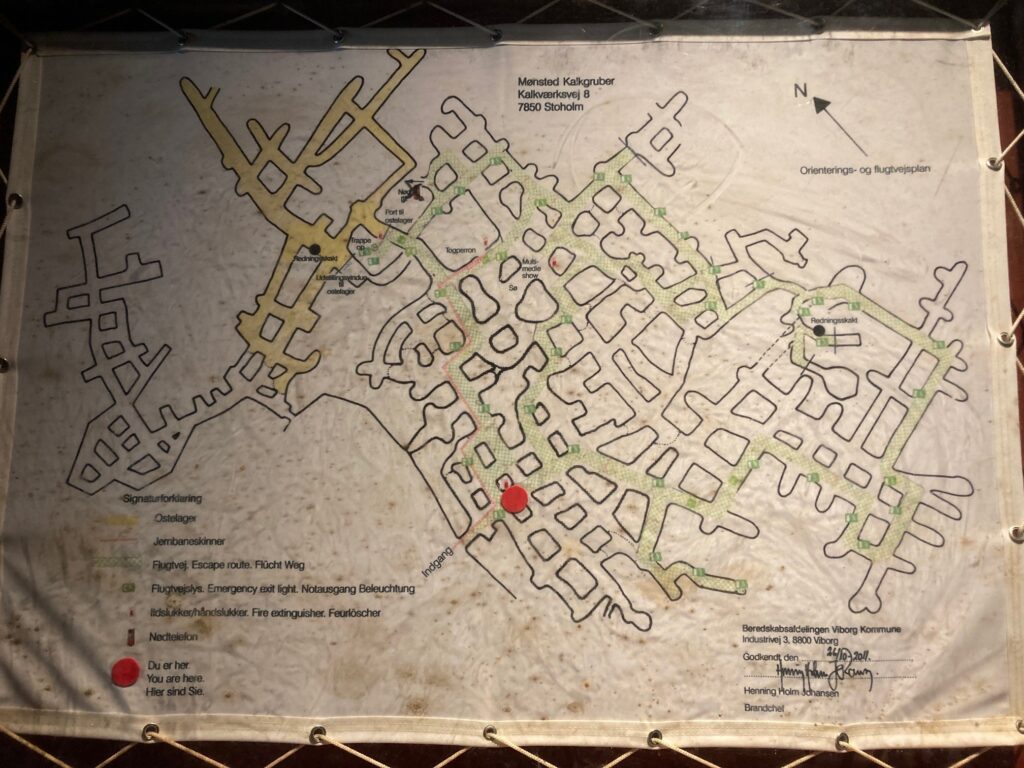
When you go down into Mønsted Kalkgruber, you enter a labyrinth of 60 km of mine tunnels. Only a small part of my tunnels is illuminated. This is where most visitors go.
There are three hiking trails underground.
Green route It is the short route, which is both wheelchair accessible and perfect for a walk with a stroller or pram. You don't miss out on experiences with a fine. tour a piece into the limestone mines
Yellow grid It's not a round trip, but a trip into the slightly smaller corridors. The stroller is easily accessible and can also be recommended for families with young children.
If you're up for a few more challenges, you can continue further into the limestone mines. red squareHere you will have to crawl a little and bend down.
If you're up for even more adventure, bring your headlamp and flashlight and explore the unlit passages yourself, as there are many of them. Make sure to be at least two people together and ensure you have at least two light sources. A headlamp is highly recommended, along with a small extra light in the backpack. Highly durable clothing and hiking shoes/boots are recommended. It may also be a good idea to bring a bottle of water and some muesli bars or similar.
It is 8 degrees Celsius in the mines year-round, so remember long-sleeved clothing and a jacket, even on warm days.
Please note that the caves are closed during the winter period, when the bats overwinter in them.
An ideal site for limestone extraction
The area around Mønstød was a paradise for lime burners, as an underground salt mine has pushed lime layers almost to the surface. Back in the 1100s and 1200s, churches were built from limestone from the area. Since then, many other buildings were created from materials from the lime quarries. Until 1872, the lime quarries were owned and operated by local farmers. In 1873, the breaking and burning of lime became industrialized and more efficient.
Museum and playground
A film about the history of the mines is continuously shown in the limestone quarries. This film is projected on the thick walls as a screen.
There is also plenty to experience above the ground. You can take a walk into the limestone quarry and see the former lime kiln. There are also several exhibitions, including one about the inhabitants of Kalkminen in winter; the bats. There are naturally also exhibitions about the history of the lime mines and about the people who worked in the lime mines.
There is a playground with a bat theme. This playground is mainly aimed at older children, as it requires some climbing skills.
At the café Kridthuset, you can enjoy lunch, a piece of cake, or cool down with an ice cream.
Hiking in the underground world
The nature around the limestone quarries is protected. There are several hiking trails near the limestone mines, where you can, among other things, walk above the pits. The area has a very special flora with ferns and orchids that have good growth opportunities in the calcareous soil. If you're up for a bit more hiking, the 3 km through the forest between Mønsted Kalkgruber and Daugbjerg Kalkgruber is an interesting trip. Here you can find old mine tunnels from the lime burning period as well as hollow ways that were used for transporting burnt lime. One option is also Kalk Kaminoen, which with its 30 km is a hike between Stoholm and Skelhøje.
.



Kalkværksvej 8, Viborg, Denmark