In short:
- Denmark's natural areas are vital for biodiversity, the climate, and public health, but many are inadequately protected. A network of large, connected natural areas can protect endangered species, store carbon, and enhance recreation. Overall, 17% of species are threatened, and the goal is to reach about 30% protected nature through strategic land expansion.
Danish natural areas are the foundation of the country's biodiversity, its ability to handle climate change, and Danes' access to recreation and fresh air. It is not an abstract claim. Biodiversity Council documents that Denmark is in the midst of a biodiversity crisis, and Copenhagen University Area Report shows that today the country has only a limited part of Denmark's area, which is effectively protected nature, against a political goal of approximately 30% protected nature. The Outdoor Council confirms that nature is Danes' preferred setting for exercise, socializing, and everyday recreation.
Three key points:
- Biological: Natural areas are habitats for plants, animals, and fungi. Without them, the arteries disappear.
- In terms of climate: Forests, moors, and wetlands store carbon and protect against flooding.
- Socially: Access to nature improves public health, supports tourism, and boosts the local economy.
| Dimension | Current status | Goal / potential |
|---|---|---|
| Effectively protected area | A limited portion of Denmark's land area (expert estimate) | A political goal of approximately 30% protected nature (EU/UN target) |
| Identified core areas | 149 core areas are designated in KU's main scenario. | Covers 16% of Denmark's area |
| Three birds | Many Danish species are threatened and at risk of disappearing. | You sell targeted area efforts |
How do natural areas support biodiversity in Denmark?
Stores, connected natural areas are far more effective than scattered, isolated patches. The reason is simple: many species require large territories, natural processes, and the opportunity to spread between populations. A forest of 5,000 hectares can host self-sustaining populations of birds of prey, large insects, and rare plant communities. A forest of 50 hectares is rarely possible.
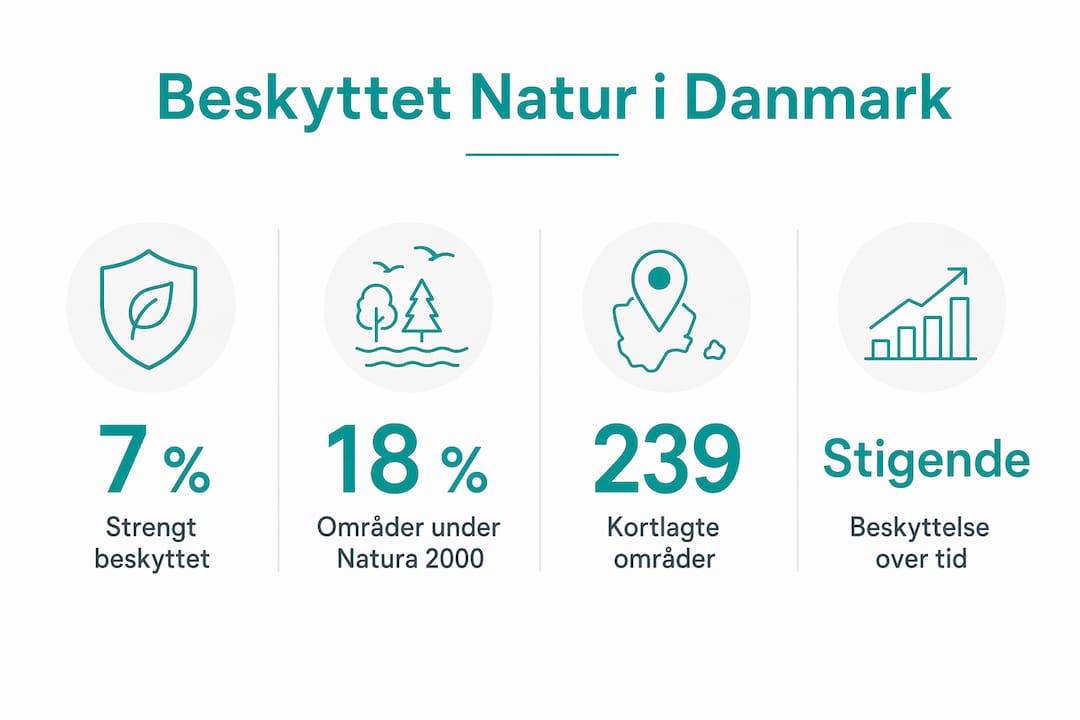
The report "More, Better, and Larger Nature in Denmark" from the Center for Macroecology at the University of Copenhagen documents that a network of 149 prioritized natural areas will cover a very large part of Danish biodiversity. The analysis identifies 239 possible areas larger than 500 ha, of which 41 sites have the potential for more than 5,000 ha of contiguous nature.
Statistics: 17% of Denmark's species are threatened and at risk of disappearing. A targeted network of large natural areas can meet the needs of most of these species in a single coordinated effort.
Birds such as sea eagle and black woodpecker, insects like solitary bees and rare day-flying butterflies, as well as plant communities associated with nutrient-poor heathlands and bogs, all depend on large, undisturbed areas. Fragmentation cuts populations and prevents genetic exchange.
- Connected natural areas reduce the need for ongoing intensive management
- Natural processes such as flooding, fire, and large herbivores can be restored
- The Biodiversity Council recommends expanding existing nature cores rather than protecting new, random patches.
Professional tip: Always prioritize efforts closest to existing natural cores. This is where the arteries already are, and here each invested krone provides the most impact for biodiversity.
What do natural areas do for climate, water, and other ecosystem services?
Natural areas provide services that no technology can replace at the same price. Moss and wetlands store carbon that would otherwise be released as CO₂. Forested river valleys retain rainwater and reduce the risk of downstream flooding. Flower-rich meadows and forest edges support pollinators, which agriculture depends on.
The Climate Council emphasizes, land use planning with biodiversity and water environment in mind provides significant climate benefits, and timing and correct placement are crucial to realizing these synergies. A wetland area established in the wrong part of a catchment provides much less effect than one placed where it actually captures nutrients and retains water.
The most important ecosystem services from Danish natural areas:
- Carbon storage Intact raised bogs and low-lying soils are Denmark's most important carbon reservoirs
- Water purification Natural wetlands filter nitrogen and phosphorus from agricultural drainage
- Erosion protection Vegetated slopes and banks keep soil and nutrients in place
- Pollination Wild bees and butterflies from natural areas pollinate crops in nearby fields
- Climate adaptation Flood plans and urban green corridors reduce damage costs
Statistics: The Climate Council and experts agree that central appointment combined with local implementation is the most effective model for realizing synergies between biodiversity, water environment, and climate.
Professional tip: When municipalities and landowners choose where to place new wetlands, mapping of existing natural cores, drainage areas, and nutrient loads should be done simultaneously. It maximizes the benefit for both biodiversity and the water environment in one measure.
What does nature mean for public health and outdoor life?
The Outdoor Council documents that Danes use nature intensively for recreation, exercise, and social gatherings, especially in forests and along coasts. It's not just a leisure activity. Access to green spaces is associated with lower stress levels, better mental health, and increased physical activity across all age groups.
Nature tourism is also a significant industry. Coastal landscapes, national parks, and forest areas attract visitors who stay overnight locally, eat locally, and use local guides. You can find concrete Nature experiences in Denmark on Rejsidanmark, which gathers a wide range of destinations for all interests.
- Forests and coastal areas are the most visited types of nature in Denmark
- Motion in nature is more motivating than similar activity indoors for many Danes.
- Nature access counteracts stress, depression, and promotes creativity according to CONCITO
Statistics: CONCITO emphasizes that more nature will improve Danes' mental and physical health, and that opportunities to be in nature counteract stress and encourage movement.
Which laws and plans govern the protection of natural areas?
The formal framework for Denmark's nature management is based on a series of laws that collectively cover different types of nature and purposes. The Board for Green Area Reorganization and Water Environment indicates the central laws such as:
- Nature Conservation Act Protects §3 natural types such as mosses, meadows, heaths, and pastures from changes in condition
- The Forest Act Regulates forest management and ensures untouched forest and protected forest
- Environmental Measurement Act Implements the EU Water Framework Directive and sets environmental objectives for water bodies
- National Park Law Lays the foundation for the establishment and management of national parks
The state sets the framework, but the municipalities have a central role in the specific land use planning through municipal and local plans. The Danish Nature Agency manages the state's own natural areas and administers grant schemes. The Danish Society for Nature Conservation (DN) and the Biodiversity Council contribute with professional recommendations and political pressure for stronger protection.
The Biodiversity Council recommends that Denmark adopt a biodiversity law with binding targets for protected areas, a timetable, and a national land strategy that coordinates considerations for food, nature, and urban development across sectors.
Professional tip: Municipalities and landowners who receive national designations should contact the Nature Agency and relevant subsidy schemes under the Agency for Green Land Reorganization and Water Environment early. Early dialogue increases the likelihood of matching the designation with existing support options.
How much nature is protected in Denmark today?
The gap between official figures and professional reality is large. Denmark has reported relatively high protection percentages to the EU, but experts from Aarhus University and the University of Copenhagen assess that the effectively protected area is significantly lower than the ministerial figures. Many guide articles cite figures of 15–18%, but the professional consensus indicates that actual effective protection is closer to 7%.
| Statement | Area (% of Denmark) | Source / note |
|---|---|---|
| Officially reported protected | A proportion reported by ministerial reports | Ministerial reports to the EU |
| Effectively protected (expert estimate) | A limited portion of Denmark's land area | KU Area Report 2024 |
| Core areas (149 main areas) | 16% | KU report, main scenario |
| Potential with an expanded effort | Up to a political goal of about 30% protected nature | KU report, extended scenario |
| EU/FAO target | a political goal of about 30% protected nature | Biodiversity Strategy / Kunming-Montreal |
Statistics: KU's land report shows that the 149 prioritized natural areas will contribute with nature equivalent to 16% of Denmark's area alone, and that an expanded effort can reach a political goal of approximately 30% protected nature.
The difference between 7% and 18% mainly concerns what counts as "protected." Natura 2000 areas have been designated, but many still contain intensive agriculture and drained low-lying land. Designation is not the same as real protection.
What threatens Danish natural areas the most?
The biodiversity in Denmark continues to decline. It is not a single cause, but a combination of threats that reinforce each other.
- Fragmentation: Motorways, urban development, and intensive agriculture are cutting natural areas into increasingly smaller pieces that cannot sustain viable populations.
- Intensive agriculture Drainage, fertilization, and pesticides have removed heaths, mosses, and meadows on a large scale since the 1950s.
- Area placement Nature is converted to agriculture, energy plants, and urban development faster than it can recover.
- Climate change Changed precipitation patterns, warmer summers, and rising sea levels are putting pressure on coastal habitats and low-lying areas.
- Nutrient pollution Nitrogen from agriculture fertilizes nutrient-poor natural habitats such as heaths and dry grasslands, which depend on poor soil conditions.
Research at Aarhus University shows that habitat restoration in agricultural land primarily benefits common species. Rare species require special habitats and natural processes, which are rarely accommodated in small, isolated areas within an intensively cultivated landscape.
The geographical threat landscape is uneven. Jutland's low-lying areas are particularly vulnerable to drainage and nitrogen loading. Coastal habitats on the islands are under pressure from rising sea levels and coastal protection. The forests generally lack untouched, old forest with the continuity required by rare fungi, insects, and cavity-nesting birds.
Five concrete solutions for more and better nature in Denmark
-
Expand existing natural cores. It is the most cost-effective strategy. The Biodiversity Council is clear: efforts should focus on expanding the core natural areas where species are already present, rather than protecting random new patches. Effects per The invested krone is significantly higher.
-
Restore wetlands and low-lying lands. Restoring drained low-lying wetlands not only releases carbon but also creates habitats for birds, amphibians, and aquatic plants. Wetlands are also Denmark's fastest way to reduce nitrogen emissions to fjords and coastal waters.
-
Convert cultivated forests into natural forests. The KU report shows that a significant proportion of the cultivated forests within the 149 prioritized areas should be converted. Untouched forest with old trees, dead wood, and natural hydrology is crucial for the most endangered forest species.
-
Create connections with green corridors. Even large natural areas are vulnerable if they are isolated. Corridors along rivers, fences, and road edges provide animals with the opportunity to spread and populations with the chance for genetic exchange.
-
Convert marginal agricultural land to nature. KU believes that a significant portion of Denmark's agricultural land must be converted in order to realize the main scenario with 149 large natural areas. It costs an annual amount in the billions in establishment and management, but the benefits in carbon storage, water environment, and biodiversity are documented.
The Danish Society for Nature Conservation (DN) and CONCITO agree that a biodiversity law with binding targets is a prerequisite to ensure that these solutions do not get stranded in voluntary agreements and short political cycles.
What can you do yourself for nature in your local area?
National mappings and political goals are important, but change also happens locally. Here are concrete actions you can take:
- Join the Danish Society for Nature Conservation (DN) and participate in local nature conservation projects
- Contact your municipality and inquire about the nature designations in the municipal plan and opportunities for voluntary nature management.
- Lodsejere can apply for grants for nature management, wetland projects, and afforestation through the Agency for Green Land Reallocation and Water Environment
- Participate in citizen dialogue about new Natura 2000 plans when they are sent for consultation
- Bridge Rejse Danmarks guide to natural experiences to find and visit natural areas near you
Local initiatives can be directly linked to national designations. Municipalities working on nature restoration within the 149 prioritized areas from the KU report can apply for state co-financing and participate in larger network projects.
Professional tip: The Outdoor Council has a database of local outdoor organizations and projects. It is the fastest place to find volunteer work with nature in your area, whether you live in the city or in the countryside.
Are you planning a trip out into nature? Rejsidanmarks Checklist for a day trip in Denmark Helps you plan the visit so you are well prepared.
What do the national mappings and reports show?
Three institutions have provided the academic foundation for Denmark's nature policy in recent years:
- Center for Macroecology, Evolution, and Climate (University of Copenhagen) The Area Report 2024 identifies 239 potential natural areas larger than 500 hectares and designates 149 as the most important in an optimal network. The cards accurately show where the effort has the most impact for the greatest number of species.
- Biodiversity Council: Recommends targeted area designation where the potential for biodiversity and water environment benefits is greatest, and emphasizes the need for a national land use strategy with binding goals.
- Climate Council: Pointing out that central designation combined with local implementation is the key to realizing synergies between climate, biodiversity, and the water environment.
Statistics: KU estimates that the establishment and management of the 149 prioritized natural areas will cost an annual amount in the billion range. For comparison, the socio-economic benefits in terms of carbon storage, water environment, and recreation are significant but not yet fully quantified in a comprehensive Danish analysis.
The cards from KU are already used by municipalities, foundations, and private landowners to prioritize where nature investments have the greatest effect. The implementation requires a long-term strategy. Single projects alone will rarely ensure lasting progress without network effects across property boundaries and municipalities.
Why the future of nature is a strategic choice for Denmark
Denmark is one of Europe's most intensively cultivated countries. It is not a natural law; it is a result of political choices made over generations. The choices can be made differently.
The Biodiversity Council and CONCITO agree that Denmark is facing the largest land reorganization in recent times. Nature should be prioritized equally with agriculture and energy, not as a byproduct of other considerations. It requires a biodiversity law with binding targets, a national land use strategy, and financing models that make it attractive for landowners to convert rather than cultivate.
Research from Aarhus University and the University of Copenhagen provides the academic foundation. Civil society, represented by DN and the Outdoor Council, ensures popular support and local implementation. What is missing is political will to set binding targets and stick to them across election periods.
Natural areas are not a luxury choice. They are the infrastructure for all living things in Denmark, including ourselves.
Sources and further reading
If you want to go deeper into the topic, these reports and portals are the most important starting points:
| Source | What you find | Best for |
|---|---|---|
| KU Area Report 2024 | Mapping of 239 natural areas, scenarios, and costs | Academic immersion and prioritization |
| More, better, and larger nature (KU report) | Concrete ways to a political goal of approximately 30% protected nature protected nature | Political and professional debate |
| Biodiversity Council: From setback to progress | Recommendations and political framework | Decision-makers and NGOs |
| Climate Council: Denmark's future land use | Climate-Nature Synergies and Land Use Strategy | Climate policy and planners |
| The Board for Green Area Reorganization and Water Environment | Legislation and grant schemes | Lodgers and municipalities |
| The Outdoor Council: Danes' use of nature | Recreation data and outdoor activities | Citizens and health policy |
| Danish Society for Nature Conservation (DN) | Citizen engagement and nature conservation | Volunteers and local communities |
Recommendation: Fagfolk og planlæggere starter med KU-arealrapporten og Klimarådets analyse. Citizens and volunteers find the best entry point at the Danish Nature Agency and the Danish Outdoor Council. If you want to combine nature conservation with concrete experiences, Rejs i Danmark The practical starting point for finding Denmark's natural gems and planning your next visit.
Recommendation
- Nature experiences in Denmark – Discover the Diversity of Nature – Travel in Denmark
- Experiences for nature lovers: 7 places in Denmark 2026 – Travel in Denmark
- What Is Denmark's Nature – Importance for Family Experiences – Travel in Denmark
- The role of nature in your holiday in Denmark 2026 – Travel in Denmark