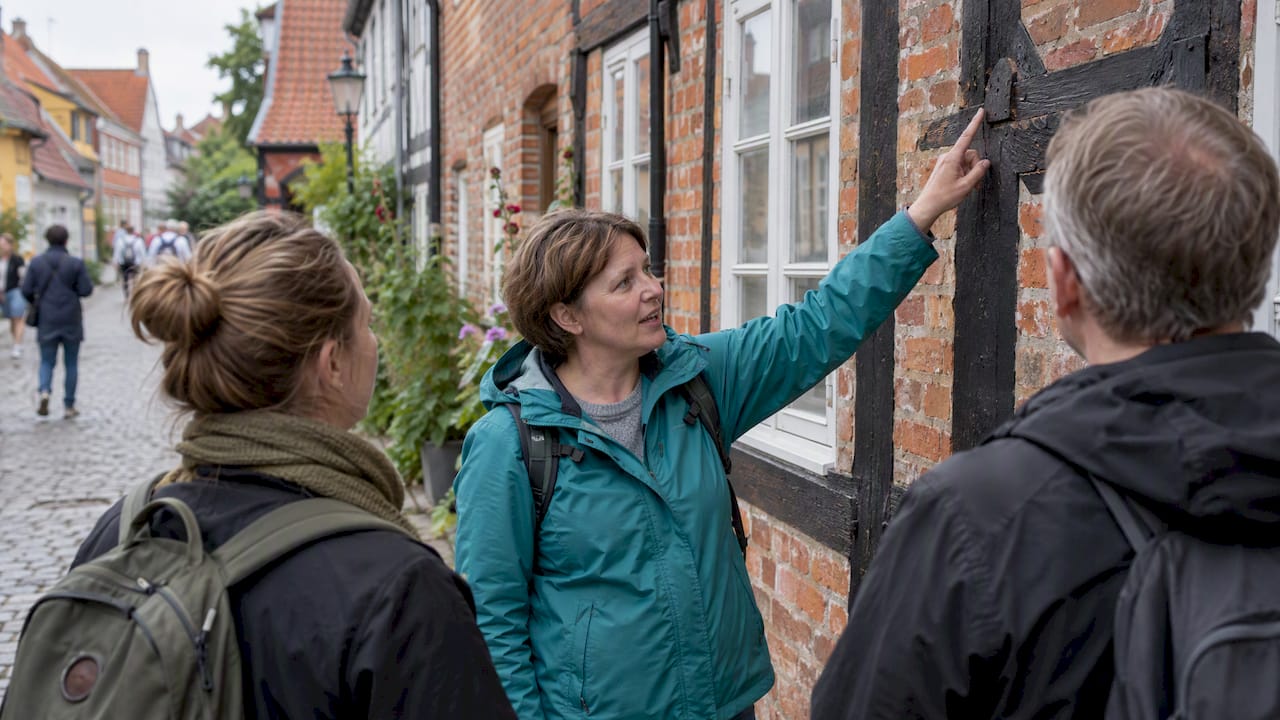
A local guide does much more than point out sights. The guide translates somewhere so you understand why a burial mound is located there, why the fishermen stopped going out to sea, or why the old merchant's house still looks the way it does. The guide also looks after you in nature, takes you around the largest crowds, and builds a bridge between you and the people who live in the area. Here you will learn what a local guide is, what roles the guide plays, where you can meet local guides in Denmark, and how to choose the right one for your next excursion.
What exactly is a local guide?
The word "guide" is used for many things in Danish: tour guides, nature guides, volunteer enthusiasts, and guidebooks. The international association of tour guides, WFTGA, draws a sharp line. A tourist guide is according to WFTGA’s definition of a tourist guide A person who guides visitors in their preferred language and conveys the cultural heritage and nature of a specific area. The guide usually has a qualification that specifically applies to that area. A tour manager, on the other hand, accompanies the group throughout the entire trip and primarily takes care of logistics, schedules, and the group as a whole.
The difference matters to you as a traveler. The tour guide ensures that the bus runs on time. The local guide is ready at the cathedral, in the forest, or at the harbor and knows exactly what has happened there. Typically, the local guide is with you for a shorter period, from one hour to a day.
| Type | What they do | How long | When you need them |
|---|---|---|---|
| Local guide / tourist guide | Conveys culture, history, and nature in a defined area | From one hour to one day | When you want to understand a specific place in depth |
| Travel guide | Manages logistics and the group throughout the entire trip | The whole journey | On package tours and group trips with many stops |
| Nature Guide | Conveys nature, often with activities for children and schools | Typically an event | When the family wants to go out and touch, taste, and experience nature |
| Volunteer local guide | Shares a personal passion, e.g., bats, historical monuments, or local history | Often a couple of hours | When you want a nerdy, personal angle |
The boundaries slide in practice. A Danish city walk can be led by a trained guide, a local historian, or a retired schoolteacher with a lifelong love for their city. The important thing is what the guide can give you, and the rest of the article is about that.
Five roles, a local guide plays
Research on the guide's work is surprisingly consistent: the good guide has multiple roles at the same time. A study in the Scandinavian Journal of Hospitality and Tourism describes how The guide's performance affects the tourist's immersionThe researchers use the term "guide plus": the guide is both a storyteller, social mediator, and instructor, focusing on the individual visitor's needs. Here are the roles you can expect.
The storyteller who brings the place to life
A information board states that the church is from the 12th century. A local guide explains who dragged the boulders, what happened when the tower collapsed, and where you can see the traces today. That is the reason why many remember a guided tour for years. A recent study from Istanbul has just looked at how The guide's demeanor creates memorable experiences on local tourswhere completely ordinary locals show around. The storytelling is not decoration. It is the product itself.
2. The bridge builder between you and the local community
When you travel, you mostly meet staff: receptionists, waiters, and ticket sellers. Research indicates that local guides are often the locals, tourists spends most time together at a destination, and thus one of the most important windows into the place's culture and way of thinking. In 2010, an article in the Journal of Sustainable Tourism already described the local guide as a social mediator between the host community and the tourists In practice, it means that the guide can get you into a workshop, to a local producer, or talking to a fisherman you would never have asked yourself.
3. The instructor who takes care of you
In nature, the guide is also your safety. It applies during tidal migration, in kayaks, on cliffs, and in forests where the paths diverge. A good guide assesses the weather, adjusts the pace to the slowest person in the group, and explains how to move without harming plants and animals. For families with children, it is often the greatest benefit: you can relax and spend time with the children instead of keeping an eye on the cards and the clock.
The navigator that saves you time
Local guides know when the cruise guests fill the streets, where there is a toilet, and which café is actually open in October. That knowledge is hard to find on the internet. Many travelers are specifically looking for a guide who can lead them around the largest crowds. If you only have one day in a city, two hours with a local guide can give you more than a whole day on your own.
5. The ambassador for the local economy
When you pay a local guide, the money typically stays in the area. The guide recommends the local baker, the farm shop, and the small museum, not the chain by the motorway. That is one of the reasons why local guides play a significant role in sustainable tourism, and you can read more about the impact in our guide to The benefits of local tourismA great example of local experiences: a local guide can show you where the locals themselves eat, and there are good tips about that in this article about, How to get the most out of local food experiences.
Where you meet local guides in Denmark
Denmark does not have a single unified guide system, but local guides can be found in many places when you know where to look.
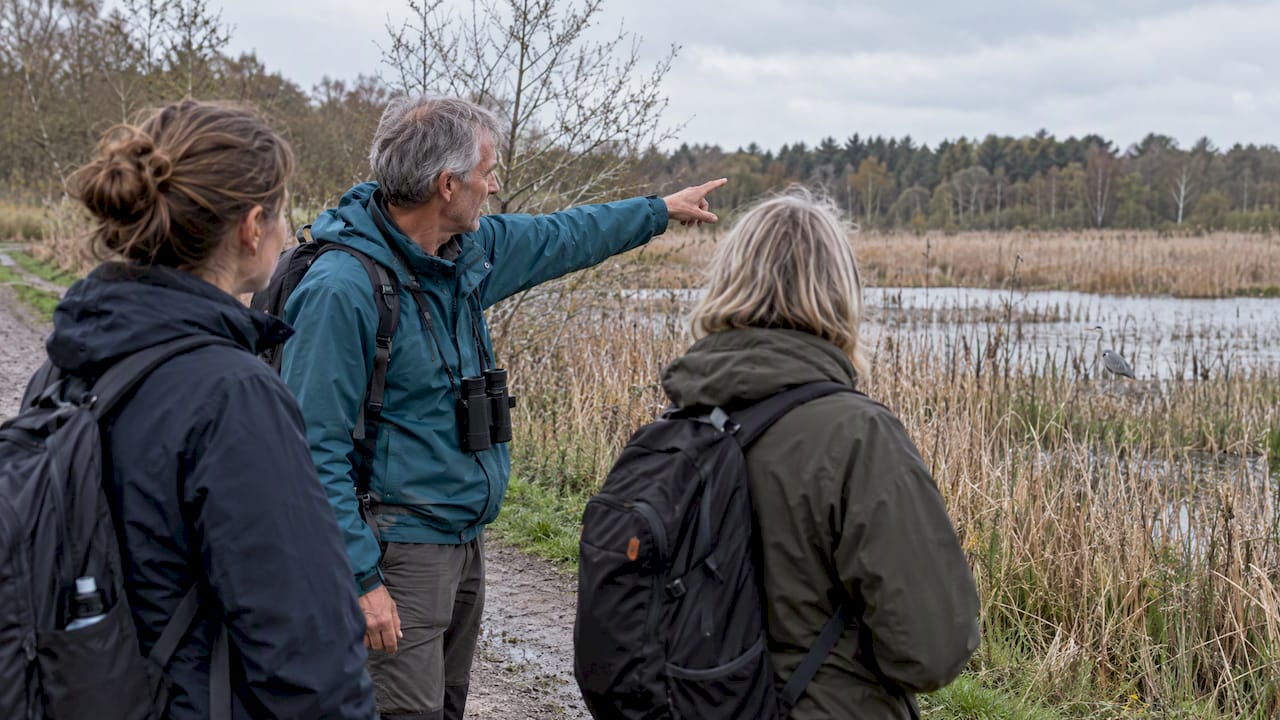
Nature parks. Several Danish nature parks work with local guides: citizens who are not necessarily trained nature guides but who communicate their own area of interest in the park. It could be birds, bats, ancient monuments, or local food culture. The trips range from a short tour to a whole day, and some combine nature with visits to eateries or museums. Check the individual nature park's page for scheduled public tours.
City walks. Most larger Danish cities offer guided city walks, both scheduled public tours and tours that you can book for a group. It's an obvious start if you're new to a city.
Museums and cultural heritage sites. Many museums offer guided tours, and at castles, fortresses, and Viking sites, a guide can turn a grassy hill into a story. Find inspiration in our overview of Cultural heritage sites in Denmark.
Nature guides. Denmark has a long tradition of nature guiding in municipalities, nature centers, and with nature management. Many events are organized for children and families. Our Step-by-step guide to nature experiences Helps you get started well.
Activity providers During experiences on the water, by bike, or on a Segway, the guide is often part of the package. For example, it applies to many thematic activities that we review in the guide about The role of thematic activities for tourists.
If you want to understand how guided tours generally work and what types are available, then read What guided tours are or about Guided tours advantages in Denmark.
We can learn from local guides around the world.
Local guides around the world are intentionally used to protect cultural heritage and generate income. The examples show how significant the role can be.
- Malta: The Merill network became Established in 2010 and recognized as a social enterprise in 2012It helps farmers and craftsmen make money from tourism while preserving local traditions.
- Mexico: I Oaxaca is more than 30 artists and cultural heritage guides I am working on art and communication projects through a temporary paid employment scheme supported by UNESCO.
- India In Taj Ganj near Agra, selected auto rickshaws have been made into Platform for cultural heritage communication and new livelihoodsAnd a means of transportation that tourists still use thus becomes a gateway into the city's history.
- World Heritage Sites: UNESCO and the TUI Care Foundation have entered into a Global partnership for sustainable tourism around World Heritage sites with a focus on the community and the preservation of cultural heritage
The common denominator is the same as you can feel on a good trip in Denmark: when the locals tell their own story, the experience becomes more authentic, and the community gains both ownership and income. During the corona pandemic, some travelers even used local guides remotely via the screenwhen they could not travel themselves. It says something about how much the guide's knowledge and voice matter.
How to choose the right local guide
A guided tour is only as good as the guide. Use these steps before booking:
- Determine the purpose. Do you want history, nature, food, or just an overview of the city? A meal and a trip with an ornithologist are two completely different experiences.
- Check the background. Does the guide talk about their area and their interest? A trained tourist guide typically provides broad knowledge, while a volunteer local guide offers a personal, in-depth perspective. Both can be excellent.
- Ask about length and tempo. One hour is enough for children under school age. A day trip requires a packed lunch, proper footwear, and strong legs.
- Clarify the language. If you have foreign guests or children with you, ask if the guide can adjust the language and level.
- Read reviews with caution. Look for comments about communication and presence, not just about price.
- Clarify price and cancellation. Ask if the price is per person or per group, and what happens in bad weather.
- Plan the rest of the day around the trip. Book the trip early in the day so you can follow the guide's tips on restaurants and places to visit afterward.
God preparation makes a big difference. A well-prepared Destinationsguide makes it easier to plan your vacation, and combined with a local guide on site, you get both the overview and the depth. If you need to get to the meeting place without a car, then see our Guide to local transportation in Denmark.
When you manage well without a guide
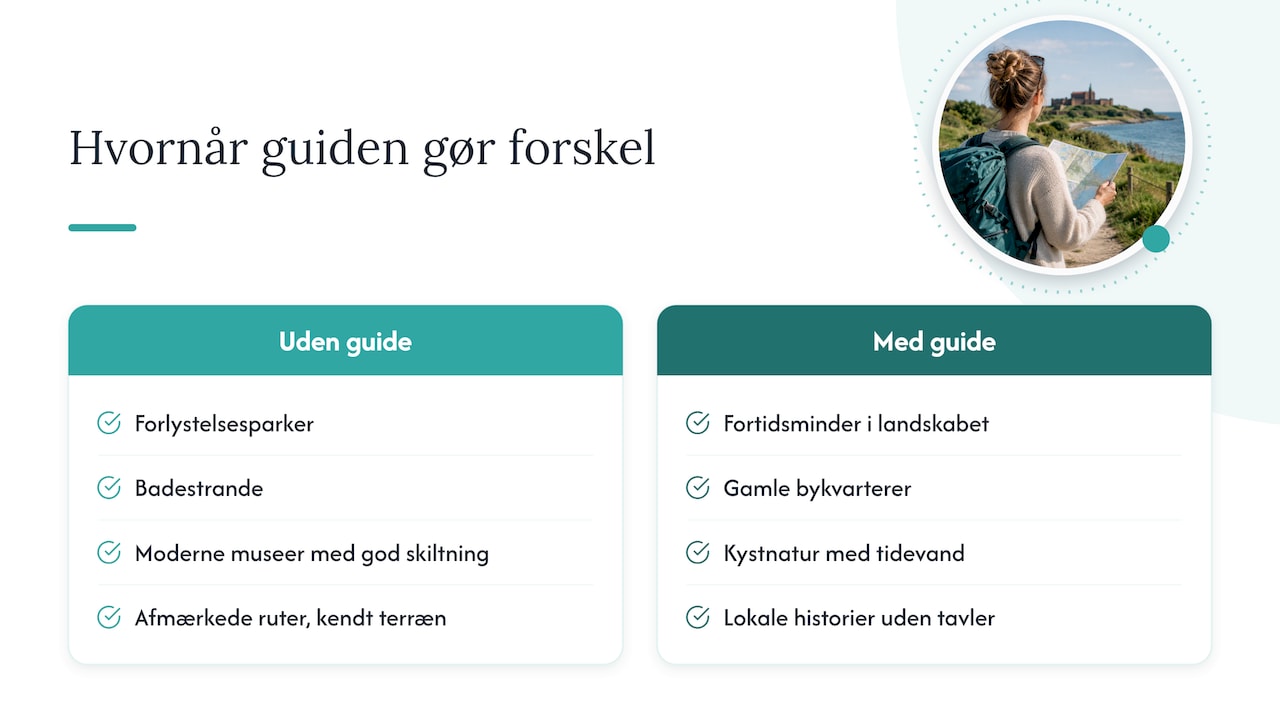
Honestly, you don't need a guide everywhere. In amusement parks, on beaches, and in many modern museums with good signage and audio guides, you are well self-guided. The same applies to marked hiking trails where you know the terrain.
The guide makes the biggest difference where the history cannot be seen with the naked eye: ancient monuments in the landscape, old city districts, coastal nature with tides, and places where the locals have a history that is not written on any plaque. Therefore, choose the guide carefully and combine guided tours with your own discoveries. Our article about Guides in travel planning Show how to make the balance work.
This is how we view local guides
On trips in Denmark, we see every day how differently the same places are experienced. One family can pass by a burial mound without noticing it, while another family, who went on a trip with a local enthusiast, comes home and talks about Vikings for a week. The difference is almost always a person who knew the place and wanted to tell.
Therefore, we believe that local guides are one of the most underrated resources in Danish tourism. They are not only for bus groups and cruise guests. They are for the curious family, for foreign guests who want to understand Denmark, and for Danes who think they know their own country. We recommend planning at least one guided experience on each trip, preferably with a local who is passionate about their subject, rather than the largest and most well-known tour.
Our best advice is to let the guide take control of part of the day. Ask where they would go afterwards. That's often where hidden experiences are concealed.
— Tommy
Find your next experience
On a trip in Denmark, you can find experiences all over the country through our interactive map and filter by season, price, and participants' age. Each experience has a price estimate per person so you can plan your budget before you go. For example Dolphin Safari og Segway Langeland, or explore in all experiences in DenmarkShould the entire trip be planned, start with our guide to, how you plan your Denmark trip.
Frequently Asked Questions
What is the difference between a local guide and a tour leader?
A local guide conveys culture and nature in a specific area and typically accompanies you from one hour to a day. A tour guide accompanies the group throughout the entire trip and especially takes care of logistics and practical matters. Many trips use both: the tour guide for the whole and local guides at the individual places.
Should a local guide be trained?
Not necessarily. Internationally, a tourist guide usually has a qualification for their area, but many local guides in Denmark are volunteers or enthusiasts who share their own area of interest. Ask about the guide's background, and choose based on what you want to get out of the tour.
Are the guided tours suitable for children?
Yes, if the trip is short and active. Choose trips of one or two hours, preferably in nature or with something to touch, and ask the guide if the presentation can be adapted for children. Nature guides' events are often created with families in mind.
How do I find local guides in Denmark?
Look at the pages of the nature parks, the local tourist offices, the museums, and the individual cities' offers of city walks. Many activity providers also include a guide as part of the experience. On a trip in Denmark, you can find experiences all over the country and filter by season, price, and age.
Sources
- WFTGA: Tourist Guide vs Tour Guide
- أداء المرشدين السياحيين واندماج السياح، المجلة الاسكندنافية للضيافة والسياحة
- Exploring memorable peer-to-peer local-guided experiences in Istanbul
- Research article on local guides and cultural dissemination (PMC)
- Social mediation in remote developing world tourism locations, Journal of Sustainable Tourism
- Rural Pact: The Merill Network in Malta
- UNESCO: Cash for Work-initiativer i Oaxaca
- UNESCO: Agras lokalsamfund og levende kulturarvsturisme
- UNESCO and TUI Care Foundation on sustainable tourism
- Perceptions and experiences of distant local-guided tours among online travelers