
TL;DR:
- A city holiday is about balancing culture, history, and everyday life with breaks and immersion to create memorable experiences. Planning should focus on a few anchor points, spontaneous discoveries, and flexibility, so that the experiences become personal and profound. Infrastructure and transportation options such as walking, cycling, and public transport make it easy to explore without stress.
Most people imagine a city trip as a race from attraction to attraction, with crowded tourist maps and sore feet before lunch. But it doesn't have to be like that at all. In Vacation deals are about balance between experiencing a city's density of culture, history, and everyday life and taking the time to breathe and immerse oneself. This guide shows you what a holiday in big cities really involves, and how to put together experiences that actually stick in your memory.
Main Points
| Point | Details |
|---|---|
| City holidays are about balance | The best results are achieved by blending culture, experiences, and breaks at a personal pace. |
| Flexible experiences | There is both space for planned activities and spontaneous discovery in the city holiday. |
| Family can be customized | City vacations can easily be made child-friendly with good breaks and fun activities. |
| Transport gives freedom | You can walk or take public transportation, and adjust the day according to your desire and energy. |
| Vacation is more than the biggest cities | Even smaller towns and neighborhood trips can give a city holiday feeling with the right choices. |
What does vacation in big cities really mean?
Many people use the word "city trip" without thinking about what it precisely entails. Is it a visit to a big city? A week with museums? A long weekend with shopping? The answer is more nuanced than that.
City trips are a form of travel where you experience a city's density of history, culture, and everyday life by moving through streets and neighborhoods, combining experiences with breaks and immersion.
It is precisely the combination of intensity and calm that distinguishes city vacations from other types of holidays. On a beach holiday, the pace is naturally slow. On an activity holiday, the pace is high all the time. The vacation allows you to manage it yourself.
What characterizes a typical city holiday?
- You live centrally and can reach many experiences on foot or by public transport.
- The day is built around one or two cultural or social highlights.
- Pauses and spontaneous discoveries are an important part of the experience
- You live in the rhythm of the city rather than observing it from the outside.
The vacation is not just what you plan. That's also what happens in between. The coffee you drink at a corner square. The shop you stumble into. The street scene you stop and observe. It is precisely this flexibility that makes the city holiday unique and deeply personal.
For family giving also offers special opportunities because the experiences are gathered and accessible. You can read more about the specifics Advantages of child-friendly cities to understand how Danish cities are designed to accommodate the whole family.
Vacation can also be both planned down to the smallest detail and completely spontaneous. Some travelers make a list of museums and restaurants weeks in advance. Andre arrives with an open calendar and finds out along the way. Both approaches work, and many combine them. The important thing is that you are present in the city's space and let yourself be moved by what you encounter.
How to experience the big city: Choosing activities and planning
Now that you know what city vacation is about, you can plan your experiences more consciously. It's not about seeing everything. It's about choosing the right ones for you and those you're traveling with.
A typical structure for city vacations is to pick a culture or activity stop, for example a museum, a concert, or an exhibition, that fills an entire day. Other days are used for exploring without a fixed schedule. The exchange gives energy and calm at the same time.
Here is a simple approach to planning a good city vacation:
- Choose one to two anchor points per day. A museum, a neighborhood, or an experience you won't want to miss. The rest is open.
- Build pauses in from the beginning. Decide to at least once a day sit down somewhere without a schedule. Not because you're tired, but because that's where the best moments happen.
- Use short mapping to understand distances. Many people spend time walking far when everything is actually close. Identify your base and find the experiences within walking distance.
- Have a B-list. The weather changes. An activity is closed. The children do not want to. A list of alternative experiences saves many days.
- Let one day stand completely free. No plans at all. See what is happening. It's often the day you remember best.
| Type of day | focus | Example of activity |
|---|---|---|
| Culture Day | Museum or exhibition | National Museum, Aros, Fuglsang |
| Discovery Day | Blocks and neighborhoods | Nørrebro in Copenhagen, Latin Quarter in Odense |
| Family Day | Child-friendly experiences | Tivoli, zoo, playground |
| Today | Pause and immersion | Cafe, bookstore, park |
| Spontandag | No plan | Go and see what you find |
Professional tip: Use the first morning in a new city to take a walk without a destination. Not with the tourist card in hand, but just to feel the city's rhythm. It gives a better sense of what you want to spend your time on in the coming days.
When you are looking for inspiration for specific activities, there are many good places to start. You can find Tips for experiences in Copenhagenthat suits many types of travelers, or you can choose activities in Denmark based on season, age, and price through a filter system that makes planning much easier.
The important thing is not that you follow a specific recipe. The important thing is that you make conscious choices instead of filling the days because you "have to accomplish something." Quantity is rarely what you remember. It's the specific moments that stick.
Transport, flexibility, and infrastructure in Danish city holidays
After you have chosen your activities, the next question is: How will you get around? The answer is crucial for whether your city trip feels relaxing or stressful.
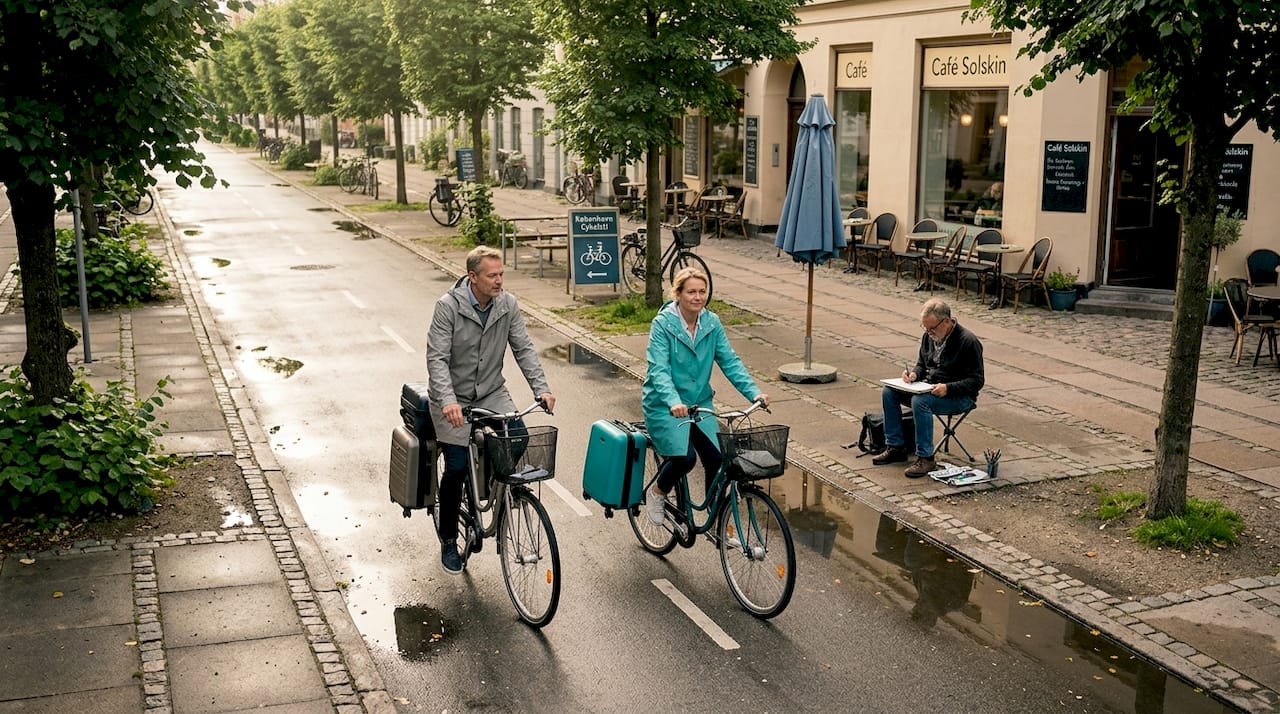
A major advantage of city trips in Denmark is that much can be done on foot or by public transport. That means you are not bound by parking spaces, queues, or departure times. You can customize the day according to energy and desire, and it's a freedom that one rarely appreciates until they've tried it.
Sammenligning: Transportformer på byferie
| Transport form | Advantages | Disadvantages | Best for |
|---|---|---|---|
| On foot | Free, flexible, discovers more | Slow, requires energy | Short distances, discovery |
| Bicycle | Fast, cheap, healthy | Requires bike rental, weather | Medium distances |
| Public transportation | Reaches far, comfortable | Can be confusing | Horizontal stripes, rain |
| Taxa/delebil | Fast door-to-door | Expensive, not flexible | Specific errands, evening |
Danish cities are generally very bike-friendly. Copenhagen has over 390 kilometers of bike lanes, and Odense has been named one of Europe's best cycling cities. Renting a bike for a day typically costs 100 to 150 kroner and opens up the city in a completely different way than the bus does.
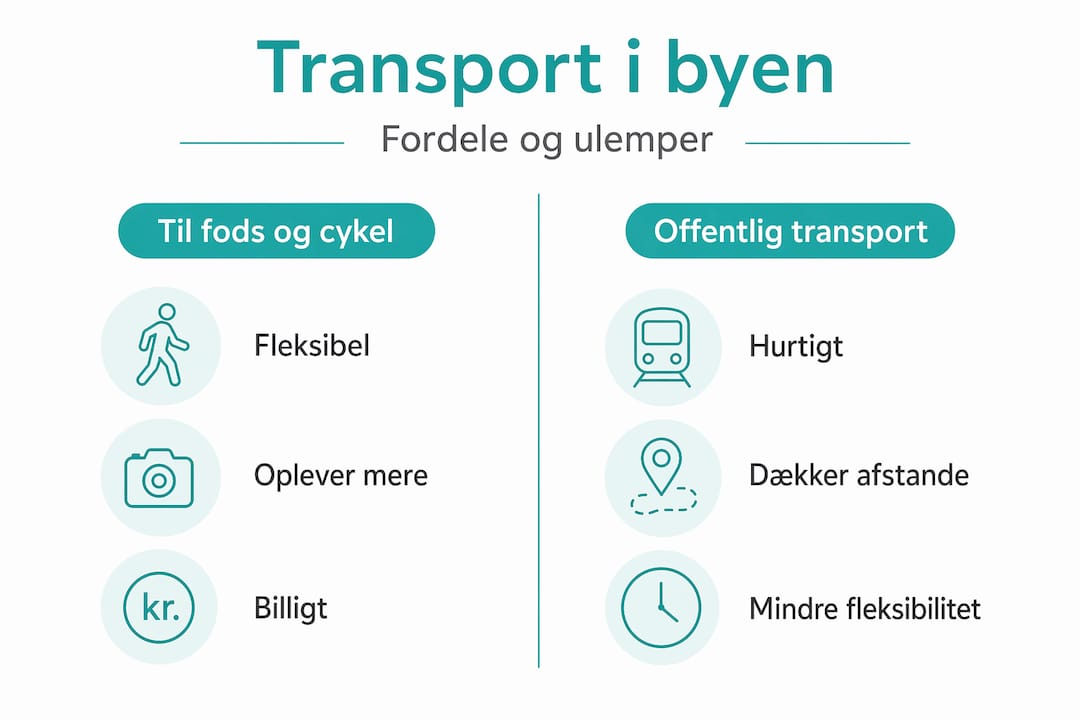
Public transportation is a natural choice when you need to travel from one district to another. In Copenhagen, the Metro and S-train cover almost the entire city, and travel cards or day tickets make it cheap and uncomplicated. In Aarhus, the light rail is a good supplement to the buses, and in Odense, the bus network functions efficiently in the city center.
Professional tip: Download the transportation app for the city you are visiting before you travel. In Copenhagen, it is the Journey Planner combined with DOT Mobile Ticket. In Aarhus and Odense, Midttrafik and FynBus are the relevant apps. It saves time and stress when you suddenly have to move on.
Walking is underrated as a mode of transportation on vacation. When you walk, you see shops, street scenes, and people you would never notice from a bus. Many of the best foundations and discoveries happen precisely because you chose to walk instead of taking transportation.
You can find more detailed advice on Use local transportation In Danish cities, including practical tips for map reading, ticket purchasing, and combined routes that make everyday life easier on vacation.
Transport choice ultimately depends on what kind of experience you want. Do you want to see very quickly? Choose the bus. Do you want to discover slowly and randomly? Go. Do you want to cover long distances with little effort and fresh air? Bike tag. The right combination depends on you and your day.
Family-friendly city trips: Activities and practical tips
When transportation and infrastructure are in place, the experiences should also consider the whole family. City vacations with children are a completely different exercise than city vacations with adults, but it's not more difficult. It just requires a slightly different prioritization.
Family vacation It's about mixing child-friendly activities, breaks, and budget-friendly solutions so that everyone can stay in the city all day. It's not either/or. It's both at the same time.
Key points for a successful family holiday:
- Start early in the day. Children have the most energy in the morning. Use it for what requires attention and activity.
- Plan breaks actively. A playground in the middle of the day is not a waste of time. It is an investment in a good afternoon mood.
- Hold the budget with free activities. Many parks, beaches, and public spaces in Danish cities are free and exciting for children.
- Choose museums with interactive content. Children thrive best when they are allowed to touch and try, not just watch.
- Bring food and drink. A small picnic bag saves money and allows you to eat right where you are.
- Accept detours. Children find interesting things you would never have noticed yourself. Let them play sometimes.
Professional tip: Spend a quarter of an hour every morning asking the children what they would like to do that day. Give them one choice out of your list. It creates ownership and shared responsibility, and you avoid resistance because they have chosen themselves.
Danish cities offer a wide range of experiences specifically aimed at families with children. You can see a wide selection of child-friendly activities divided by cities and seasons, or you can dive into the list of them best museums for children with concrete recommendations and price overviews.
Many families underestimate how much a city can offer children who are not the typical museum type. Zoos, aquariums, nature playgrounds, maritime museums with real ships, and interactive science centers are spread throughout Denmark. You don't need to travel to Legoland to have a memorable children's day in a Danish city.
The budget is a real factor for many families. A thumb rule is to set a maximum limit for paid activities and fill the rest with free experiences. Parks, harbor fronts, markets, and street scenes cost nothing and can be just as entertaining for children as an expensive attraction.
Is city break only for big cities? Nuances and alternatives
From a family perspective, it is natural to ask: Does a city holiday actually require a big city? The answer is no, and it opens up many exciting possibilities you may not have considered.
In vacation can include both classic city stays and nearby city vacations, for example weekend stays in a medium-sized city or a hotel in an interesting neighborhood. The important thing is not the size of the city. It's how you plan the content.
Examples of city vacations outside the big cities:
- Ribe: Denmark's oldest town with a compact center that can be explored on foot in a weekend. Medieval history and a special atmosphere in the evening.
- Elsinore Kronborg Castle, maritime districts, and easy access to Sweden by ferry. A full day can easily be filled with culture.
- Roskilde: The cathedral, the Viking Ship Museum, and a lively city center with markets and cafes. Perfect for the family.
- Vejle Fjord town with exciting architecture, paths along the water, and an active cultural scene. Unknown to many, but well worth a visit.
- Næstved The largest town in South Zealand with a charming old town center, proximity to forests, and the Suså River valley.
The point is that the city holiday experience is created by your attitude, not by the size of the city. If you choose to stay centrally, walk around, seek cultural experiences, and take breaks along the way, it is a city holiday. Whether you are in Copenhagen or Kolding.
Quarter-based stays are another variant. Instead of seeing the whole city, you choose one neighborhood and get to know it in depth. You eat at the local places, find the small shops, and talk to the people who live there. It is a slower form of city holiday, but often much more rewarding.
If you want concrete ideas for composing content, you can find Examples of family activities from many different Danish destinations, illustrating what a city holiday can look like in practice.
Why balanced city vacations give you the best memories
Here is the uncomfortable truth about city vacations: Most people do it wrong. It's not because they choose the wrong sights, but because they try to see too many.
The dominant perception of city vacations is that you have to see everything. Put a checkmark next to the known attractions. Follow the tourist map. Spend every waking hour experiencing. And the result? You come home tired, with hundreds of photos you'll never look at again, and a vague feeling that you weren't really present in the city you visited.
Vacation can be understood as an intensive project of "seeing everything," but the most rewarding definition actually emphasizes the balanced pace and the pause. It's not the same as doing nothing. It is a matter of choosing carefully.
We have observed a clear pattern: the travelers who remember their city vacations best are those who had time to reflect on what they experienced. Sat at a table and observed a street scene. They talked to a random person in a line. They accidentally discovered a side street and followed it. None of these things cost money, and none of them require planning. They only require that you're not too busy to notice them.
The best advice we can give is to narrow down your choice of city activities to what truly matters to you. Not what you think you "should" see. What you are actually looking forward to.
Curiosity is the most important tool on a city trip. Not the card, not the list, not the recommendations from others. Your own curiosity. What attracts your attention? What would you like to understand better? That's where your city holiday should begin.
Get even more out of your next city trip
Travel in Denmark is designed to help you do exactly what we have discussed in this article. The platforms gather hundreds of experiences, attractions, and activities from all over the country, filtered by season, price, and age group, so you can quickly find what suits your travel group.
Whether you're planning your first city trip to Denmark or looking for new perspectives on familiar cities, there's plenty of inspiration to be found. Start with the practical Guide to Denmark for visitors, bridge day trip checklist to ensure that you have control over the practical matters, or see the many child-friendly attractions for ideas that work for the whole family. Your next city holiday starts here.
Frequently Asked Questions About Holidays in Big Cities
Which Danish cities are best suited for a city trip?
Copenhagen, Aarhus, and Odense are the most popular choices, offering a wide range of culture, history, and easily accessible activities all within compact city centers.
Is it necessary to have everything planned on a city trip?
No, and you should actually avoid that. A typical mechanic in city vacations is precisely to combine fixed activity days with open days for spontaneous exploration.
How do I make the city holiday child-friendly?
Include playgrounds, interactive museums, and budget-friendly breaks in the program. Holiday with children is about finding the balance so that everyone in the family has energy and the desire to participate.
What is the difference between a city trip and other vacations?
City vacations are centered around urban life and a dense concentration of culture and experiences. The classic definition of city vacation emphasizes the density of experiences and the opportunity for immersion, which distinguishes it from nature vacations or activity holidays with long transports between experiences.