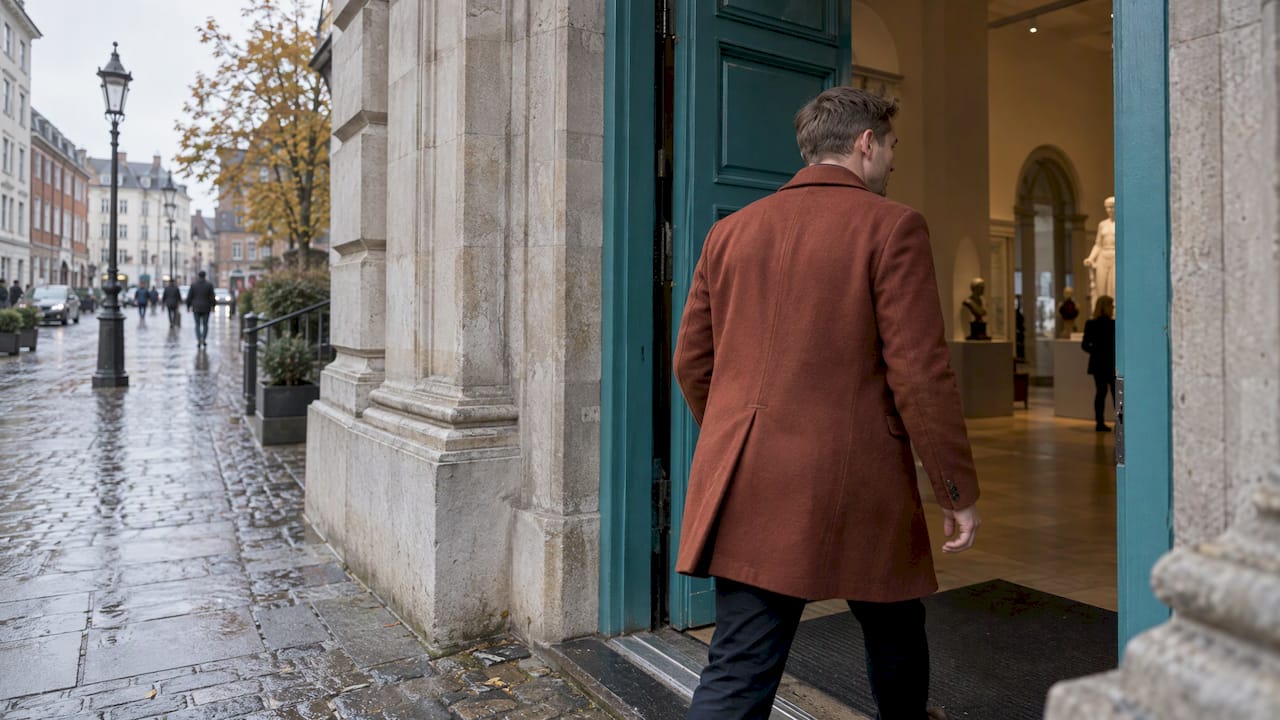
A year-round destination is a travel destination that attracts guests and keeps its offerings open throughout the year, not just during the summer holidays. This means that you can also find open restaurants, attractions, accommodations, and experiences in October, February, or March that make sense specifically for that season. For you as a traveler, the concept is useful because it tells you where you can expect life outside the high season. But the word is often more a goal than a guarantee, and therefore good planning is about finding the specific experiences that are available when you travel. That is exactly what we help with at Rejs i Danmark, where you can filter experiences by season, price, and age.
Year-round destination briefly explained
The word consists of two parts. A destination is the place you are traveling to: a city, an island, a coastline, or an entire region. "Year-round" means that the place operates as a destination all twelve months of the year.
A year-round destination is therefore not just a place where people live all year round. Almost all Danish towns have permanent residents in the winter. The difference lies in whether the place also has something to offer tourists when the summer guests have gone home. It can be:
- restaurants and shops open on weekdays and weekends
- attractions, museums, and nature experiences that do not close after the school summer holidays
- accommodation that accepts guests during the winter season
- events and seasonal themes that provide a reason to come specifically in the autumn or winter months
The term is used in two contexts. Travel providers use it for places with a mild climate all year round, for example warm islands where you can swim in both March and November. In Denmark, it is most often used to mean something else: a strategy where cities and regions work to attract visitors outside the busy summer weeks. When a Danish coastal town calls itself a year-round destination, it rarely means that the water is warm in January. It means that the city will be worth visiting, even when it is windy.
High season, shoulder season, and low season
To understand year-round destinations, you need to know the three seasons into which the tourism industry divides the year. A thesis from Aalborg University defines the shoulder season such as the periods just before and after the high season. The researchers also point out that tourist advertisements featuring sun and blue skies help to maintain the idea that Denmark is only a summer country.
| Season | Typical period in Denmark | What you can expect |
|---|---|---|
| Peak season | Summer holidays, especially July | Most guests, most life, highest demand for accommodation |
| Shoulder season | Spring and autumn, e.g. May, September, and October | Fewer guests, many offers still available, often good opportunities for nature and culture |
| Lambing season | The winter months, especially January and February | Quietest, some places close while others have special winter and Christmas offers. |
The fluctuations are called seasonality. A task from Aalborg University on seasonality in Møn describes it as a periodic change in guests' use of the destination, where the number of guests fluctuates with weather, calendar, attractions, and availability. A year-round destination is a place where the fluctuations have become smaller because there are reasons to come all year round.
If you want to dive into how the seasons shape your opportunities, we have compiled a guide for you. seasonal experiences and one more seasonal travel.
Why year-round tourism is so significant in Denmark
If you have read local newspapers or tourist news, you have probably seen the word year-round tourism again and again. This is because Denmark has a clear national goal. According to the National Tourism Strategy, shall 2/3 of all overnight stays in 2030 will be outside the high season.
The development is heading in that direction. In 2024, Danish and foreign tourists made 65 million overnight stays in Denmark, an increase of 2.1 percent from 2023. It was May and October that contributed most to the growth, while June and July declined slightly. In other words, more travelers are choosing the quiet months.
Denmark is not alone. In Austria, April, May, September, October, and November together constituted 28.1 percent of all overnight stays in 2025, and the country's tourist organization refers to spring and autumn as growth drivers rather than shoulder seasons. The trend is the same in many places in Europe: more people want to travel when there is space, calm, and a slower pace.
For you as a traveler, it means that the offerings outside of summer are growing. Several places stay open longer, and more cities create events in the autumn and winter to give guests a reason to come.
How to see if a place is actually open year-round
Here lies the most important point: That a place calls itself a year-round destination does not mean that everything is open all year. Some places are further ahead than others, and the difference is significant.
Look at how large the fluctuations are.
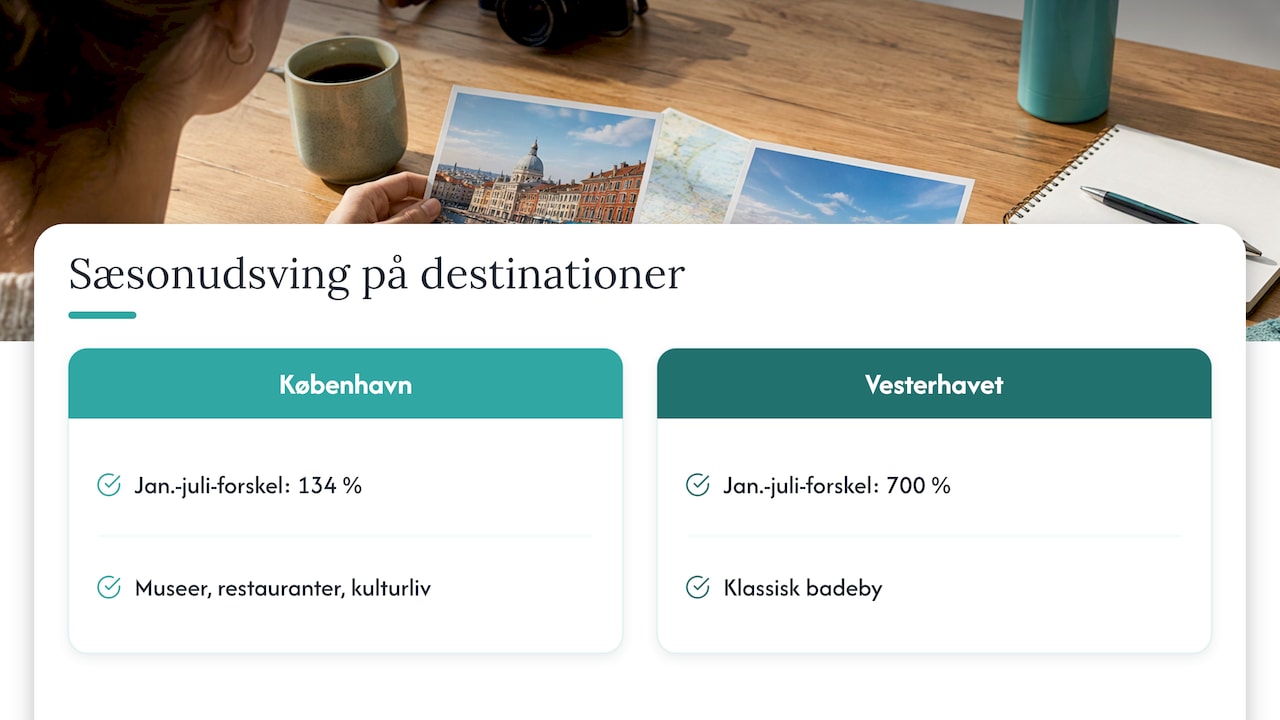
Figures from Statistics Denmark, as reproduced by Turistmonitor, clearly show the difference. In 2019, there was in Copenhagen 134 percent difference between January and July, while the difference along the West Coast in Destination Vesterhavet was 700 percent. A big city with museums, restaurants, and cultural life thus functions much more as a year-round destination than a classic seaside town.
The same pattern applies to the small islands. A note from Danish Small Islands shows that July is the month with the most ferry passengers. to the small islands, and that in winter it is especially residents and workplaces that determine the traffic. If you are planning an island trip in the low season, it is therefore a good idea to check the ferry schedule and available offers before you set off.
Look for places that collaborate on opening hours.
The places that succeed best are those where the local actors come together. In Svaneke on Bornholm, the trade association decided in 2019 to stay open outside the season, and 20 participants supported it. According to the Tourist Monitor, the number of overnight stays has since increased by 150 percent.
Along the Wadden Sea, DR has described how the cities aims for year-round openingbecause tourists are tired of empty shop windows and closed restaurants in the winter. Shops and eateries are encouraged to keep staggered opening hours so that there is always something to go to.
Be prepared that not everything is included
Elsewhere, one is still on the way. Turisme.nu mentions Gudhjem on Bornholm as an example of a town where several restaurants are closed in November. Therefore, it is wise to view a location's year-round profile as a direction and then check the specific experiences you want to spend your time on.
Danish places working to become year-round destinations
Many Danish cities and regions aim to be year-round destinations. Here are some of the examples that have received attention:
- Blokhus: The coastal town has for several years fought to become a year-round destination, so the city is not only filled up in the summer. Blokhus Natur Camping held winter opening for the first time to support the cause, and the town has a ice rink on the square in the dark time, which is meant to create a Christmas atmosphere. If you are considering a trip there, you can read our guide to camping in Blokhus.
- Bornholm The island has the ambition to be a year-round destination, and towns like Svaneke show what cooperation can mean for life outside the season.
- The Wadden Sea Coast: The cities coordinate opening hours so that visitors can find open shops and eateries even during the winter months.
- Copenhagen: The capital has the smallest seasonal fluctuations of the examples mentioned by Turistmonitor, thanks to a broad cultural and restaurant scene.
Many international guests land in Kastrup all year round and combine Copenhagen with a trip across the Øresund. If you are going on to Malmö or the rest of Skåne, do a airport transfer in Skåne It is easy to get from the plane to accommodation, even on dark winter evenings.
How to plan a trip outside the peak season
A trip in the shoulder or low season requires a bit more preparation than a summer vacation, when everything is open. In return, you often get more peace, more space, and another side of Denmark. Here's how to approach it:
- Choose the season according to the experience. Autumn is great for forest walks and mushrooms, winter for museums, Christmas markets, and winter swimming, and spring for bird migration and bright evenings. Start with what you want to experience, and then find the place.
- Find experiences that are available during your period. This is where most plans go wrong: You find an exciting place and discover upon arrival that it is closed for the season. On Travel in Denmark You can search on the map and filter experiences by season, so you see suggestions that match the time of year.
- Check the price per person. We provide a price estimate per. person with the experiences, so you can create a realistic budget. If you want to keep the cost down, we have gathered free experiences Throughout the country.
- Check age and target audience. If you are traveling with children, you can filter by participant age to find experiences that suit the whole family.
- Keep an eye on holidays and vacations. Opening hours may change around Christmas, Easter, and other holidays. Our guide to Danish holidays and opening hours helps you avoid surprises.
- Confirm the opening hours before you drive. Opening hours outside the season may change from year to year. A quick look at the attraction's own page before departure ensures that the door is open when you arrive.
- Take care of the weather. Danish winter and autumn can be wet and windy. With rainwear and warm footwear, a coastal or forest trip becomes a good experience instead of a cold one.
If you are traveling with children, the low season can be an advantage. Read more about the benefits of vacationing in the low season for families with children.
Experiences that make Denmark a year-round country
Although summer attracts the most visitors, there are many experiences that work just as well, or better, the rest of the year.
Nature. Forests, dunes, heaths, and coasts change character with the seasons. Autumn colors, winter storms at the North Sea, and the first green shoots of spring are reasons to travel in themselves. Find inspiration in our guide to Nature experiences in Denmark or our overview of nature parks in Denmark.
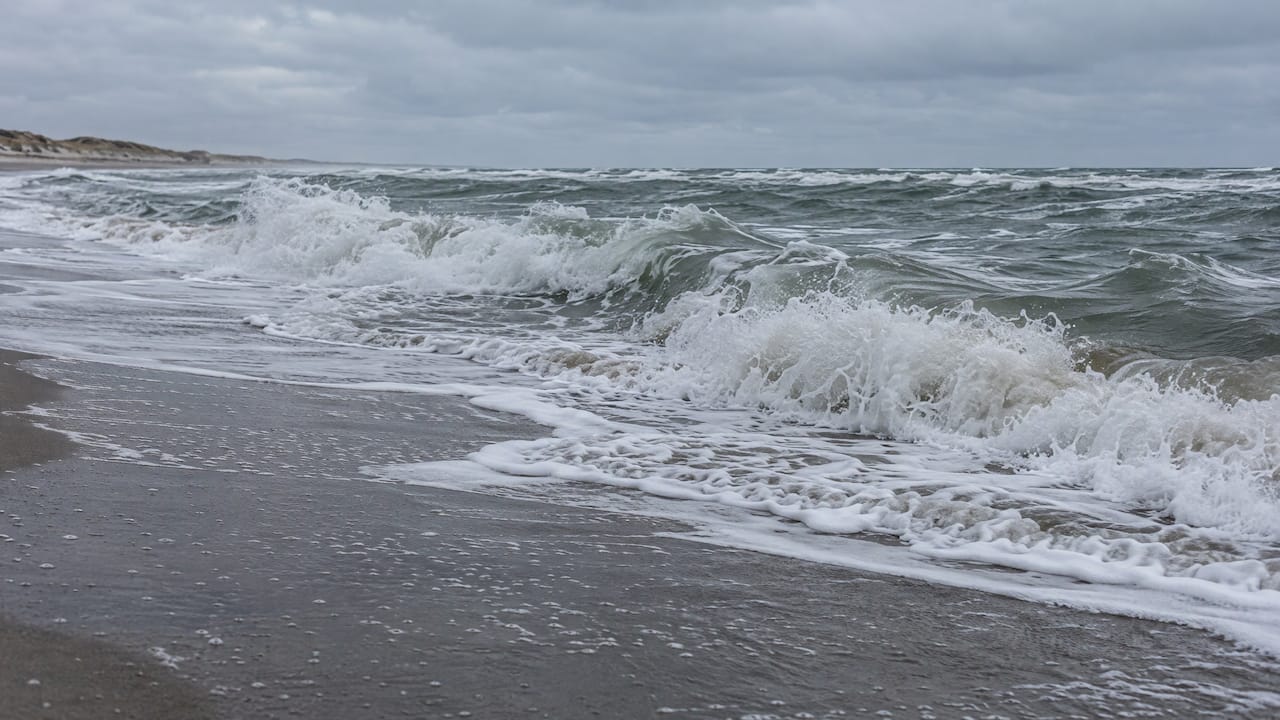
Museums and culture. Indoor experiences are perfect when the weather is bad. Denmark has everything from art museums to historical collections, and our guide to types of museums in Denmark helps you choose. Open-air museums often have special events during the holidays, so also check out our page on open-air museums.
Historical attractions. Castles, churches, and ancient monuments can be visited in all seasons and are often less crowded outside of summer. See our selection of historical attractions for families.
Holiday parks and indoor activities. Many families choose holiday parks with water parks and activities that do not depend on the weather. See our overview of holiday parks in Denmark.
You can find more ideas in our 7 tips for experiences all year round.
Find experiences for every season at Travel in Denmark
When a place calls itself a year-round destination, your next question is: What can we do when we are there? At Travel in Denmark, we gather experiences, attractions, museums, natural areas, amusement parks, and events from across the country. You can search on the map, filter by season, price, and participants' age, and see a price estimate per. person, before you decide. We show both the well-known places and the hidden gems, and we refer you to booking when you are ready. Find your next experience in Denmark.
Our perspective on year-round destinations
We see year-round destinations as one of the most exciting concepts in Danish tourism right now because it shifts the focus from the weather to the experience. Denmark has never been able to compete with Southern Europe on guaranteed sunshine, but we have nature, culture, and city life that are worth experiencing all twelve months.
The challenge for travelers is rarely that there is nothing to do. The thing is, it can be difficult to figure out what is relevant in the exact week you have off. Therefore, we have built Travel in Denmark with seasonal filters, map search, and price estimates per. person: så du kan starte med din rejseperiode og se, hvad der passer til den.
Our advice is simple. Use the word year-round destination as an invitation, not as a promise that everything is open. Choose the place, find the experiences for your season, and travel when there is space and peace. Many of the best Danish experiences await in October, February, and March.
Tommy
Frequently Asked Questions
What is the difference between a year-round destination and year-round tourism?
A year-round destination is the very place that attracts guests all year round. Year-round tourism is the broader development where tourism spreads over several months instead of concentrating in the summer. In Denmark, year-round tourism is a national goal, and year-round destinations are the places that achieve it.
Is Denmark a year-round destination?
Denmark is moving in that direction. More overnight stays are scheduled for May and October, and the national goal is that two-thirds of overnight stays in 2030 should occur outside the peak season. Big cities like Copenhagen are the most advanced, while many coastal towns are still working on it.
When is the shoulder season in Denmark?
The shoulder season is the periods just before and after the peak season, typically spring and autumn such as May, September, and October. Here there are fewer guests, but many experiences are still open. It is often a good time for nature and cultural experiences.
How do I find experiences that are open in the winter?
Start by selecting your travel period, and use a season filter to find relevant experiences. On Travel in Denmark, you can filter by season, price, and age and see the experiences on the map. Then check the opening hours of the place itself just before departure.
Sources
- Here Comes the Sun: A case study of seasonality inducing discourses, Aalborg University
- Tourism Seasonality on the Island of Møn, Aalborg University
- Behind Bornholm's struggle with the off-season, turisme.nu
- More guests outside the peak season create a new record year in Danish tourism, Danish Business
- Austria's Path to a Year-Round Destination, Prost Magazine
- Expert believes year-round tourism is important, Tourist Monitor
- Ferry passenger numbers for the small islands, Danish Small Islands
- Tourists tired of winter closures, DR
- Coastal town fights to become a year-round destination, TV2 Nord
- The ice rink transforms the city into a year-round destination, Nordjyske