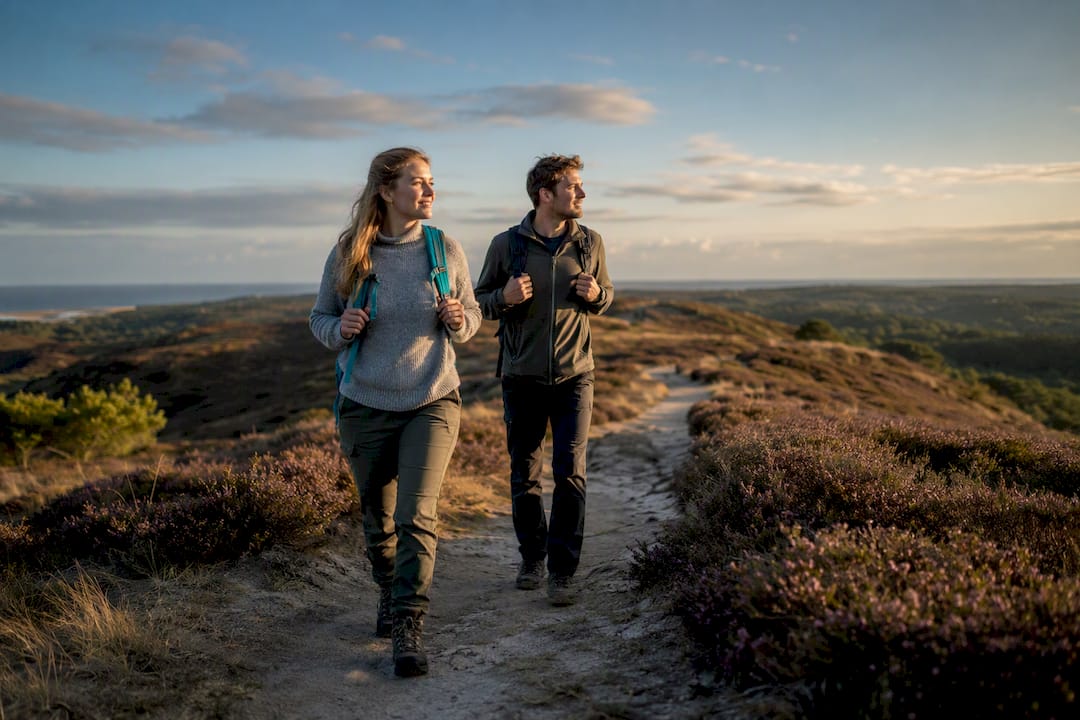
Start with a short, marked route of 5 to 10 km, pack the essential gear, and check the weather before you leave the house. Choose a trip that matches your level, make sure to bring 1.5 liters of water, a wind or rain jacket, good shoes, and a small first aid kit. Check DMI's alerts, tell someone else where you're going, and keep your phone with a charged battery ready to call 112 if something goes wrong.
Step 1: choose route based on distance, terrain, and facilities
The length of the stick and the terrain determine whether the trip will be a good experience or a tough ordeal. For beginners, 5 to 10 km on flat or gently hilly terrain is a reasonable starting point, preferably with a reference point of around 4 km per hour on flat ground, as recommended in German hiking guide for beginnersTerrain with hills or uneven surfaces noticeably slows down the pace, so allow extra time if the route involves elevation changes.
Marked trails make a big difference for beginners because they reduce the risk of getting lost. Look for routes with clear signage, preferably documented in local folders or on official route pages, where The Danish Nature Agency collects descriptions of Danish hiking trails with information about parking and facilities.
When choosing a route, you should consider:
- Distance from the parking lot or the nearest public transport to the starting point.
- Access to toilets, benches, or shelters along the route.
- If the route is circular or requires return transportation.
- Terrain difficulty: flat, hilly, or alternating terrain.
You can find specific suggestions on the interactive map on Rejs i Danmark, where filters make it easy to find routes that suit your time and your level. A good rule of thumb for your first trip: choose a route you can shorten if the weather changes or your energy wanes.
Step 2: Packing list for your first nature walk
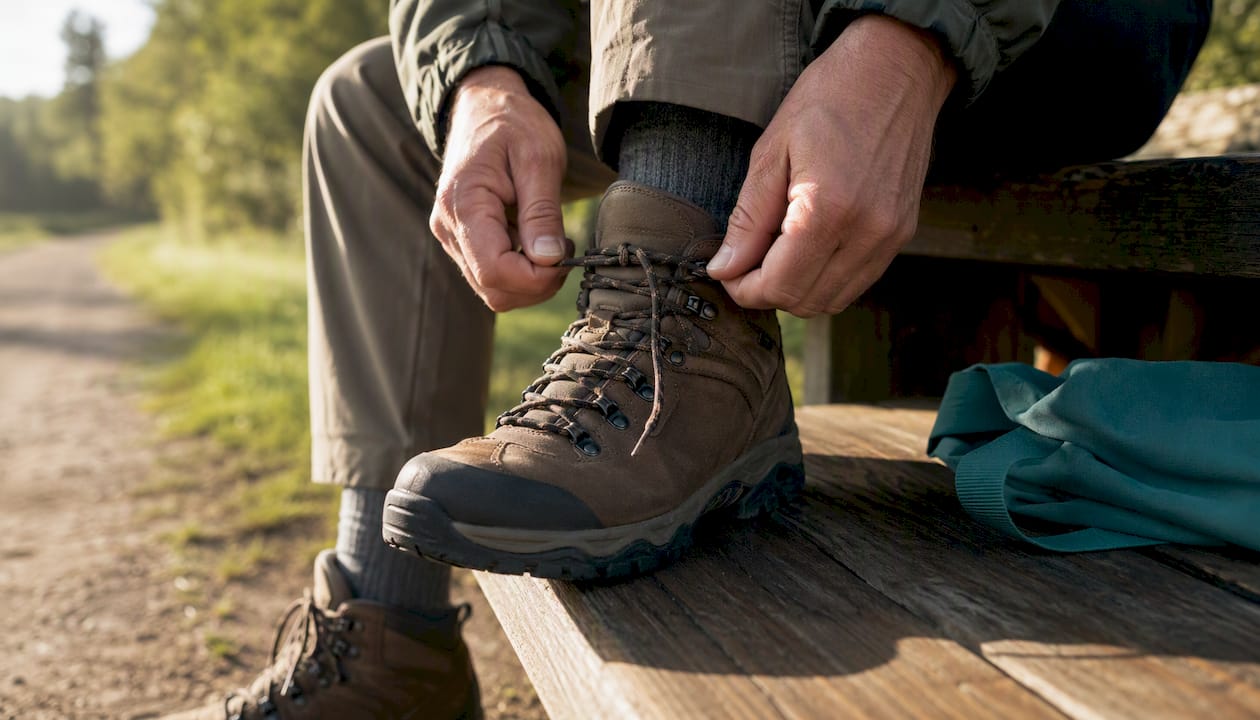
A good packing list saves more trips than most other equipment. Footwear comes first: choose hiking shoes or sturdy carpenter's shoes with a good sole, and avoid brand new shoes on a long trip. Dress in layers so you can adapt to temperature changes: a breathable layer underneath, an insulating layer, and a wind or rain jacket on the outside.
A backpack of 20 to 30 liters is enough for a day trip and provides space for the following:
- Vand: mindst 1,5 liter per person til en almindelig dagstur.
- Mad: energirig snack som nødder, frugt eller en sandwich.
- First aid: plaster, compress, and possibly a bandage for sprains.
- Mobile phone with full battery and a power bank as backup.
- Extra layer: a light jacket or fleece, even in the summer months.
- Kort eller app med den planlagte rute downloadet på forhånd.
Shoes are often the weakest link in beginners. According to the guidelines, walking shoes for children should be broken in before a longer trip, because new shoes easily cause blisters and chafing.
Professional tip: Break in your hiking shoes with short walks during the week leading up to the hike, so that the sole and insole mold to your foot before you cover kilometers on a long route.
Step 3: navigation with map, app, and markers
You don't need to be technically skilled to navigate safely in nature. Paper maps and digital apps each serve their own purpose, and most experienced hikers use both as backups for each other.
- Paper maps work without batteries and signals, making them a safe supplement on longer trips.
- Apps with GPX files display your location in real time and make it easy to follow a planned route.
- Download the entire route before leaving the coverage area so the app works offline.
- Use the physical markings of the trail as checkpoints, and feel free to note them on a map before departure.
Beginner's guide to hiking emphasizes that the combination of paper and digital maps provides the best safety, because technology can fail, while a map in your pocket always works.
Set a realistic finish time and keep an eye on how much time has passed relative to the distance. If you haven't reached halfway after half of the planned time, it is a signal to consider a shorter return route. A simple plan B, which is a shortcut back to the parking lot, makes the decision easy if the weather or energy turns.
Step 4: safety, weather, and access rules in nature
The weather is the factor that most often changes a nature walk from a good day to a risky situation. During thunderstorms, clear advice applies:
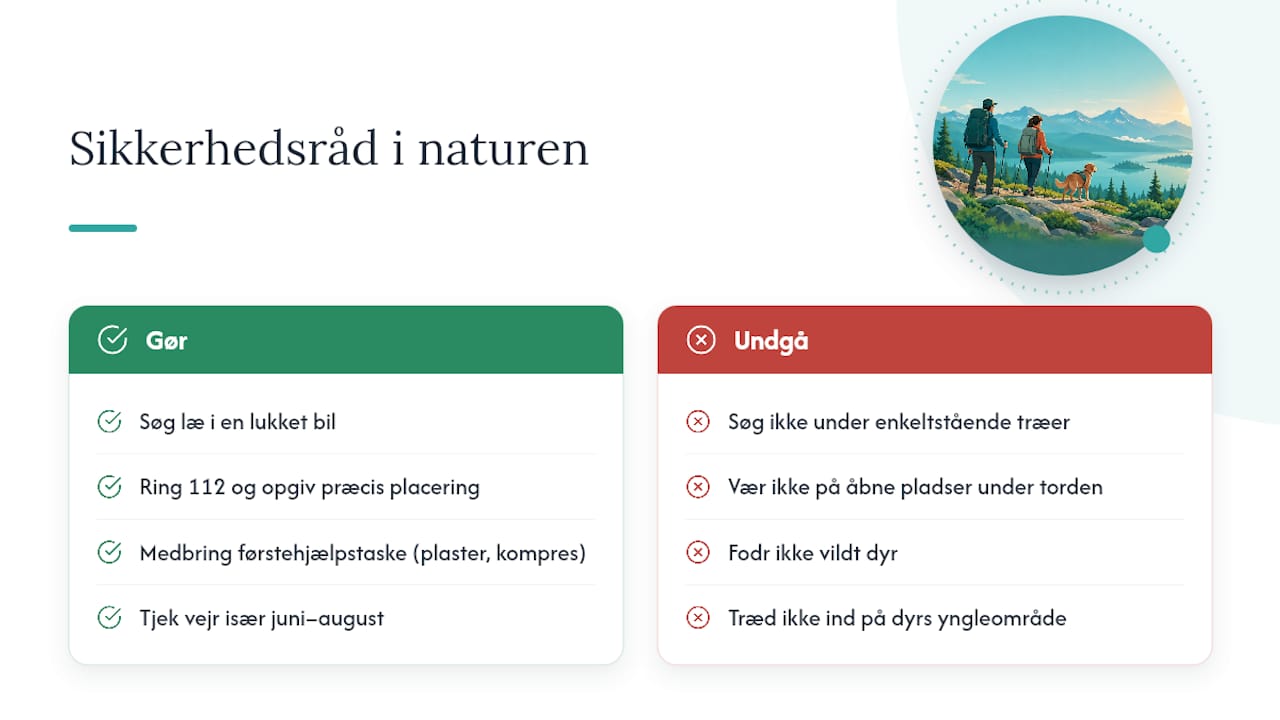
Do not seek shelter under isolated trees or in open spaces. A closed car functions as a safe Faraday cage, and a rule of thumb is that 3 seconds between lightning and thunder corresponds to about 1 km distance.
Kilde: DMI’s forholdsregler ved tordenvejr.
85% of thunderstorms in Denmark occur in June, July, and August., according to DMI, which makes the summer months particularly important to keep an eye on when planning a trip.
Access to nature in Denmark is regulated. Regulation of the Nature Conservation Act It states that stays must not take place within 50 meters of residential buildings on private beaches, and that dogs must be kept on a leash on beaches from the 1st. April to the 30th. September If you have a dog, the leash period is therefore something you should plan around, especially during the summer months.
Encounters with wild animals are rare, but keep your distance and avoid feeding or intruding on animals you meet along the way, especially during the breeding season in spring. If you or someone in your group is injured, call 112 and provide as precise a location as possible, preferably with coordinates from your navigation app. A simple first aid kit with plasters and compresses covers the most common injuries such as scrapes and sprains.
Step 5: tempo, pauses, and physical preparation
Realistic trip planning makes the journey more enjoyable and less exhausting. On flat terrain, about 4 km per hour is a reasonable starting point for a beginner, while hilly terrain or inclines significantly reduce the speed, as described in the guide for new hikers.
- Plan a break of about 15 minutes every 60 to 90 minutes of walking.
- Eat and drink a little during each break instead of waiting until you're exhausted.
- Use the first few kilometers to find a pace you can maintain for the entire ride.
- Build up to longer hikes with a few short walks in the weeks before your first real hike.
Physical preparation doesn't have to be advanced. Take a walk of 3 to 5 km a couple of times a week before your hike, and gradually increase the distance so your body gets used to the strain. It reduces both the risk of injuries and the chance that the trip feels overwhelming along the way.
Step 6: Hiking with children or dogs
Families and dog owners need a few different adjustments than the solitary hiker. Choose a route with natural points of interest, such as a viewpoint, a creek, or a birdwatching tower, so the children have something to look forward to between the stages.
- Divide the route into short sections with breaks at specific landmarks, which the Nature Agency often marks on their routes.
- Hold the dog on a leash during the period from 1. April to the 30th. September, as required by the Nature Conservation Act, on beaches.
- Avoid areas with grazing animals, and keep your distance even when the dog is on a leash.
- Bring extra change of clothes, a small activity like binoculars or a magnifying glass, and build flexible time into the plan.
A trip that feels too long for adults is often far too long for a child. Expect shorter distances and more breaks than you would plan for yourself alone.
Five easy Danish routes for your first hike
These routes are chosen because they are marked, have access to parking or public transportation, and suit distances between 5 and 12 km.
- A coastal route along a beach with marked trails and access to bathing facilities, suitable because the terrain is flat and easy to follow.
- A forest trail with a car road near the starting point, where signage and information boards make navigation easy.
- A lake or fjord route with a rest area, where benches and viewpoints provide natural breaks for families.
- A route with a short distance and open landscape, where you can easily see the path ahead and plan the pace.
- A park route near a town, ideal as a warm-up before a longer nature hike, with easy transportation to and from the starting point.
You will find more specific suggestions with distances and facilities in Overview of ten hiking trails in Denmark, and a broader introduction to planning in Step by step guide to nature experiencesIf you want to combine forest or heathland with a coastal trip, you can Guide to beach excursions Give you a couple of extra ideas for routes along the water.
Get off to a good start, even as a new traveler
The best first trip is not the longest or most impressive, it is the one you actually complete without getting injured or scared to go again. Many beginners overestimate how far they can walk in an afternoon and underestimate how much weather and terrain change the pace along the way.
Start with a short route, and use it to learn how your body reacts to distance, weight in the backpack, and changing terrain. Then gradually build up with longer or more hilly routes as your experience grows.
— Tommy
Plan your next trip with relevant route guidance and inspiration.
You don't need to build a plan from scratch every time you want to go into nature. There are collections of route suggestions, filters by season and age groups, and practical checklists, so you can go directly from idea to packed backpack without searching for information elsewhere.
Use the interactive map to find a route near you, and check The checklist for Denmark trip before you put the next trip in the calendar. If you're planning a whole weekend for the hike, you can find inspiration for accommodation and local food experiences in The guide to combining accommodation and gastronomy.
Sources
The advice in this guide is based on official sources such as DMI's thunderstorm guide and the Nature Conservation Act, as well as practical guidance from hiking organizations on route selection and equipment.
There are interactive maps and filters where you can search for routes by season, distance, and facilities without having to browse through multiple pages on your own. The combination of official documentation and practical planning tools is designed to make your first nature hike less overwhelming.
Frequently Asked Questions
How long should my first nature walk be?
A good first distance is between 5 and 10 km on flat or gently hilly terrain, as recommended in the guide for new hikers. It probably allows time for breaks and experiences without the trip becoming exhausting for a beginner.
What should I always have in my backpack?
At least 1.5 liters of water, a wind or rain jacket, a small first aid kit, and a charged mobile phone with a card or app. An energy-rich snack and an extra layer of clothing are also part of the basic packing list.
What should I do if it thunders during my hike?
Do not seek shelter under isolated trees or in open spaces. DMI recommends seeking shelter inside a closed car, which functions as a safe Faraday cage, while waiting for the thunderstorm to pass.
Can I take my dog to the beach without a leash?
No, the Nature Conservation Act requires dogs to be on a leash on beaches from the period starting from the 1st. April to the 30th. September Outside this period, different rules apply, which you should check locally for the specific beach.
How do I find good beginner routes in Denmark?
You can search for marked routes with parking and facilities via the Nature Agency's route overview or the interactive map on Travel in Denmark. Filter by short distance and flat terrain if you are new to nature walking.