
DSB is not just trains. It is the backbone of a travel experience that connects all of Denmark across cities, regions, and modes of transportation. Many travelers think of DSB as just a train operator, but in practice, DSB is the link that makes it possible to combine train, bus, metro, and ferry in a seamless journey. This guide helps you understand when and how DSB is involved in your planning, and provides you with concrete advice for smart changes along the way.
Main Points
| Point | Details |
|---|---|
| DSB is the backbone of travel | DSB connects towns and makes it easy to combine modes of transportation. |
| Easy to change along the way | DSB tickets can often include train, bus, and metro, making your journey flexible. |
| Plan and save time | By using DSB's offers and guides, you can optimize your experiences and minimize waiting time. |
| Choose the right transportation | Tog is usually smartest over longer distances and with many transfers between cities. |
What is DSB, and why are they central to Danish travel planning?
To understand the practical planning, we must first take a closer look at what DSB actually represents in Danish travel culture.
DSB is main operator for train traffic in Denmark and has influenced Danish travel culture for more than 100 years. It's not a small detail. This means that DSB's network, ticketing systems, and timetables are deeply integrated into the way Danes and tourists move around. Whether you're traveling from Copenhagen to Aarhus or from Odense to a small station town on Funen, DSB is probably part of the equation.
DSB operates both national InterCity trains and regional connections, and the company collaborates closely with local transportation companies such as Movia, Midttrafik, and Sydtrafik. That means your DSB ticket is often more than just a train ticket. It can be the gateway to a whole network of public transportation options across the country.
Here are the main types of travel where DSB plays a central role:
- Long national routes: Copenhagen to Aarhus, Odense, or Aalborg
- Regional connections Smaller towns and stations outside the large city centers
- Commuter route: Daily commuters between suburbs and city centers
- Tourist routes: Trips to coastal towns, natural areas, and historical sights
- Combined connections Took as the first or last link in a journey by bus or ferry
To provide a quick overview of DSB's network and coverage:
| Rutetype | Example | Typical travel time |
|---|---|---|
| National InterCity | Copenhagen to Aarhus | About 3 hours |
| Regional | Odense to Svendborg | Approximately 45 minutes |
| S-train (local) | Hellerup to Høje Taastrup | Approximately 35 minutes |
| Combined connection | Tog + ferry to Bornholm | Approximately 2.5 hours |
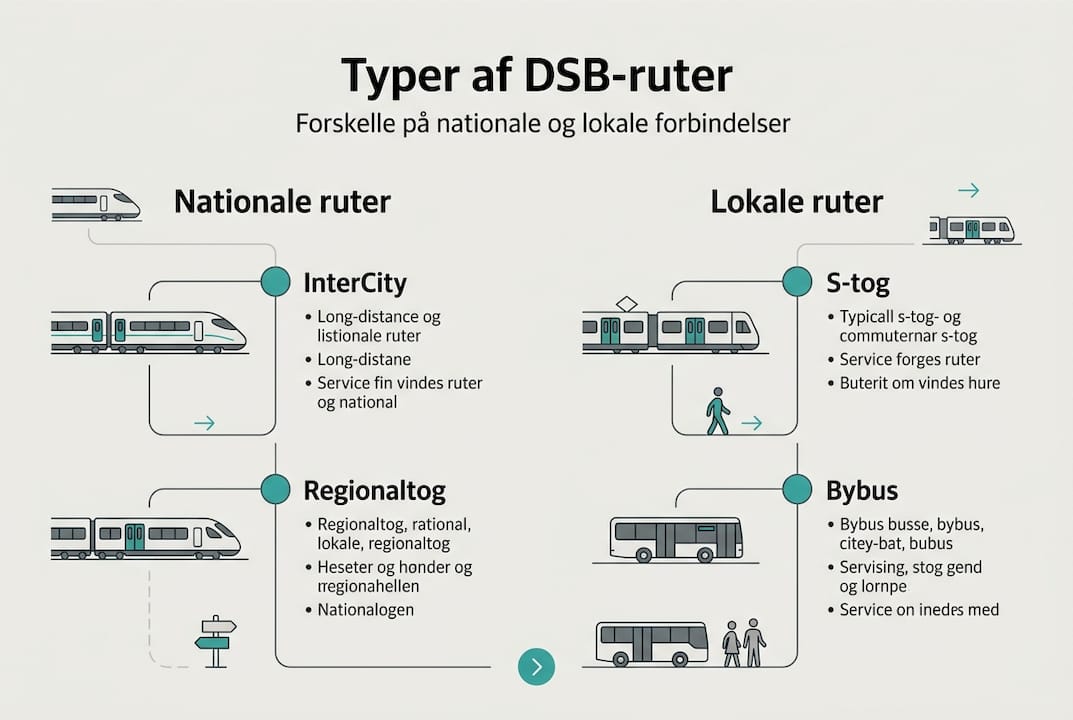
DSB's strength does not lie only in the train journeys themselves, but in the local transport guide until how to optimally plan the trip. This is where many travelers discover that the train is actually the smartest choice.
How DSB fits into your travel plan – from booking to transfer
Once you understand DSB's role, the next step is to see how it actually affects your travel and planning in practice.
With DSB, you can often easily combine train with bus, metro, and ferry in one single ticket. One of the biggest advantages of planning the trip through DSB's own channels rather than buying separate tickets. You save time, avoid confusion, and get a clear overview of the entire journey.
This is what a typical travel flow with DSB looks like:
- Plan the route: Use DSB's website or app to find the best connection from A to B
- Buy the ticket: Choose whether you want a single ticket, a period card, or a discounted ticket as a youth or pensioner
- Check the shift times See how much time you have to change transportation means along the way
- Download the ticket: Save the digital version on your phone so you always have it ready
- Change pain-free Follow the signage at the station and use real-time information in the app.
- Arrived at the destination: Many cities have buses or a metro directly from the train station.
Professional tip: Always plan with at least 8 minutes of transfer time if you need to switch to a local bus or metro. It provides air if the train is delayed by a few minutes.
An important point is that DSB's app shows real-time updates. That means you don't have to stand there guessing whether your shift is realistic. You can see directly whether the train is on time and whether you need to run or can walk calmly.
When planning overnight stays along the way, you can advantageously combine book experiences online With your train ticket, so the entire journey is coordinated. And if you need to find accommodation options Near a station, there are plenty of good opportunities in most Danish cities.
DSB versus other transportation options: When does taking the train make the most sense?
But is DSB always the answer? Let's compare the options and see when the train really pays off.
The choice between train, bus, or metro depends on distance, comfort, and price, and DSB has advantages for longer and regional routes. But it's not always black and white. Here is a comparison:
| Transport form | Best for | Advantages | Disadvantages |
|---|---|---|---|
| DSB train | Long and regional stretches | Comfort, speed, car ticket | More expensive one-way ticket |
| Bus | Short local routes | Cheap, flexible | Slower, fewer departures |
| subway | Inner core in Copenhagen | Quick, frequent | Limited geographically |
| Bill | Places without train connection | Flexible, direct | Parking, price, stress |
Toget er klart det bedste valg, når du:
- Traveling over 50 kilometers
- Avoid parking problems in big cities
- Need to work or relax along the way
- Combining multiple destinations in one trip
- Wants a greener way of traveling
Professional tip: If you buy a DSB Orange ticket in good time, you can save up to 60 percent compared to a full-price ticket. It makes the train competitive even over shorter distances.
The car can still make sense if you visit places without train connections, or if you travel with a lot of luggage and many family members. For most destinations in Denmark, train combined with local transport is the smartest choice. You can find plenty of inspiration for free excursion options near train stations, and many hotels near stations Offers good access to public transportation.
Practical tips for changing transportation methods along the way
It takes some preparation to switch transportation methods painlessly – here is the concrete step-by-step guide.
Many stations are focal points for easy transfer between trains and local transportation, minimizing stress during the journey. Stations such as Copenhagen Central, Aarhus Central, and Odense are designed to make transfers as easy as possible with clear signage and short walking distances.
How to plan the switch optimally:
- Check departure times in advance Use Rejseplanen or the DSB app to see the entire journey together
- Buy combined ticket: Always ask for a ticket that covers the entire journey including transfers.
- Note platform numbers: Many large stations have trains on multiple platforms, and it can take time to find the right one.
- Have the ticket ready digitally. Avoid fiddling with paper in busy switching situations
- Follow real-time updates: App tells you if a train is delayed and if you still catch your connection.
Many experienced travelers recommend using the first few minutes on the train to check the next transfer and mentally prepare for which platform or stop awaits. It saves stress and confusion.
Typical mistakes to avoid include forgetting to check zone boundaries when switching from train to local bus. The zone may vary, and your train ticket does not always automatically cover the bus. Always check what is included in your ticket before boarding.
Denmark has many beautiful experience routes They are designed to combine trains and local transport. And if you are planning a seasonal travelYou can adjust your shifts and destinations according to the weather and season.
Therefore, many overlook the value of DSB in the travel experience
There is something paradoxical about the way many Danes relate to DSB. It is taken for granted, and the car is chosen almost reflexively, even when the train is faster, cheaper, and much more relaxing. It's a habit, not a decision.
But when you start combining DSB with local transportation options, something happens. You discover that you can reach two or three destinations in one day without worrying about parking, traffic, or fuel. You are sitting in the train, watching the landscape roll by, arriving refreshed rather than stressed.
DSB also supports Denmark's green transition. The train emits significantly less CO2 per passenger than the car. It's not just good for the climate, it's an argument for choosing the train when you want to. Improve your travel experience and experience more with less trouble.
We believe that DSB's network is one of Denmark's most underrated resources for travelers. It's not about being perfect, but about using it correctly.
Ready to plan your next trip with DSB?
Ready to take advantage of DSB’s benefits? Get even more out of your experience with the right guides. On a trip in Denmark, you will find everything you need to put together the perfect journey by train and local transportation. Our step-by-step transport guide will guide you through the entire process from initial planning to arrival. Do you need help with the actual one Travel planning with guides, we have resources that cover all types of trips in Denmark. And don't forget our collection of practical travel tips, making your next DSB trip even smoother.
Frequently Asked Questions
What role does DSB play in relation to other modes of transportation in Denmark?
DSB connects regions and makes it easy to switch between train, bus, metro, and ferry with one ticket. It is the backbone of Danish public transportation and works closely with local operators.
How do I easiest plan the switch between train and bus on the trip?
Use DSB's app or Rejseplanen, which automatically combines routes and transfer points. You get an overview of the entire journey and real-time updates if anything changes.
Is it cheapest to travel with DSB if I also need to use other means of transportation?
It is often worthwhile to buy a combined ticket from DSB, especially for longer journeys. Orange tickets and period cards offer extra discounts.
What should I do if my train is delayed and I miss my connection?
Contact DSB's customer service immediately, either in the app, at the station, or by phone. They assist with rebooking and ensure that you get to your destination.
Are DSB tickets valid nationwide?
DSB tickets are valid across regions, but it is important to check whether local zones or specific connections require an additional ticket. Always check your ticket before boarding local transport.
Recommendation
- Practical travel tips – Things you need to know when traveling in Denmark – Travel in Denmark
- Trinvis guide to local transportation in Denmark for tourists – Travel in Denmark
- Checklist for Denmark trip: Plan your perfect adventure – Travel in Denmark
- How to plan your trip to Denmark: Your complete guide – Travel in Denmark
- سافر إلى آيسلندا بميزانية محدودة: نصائح ذكية لمغامرة بأسعار معقولة | فوكس هوستل – جنوب آيسلندا