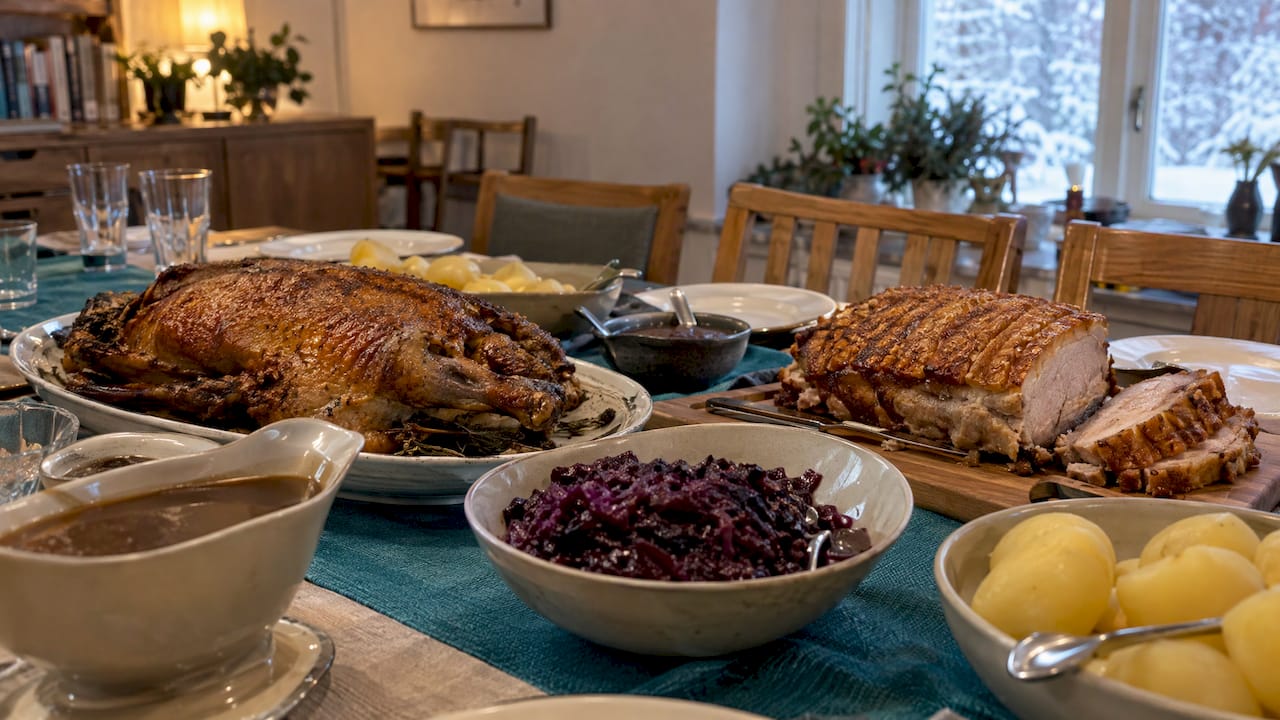
The Danes eat duck and roast pork on Christmas Eve, often both on the same table, with caramelized and white potatoes, red cabbage, and brown gravy, and finish with rice pudding with warm cherry sauce. I Agriculture & Food's Christmas and New Year analysis from December 2025 Expected 75% to have duck and 70% to have roast pork for Christmas dinner. The menu has hardly changed in over a hundred years, and it is closely connected to places, traditions, and history that you can experience around the country. Here you get the entire Christmas dinner explained dish by dish, the differences between the regions, the Christmas lunch, and where you as a traveler can taste the Danish Christmas. At Travel in Denmark, we gather experiences, museums, and attractions from across the country on one map, so you can also find the places where Christmas food becomes an experience.
Roast on the table: duck, pork roast, or both
The meat is the centerpiece of the Christmas dinner, and the question "duck or pork roast?" is not a choice in many families. According to The Food Culture's Numbers for Christmas 2025 Two out of three Danes expect two or more types of meat for Christmas dinner. Only 10% in Agriculture & Food's 2025 analysis had chosen neither duck nor pork roast.
The image recurs in other studies. In a YouGov survey from December 2023 77% of those who celebrate Christmas had duck on the menu on Christmas Eve and 60% had roast pork. Further down the list came medister sausage with 14%, turkey with 8%, and goose with 5%, and 15% ate three or more types of meat the same evening.
This is what the classic roasts look like:
- Breath step: A whole duck, often filled with apples and prunes, slowly roasted in the oven. The fat and the cloud are then used for the sauce.
- Roast pork: Pork roast with crispy crackling, the crusty layer of fat that many consider the most important bite of Christmas.
- Medister sausage: A spicy, coarse pork sausage, especially popular in parts of Jutland and Funen.
- Goose and turkey: less common today, but still festive food in some homes.
If you want to try your hand at duck yourself, we have written a guide for it, this is how you make a Christmas duck from start to finish.
The side dishes: potatoes, red cabbage, and brown gravy
If the meat is the main character of the Christmas dinner, the side dishes are what make it Danish. DR's schedule for the Christmas dinner describes the classic menu as duck, roast pork, brown sauce, red cabbage, caramelized potatoes, white and French potatoes, redcurrant jelly and pickles, with rice pudding for dessert and dinner on the table at o'clock. 18.
The potatoes take up the most space. In Coop Analysis survey of the Christmas dinner ate 86% white potatoes and 85% browned potatoes, and 52% put potato chips on the table, a tradition that surprises many foreign guests.
| Back | What it is |
|---|---|
| Browned potatoes | Small boiled potatoes tossed in caramelized sugar and butter, sweet and glossy |
| White potatoes | Small boiled potatoes, served with the sauce |
| French fries | Potato chips, eaten with the sauce or as a snack on the side |
| Red cabbage | Red cabbage cooked or stewed with vinegar, sugar, and often currant juice, sweet and sour |
| Brown sauce | Sauce made from the drippings of duck or roast pork, the unifying flavor of Christmas |
| Sold out | Pickled cucumbers, beets, and the like, that cut through the richness |
| Rib yellow | Redcurrant jelly, which provides a fresh, tangy counterbalance |
| Risalamande | Cold rice dessert with cream, vanilla, and chopped almonds, served with cherry sauce |
The combination of sweet, sour, and salty is not accidental. The same basic model with roast goose and/or roast pork, potatoes, brown sauce, and red cabbage has according to Catch Denmark's posts about Christmas in Denmark has been Danish homes' preferred Christmas meal for over a hundred years. Red cabbage has its own history, which you can read about in the story of red cabbage.
With the food, most people drink red wine. In Coop Analysis' survey, 66% drank red wine at the Christmas dinner, while 14% chose white wine and 14% beer. Christmas beer and Christmas brew from the Danish breweries also belong to the season.
Rice pudding and the hunt for the almond
The dessert is almost as firm as the roast. A full 88% of those who celebrate Christmas Eve ate rice pudding. Coop Analysis Christmas Survey, and 75% of them had warm cherry sauce, 18% cold sauce, and 7% no sauce.
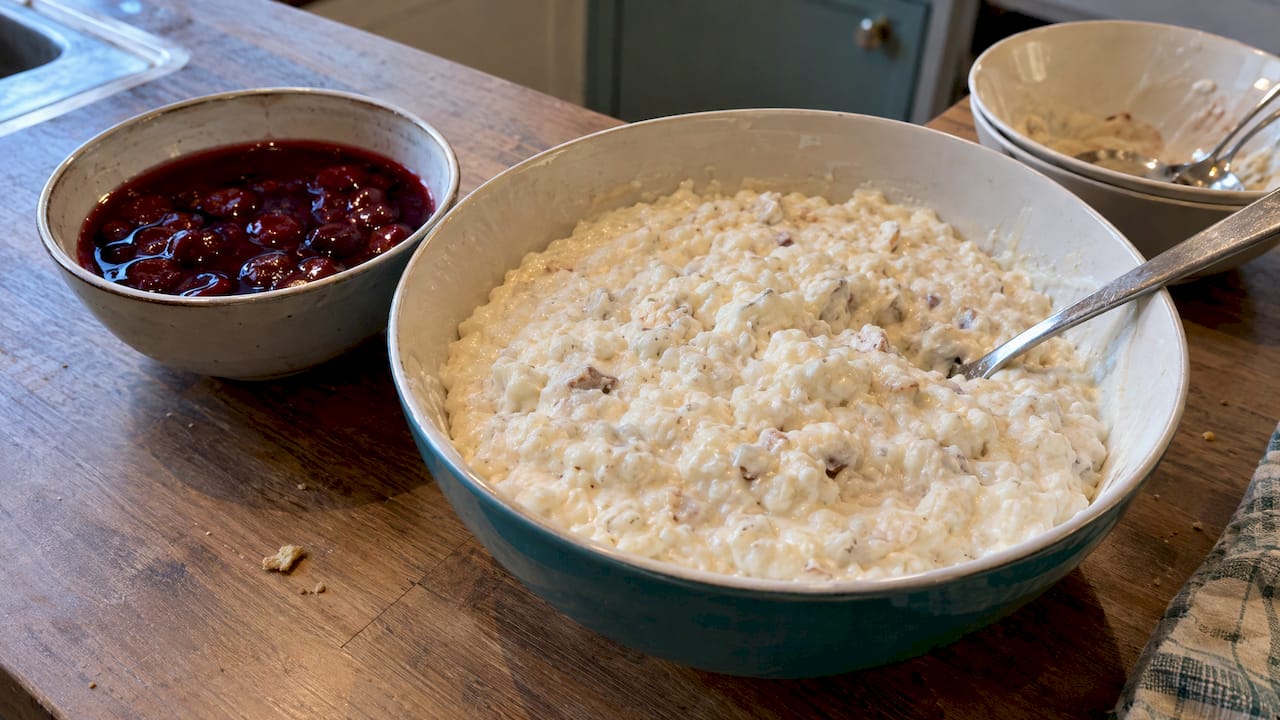
The name sounds French, but the dish is Danish. According to Information The first recipe can be found in Miss Jensen's Cookbook from 1901, and from World War II onwards, risalamande completely outcompeted the rice porridge that previously appeared on the Christmas table. The name comes from the French "riz à l’amande," rice with almonds. We have gathered everything the story of risalamande and a step-by-step recipe for rice pudding with almonds, if you want to make it yourself.
The fun happens during dessert. In the bowl hides a whole almond, and the one who finds it wins the almond prize, often a marzipan pig. According to Science.dk The tradition comes from a French custom where the person who found a hidden bean in the cake became king for the evening. The pig is due to the pig being central in the old Danish Christmas. Many find the almond early and hide it in their mouth, so the rest of the table must continue eating until it is revealed.
That is why the Christmas dinner looks like this.
The Danish Christmas dinner is unusually similar from home to home. Trap Denmark describes that since the bourgeois Christmas celebration emerged at the end of the 19th century, there has been relatively broad agreement on what the Christmas meal should look like, and that the Christmas dinner became the highlight of the evening.
Before that, the party looked different. At the manor houses in the 18th century, the Christmas menu was according to a historical article in the journal Herredssaga rice porridge as a starter, roast goose with kale as the main course, and æbleskiver for dessert, followed by apples, hazelnuts, peppernuts, klejner, and punch. The turkey first arrived in the second half of the 19th century, inspired by England.
The medieval historian in the article from Information points out that Denmark was a nation of porridge eaters for many hundreds of years, consuming very little meat. That explains why a big step was the very proof that it was a party. Several of the Christmas dishes, from the roast pork to the sausage, originate from the time when the family slaughtered the Christmas pig. If you want to see what the old rural Christmas looked like like, a visit to an open-air museum gives a good picture, and we have gathered the Danish open-air museums in a guide. You can find more customs about the food in our guide to Christmas traditions in Denmark.
Differences from region to region
The menu is similar in the main features, but the details reveal where in the country you are sitting at the table.
- Zealand: The roast pork stands strong. In Agriculture & Food's analysis from 2025, 78% in the Zealand Region expected pork roast. Statistics Denmark found that families in Region Zealand in December 2017 spent 32 DKK. on ready-made rice porridge and rice pudding for 5 DKK. on average nationwide.
- Funen and Southern Jutland: The medister sausage belongs. According to Trap Denmark, medister is served in every fourth home in the Region of Southern Denmark, but almost never in Zealand.
- Copenhagen: Statistics Denmark showed that families in the Capital Region spent 135 DKK. on duck and goose in December 2017, mostly in the countryside, and the people of Copenhagen also mostly used it for rolled and rib roasts.
- Jutland in the old days: Savoy cabbage has deep roots in the Jutland Christmas. According to the journal Word and Deed Did the Christmas Eve meal in Southern Jutland south of the border consist of kale, pork, meat, and sausage with rice pudding and sweet beer afterwards, while in the Herning area they had soup, meat with horseradish sauce, rice pudding, and dried salted cod. Green kale with sausage and pork belly is still on many Jutland Christmas tables.
If you drive around Denmark in December, you can taste several variations of the same Christmas. We have gathered regional specialties from all over Denmark, so you can see what each region is known for.
Julefrokosten: en anden fest med andre retter
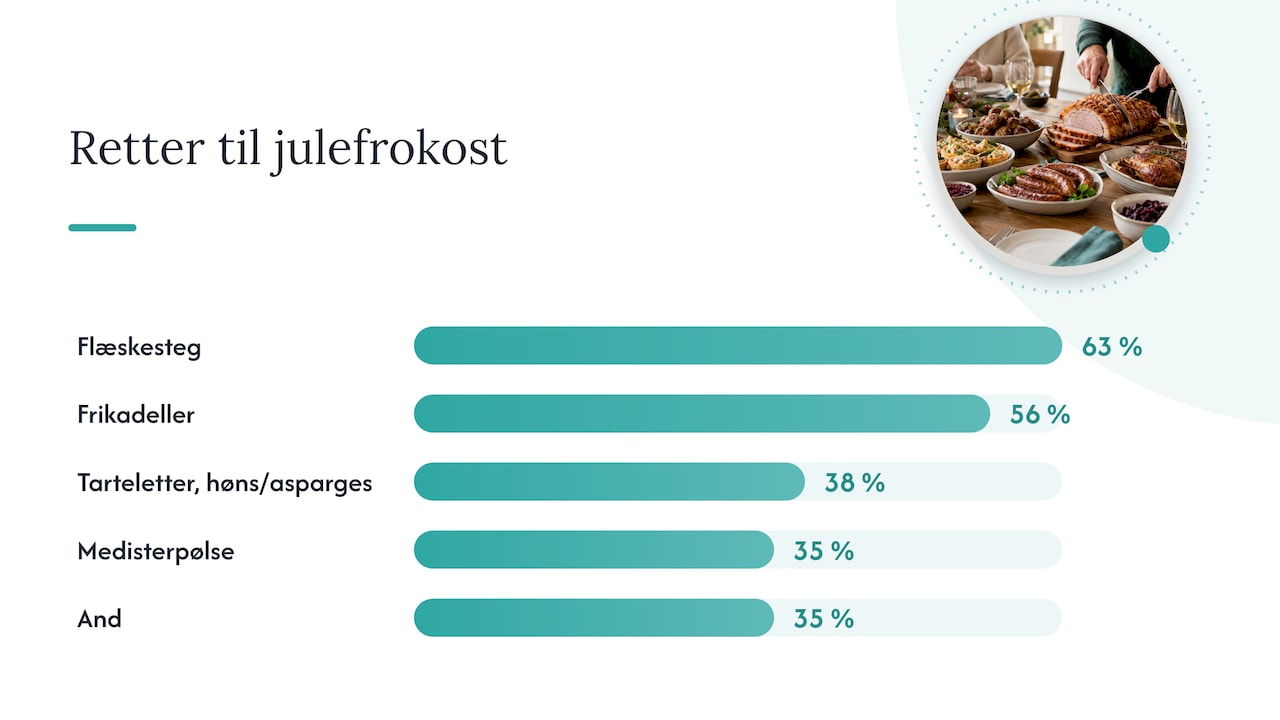
The Christmas lunch is not the same as the Christmas dinner. It is held throughout December, with colleagues, friends, or family, and the table is much more varied. In the YouGov survey from 2023, 63% ate roast pork at the Christmas lunch, 56% meatballs, 38% tartlets with chicken in asparagus sauce, 35% sausage, and 35% duck.
There are also local differences here. Statistics Denmark found that families in the Capital Region spent 12 DKK. on preserves in December, seven times more than in an average month, while the Region of Southern Denmark spent 19 DKK. on poultry sausage and Region Zealand just over 7 DKK. on blood sausage.
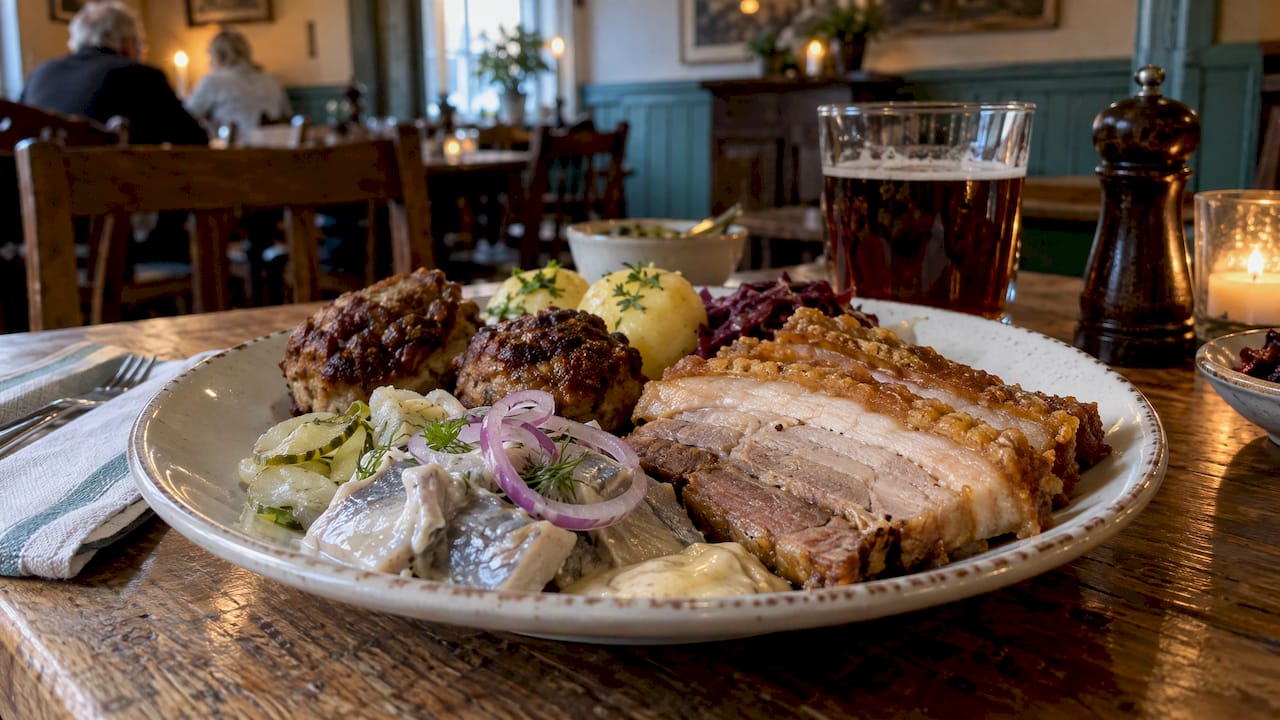
A Christmas lunch is typically eaten in a fixed order: first fish such as herring, then warm dishes and cold cuts, and finally cheese and dessert, preferably with schnapps and beer along the way. You can read more about how the custom originated in The story of the Christmas lunch with work.
How to taste Danish Christmas food while traveling
You don't need a Danish family to experience the Christmas food. In December, inns, restaurants, and Christmas markets offer the classic dishes, and in many places, you can have the flavors of the Christmas dinner served as a whole Christmas platter or menu. If you are planning an event for a group, a list of festive menus for events give ideas on how a Christmas menu can be put together.
The most atmospheric tasting you get in the historic settings. Under Christmas in The Old Town In Aarhus, you can walk around the food stalls and taste mulled wine, apple slices made from a recipe from 1616, wild boar sausages, and duck sandwiches with the house Christmas brew. The Christmas program runs every year in the weeks leading up to Christmas, and the current dates and opening hours are listed on the museum's own page.
Three good tips when you want to taste Christmas along the way:
- Book early in December. The Christmas lunch season fills restaurants and inns, especially on weekends.
- Combine the food with a place. A Christmas market, a museum, or a manor house provides a setting for the dishes, so you understand why they are eaten.
- Ask for the local varieties. Green kale in North Jutland or sausage on Funen tells more about the region than a standard menu.
At Rejs i Danmark, you can find experiences all over the country on our interactive map and filter by season, price, and age, making it easy to find Christmas markets, museums, and family experiences for a trip in December. The experiences have price estimates per. person, so you can plan the budget before you leave. Start in our collection of Experiences in Denmark.
Our view on Danish Christmas food
When we write about Danish Christmas food, we are actually writing about Denmark. The duck, the roast pork, and the rice pudding are not just recipes. They tell of a time when meat was a luxury, of a pig slaughter that had to last the entire winter, and of a bourgeoisie that gave a rice pudding a French name.
Therefore, we believe that the best way to understand Christmas food is to experience it where the history is. An æbleskive stand in an old market town, an open-air museum with decorated peasant cottages, or an inn with kale on the menu makes more sense than ten recipes.
That is exactly what our maps and filters are designed for: to make it easy to find both the well-known and the more hidden experiences, whether you are a Dane on a Christmas trip, a tourist during the Christmas month, or a family wanting to show the children what Christmas looked like in the old days. We have also written the guide This is how Christmas is celebrated in Denmark, if you want to have the whole evening.
Tommy
Frequently Asked Questions
What do most Danes eat on Christmas Eve?
Most people eat duck and roast pork with caramelized and white potatoes, red cabbage, and brown gravy. In Agriculture & Food's analysis from 2025, 75% expected pork roast and 70% pork roast, and many get both. For dessert, almost everyone eats rice pudding with cherry sauce.
When do Danes eat Christmas dinner?
The Christmas dinner is eaten on Christmas Eve, the 24th. December, in the evening. Many sit down at the table around o'clock. 18, and afterwards the family dances around the Christmas tree and opens presents.
What is risalamande?
Risalamande is a cold dessert made of rice pudding, whipped cream, vanilla, and chopped almonds, served with cherry sauce. Despite the French name, it is a Danish invention from around the year 1900. One whole almond is hidden in the bowl, and the one who finds it receives the almond gift.
What is the difference between a Christmas lunch and a Christmas dinner?
The Christmas dinner is the family's main meal on Christmas Eve with duck, roast pork, and rice pudding. The Christmas lunch is held throughout December, often with colleagues or friends, and offers many more dishes such as herring, meatballs, tartlets, warm dishes, and cheese, often accompanied by schnapps.
Can you taste Danish Christmas food as a tourist?
Yes. In December, many inns and restaurants serve Christmas dishes, and Christmas markets and historic settings like Den Gamle By in Aarhus sell æbleskiver, mulled wine, and other Christmas classics. On our map, you can filter experiences by season and find places near your route.
Sources
- Agriculture & Food: Duck or roast pork? Christmas and New Year analysis 2025
- Madkulturen: Tal om jul 2025
- YouGov survey on Christmas food, December 2023
- Coop Analysis: This is what Christmas looks like
- DR: Tidsplan for en succesfuld julemiddag
- Trap Denmark: Christmas in Denmark
- Information: Hvorfor spiser vi risalamande?
- Videnskab.dk: Why is the almond gift a marzipan pig?
- Herredssaga: historisk artikel om julen på herregårdene
- Statistics Denmark: Your Christmas shopping can reveal where you live
- Words and Matter: Christmas Eve, St. Stephen's Morning, and King's Evening
- The Old Town: Christmas in The Old Town